

There's a particular kind of recipe that lives between the spiral-bound pages of a church cookbook — handwritten amendments in the margins, a smudge of butter on the corner, a name signed below in neat cursive. The 1960s were the golden age of American community cookbooks, assembled by parish ladies' auxiliaries, Baptist fellowship circles, and Methodist supper committees who pooled their best dishes into thin volumes sold for a dollar fifty at the church door. These casseroles fed potluck crowds, grieving families, and new neighbors. They were practical, generous, and quietly brilliant.
Spring is arriving, but these recipes belong to a deeper calendar — the rhythm of community tables, of dishes carried warm across town in the back seat of a station wagon. Ten of the most compelling casseroles from that era are gathered here, reconstructed from clipped pages and handwritten recipe cards, updated only where necessary, and left otherwise exactly as they were intended. Tie on an apron. These are worth making.
| Preparation | 25 min average |
| Cook time | 45–60 min |
| Portions | 6–8 people |
| Difficulty | Easy to Medium |
| Cost | $$ |
| Season | Year-round · Spring onions, canned tomatoes, pantry staples |
What made 1960s church casseroles different
Before the slow cooker and long before the Instant Pot, the casserole dish was the American home cook's most democratic tool. A single baking dish could stretch a pound of ground beef into dinner for ten. Cream of mushroom soup, introduced in condensed form by Campbell's in 1934, had by the 1960s become the quietly assumed base of an entire culinary infrastructure. Church cookbooks of the decade reflect a cuisine of resourcefulness dressed in comfort — layers of starch, protein, and cream, baked until the top turns golden and just pulling away from the edges.
These were not recipes written for restaurant kitchens. They were written for women who had already put in eight hours, who were cooking for husbands and children and the occasional visiting deacon. The instructions are terse and confident: "Mix well, bake at 350°, serve hot." There is no hand-holding. The cooks who wrote them assumed you knew what a casserole dish was, and that you owned one.
The 10 recipes
1. Green bean and french-fried onion bake
The ur-casserole of the American Midwest. Every church cookbook from 1955 to 1975 contains a variation. Two cans of green beans, one can of condensed cream of mushroom soup, a splash of milk, a grind of black pepper, and a full can of French-fried onions split between the filling and the top. Bake at 350°F for 30 minutes. The onions on top crisp back up in the final ten minutes. The version found in a 1963 Presbyterian Women's Fellowship cookbook from central Ohio adds a layer of sharp cheddar beneath the onion topping — a small, excellent decision.
2. Tuna noodle casserole
Egg noodles cooked al dente, two cans of tuna in water drained and flaked, one can of cream of celery soup, a half cup of frozen peas, a cup of whole milk, and salt and white pepper to taste. Everything folded together in a buttered baking dish, topped with buttered breadcrumbs, baked at 375°F until the surface is audibly crackling. A 1961 Baptist Ladies' Circle cookbook from rural Tennessee specifies "dry bread crumbs, not the seasoned kind" — important advice that holds today. The celery soup provides a gentle herbaceous lift that cream of mushroom cannot.
3. King ranch chicken
A Texas staple of contested origins, this casserole appears in church cookbooks across the Southwest from the late 1950s onward. Shredded cooked chicken — rotisserie works, though the original assumes a whole stewed hen — layered with corn tortillas, a sauce of cream of mushroom, cream of chicken, canned Ro-Tel tomatoes with green chiles, sour cream, and chicken broth. Finished with a thick blanket of grated Velveeta, baked at 350°F for 45 minutes until the cheese is bubbling and beginning to brown at the corners. Rich, smoky, slightly spicy. One of the great casseroles of the American South.
4. Hamburger and rice casserole
Ground beef browned with diced white onion and a clove of garlic, seasoned with salt, pepper, and Worcestershire sauce. Uncooked long-grain white rice stirred in raw — a technique that was standard practice in the era and still works perfectly — along with beef broth, a can of stewed tomatoes, and a teaspoon of dried thyme. Everything poured into a covered casserole dish and baked at 350°F for one hour. The rice absorbs the broth and the tomato liquid, swelling into the meat. No pre-cooking the rice. No separate pot. That was the point.
5. Scalloped potatoes with ham
Thinly sliced russet potatoes — mandoline-thin, roughly 1/8 inch — layered in a buttered baking dish with diced cooked ham and thinly sliced white onion. A béchamel of butter, flour, milk, and sharp cheddar poured over each layer. The top layer of potatoes left exposed to the oven heat, where they curl and turn golden and slightly crisp at the edges. Bake covered at 350°F for 45 minutes, then uncovered for 20 minutes more. A 1967 Episcopal Women's Auxiliary cookbook from Mississippi insists on using leftover Easter ham — the slight smokiness from a cured ham makes an audible difference.
6. Chicken and wild rice casserole
A more refined entry, found frequently in church cookbooks from the upper Midwest and Pacific Northwest. One package of long-grain and wild rice blend, cooked according to package directions. Combined with diced cooked chicken, sautéed mushrooms and celery, a can of cream of chicken soup thinned with chicken broth, and a cup of sour cream. Baked uncovered at 350°F for 35 minutes. The sour cream gives the sauce a subtle tang that cuts through the richness. A 1964 Lutheran church cookbook from Minnesota recommends adding toasted slivered almonds over the top in the last five minutes — do not skip this.
7. Beefy noodle bake
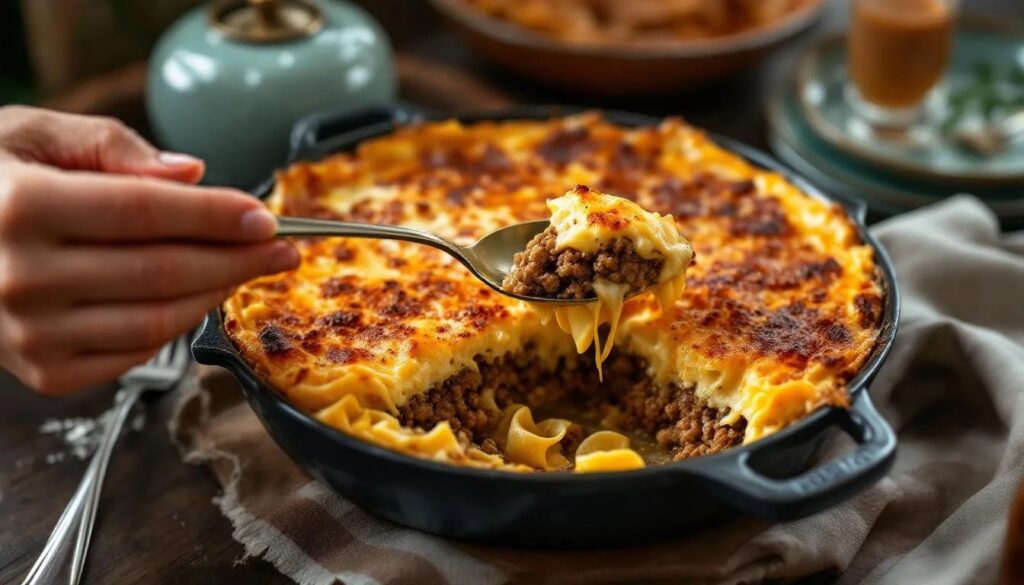
Ground beef and yellow onion browned together, drained well, then combined with cooked egg noodles, a can of condensed tomato soup, half a can of water, a cup of frozen corn, and a generous hand of garlic salt. Folded into a casserole dish, topped with shredded cheddar, baked at 375°F for 30 minutes. This is the casserole that appears, almost word for word, in six separate church cookbooks from six different states between 1959 and 1969. Regional variations include a dash of chili powder in Texas versions and a tablespoon of brown sugar in the Carolinas. Both are worth trying.
8. Sweet potato and marshmallow casserole
Technically a side dish, though it appears at potlucks as a thing unto itself. Boiled and mashed sweet potatoes — not the canned kind, though those were frequently specified — beaten with butter, brown sugar, a beaten egg, a pinch of cinnamon, and a splash of vanilla extract. Spread into a buttered dish, topped with a single even layer of miniature marshmallows. Baked at 350°F for 20–25 minutes until the marshmallows are puffed, golden, and just beginning to caramelize at their edges. The texture contrast between the dense, spiced potato base and the yielding, toasted marshmallow surface remains one of the most effective in American home cooking.
9. Sausage and egg breakfast casserole
Assembled the night before, baked the morning of. Cubed white bread laid in a buttered baking dish, topped with browned and crumbled pork breakfast sausage, then blanketed with shredded cheddar. A custard of six beaten eggs, two cups of whole milk, one teaspoon of dry mustard, salt and pepper poured evenly over everything. Refrigerated overnight. Baked uncovered at 350°F for 45–50 minutes until puffed, set in the center, and golden across the surface. This recipe appears in virtually every church cookbook from the 1960s through the 1980s, often attributed to the most organized woman in the congregation. There is a reason it survived fifty years unchanged.
10. Poppy seed chicken
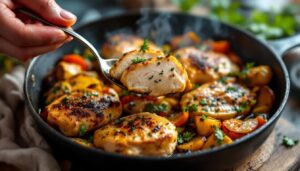
A casserole of Southern origin that spreads steadily northward through church cookbooks of the late 1960s. Cooked shredded chicken — two full breasts — combined with a cup of sour cream and a can of cream of chicken soup, spread into a buttered baking dish. Topped with a layer of crushed Ritz crackers mixed with melted butter and a generous tablespoon of poppy seeds. Baked at 350°F for 30–35 minutes. The cracker topping bakes into something between a crust and a crumble, buttery and faintly nutty from the poppy seeds. Serve over white rice. A 1968 Methodist Women's Fellowship cookbook from Georgia specifies this serving instruction without explanation, as though rice beneath the casserole were simply obvious. It is.
Chef's note
The single most common mistake with vintage casseroles is overbaking. These recipes were developed for ovens that ran inconsistently — many of them hot — so the original temperatures often assume a slightly lower actual heat. Start checking at the two-thirds mark of the stated baking time. You're looking for a set center, bubbling edges, and a golden surface that has pulled slightly from the dish. Once that's achieved, the casserole is done, regardless of what the clock says. Trust the dish, not the timer.
On pairing
The flavor profiles of these casseroles — rich, savory, cream-forward, often with pork fat or beef as the backbone — call for beverages that cut through rather than amplify the richness.
For the chicken-based casseroles, a dry Riesling from the Finger Lakes or Alsace offers bright acidity and a mineral edge that lifts the cream without overwhelming the dish. For beef-based versions, a medium-bodied Côtes du Rhône or a California Zinfandel works well — enough fruit to match the tomato notes, enough structure to stand beside the fat. For those not drinking, a cold glass of unsweetened iced tea with a squeeze of lemon is the historically accurate companion. Served in a tall glass. With ice.
The world these recipes came from
Church cookbooks of the 1960s were hyperlocal publishing in its purest form. Print runs rarely exceeded five hundred copies. Contributors were identified only by first name and last initial, or sometimes just "Mrs. Harold Kowalski" — a woman erased into her husband's name but present in the recipe itself, in the specific instruction to use sharp cheddar, not mild. These books documented a cuisine that never appeared in glossy magazines or on television cooking programs. They recorded what people actually ate, week after week, at the tables where real life happened.
The casserole as a form suited this world perfectly. It could be assembled hours or even a day ahead. It traveled well. It served a crowd without demanding a second dish. It used what was available — pantry staples, frozen vegetables, canned soups — without apology. And it fed people who needed feeding, which was, in the end, the whole point. These recipes are not about nostalgia. They are functional objects that still work. That's why they survived.
Nutritional values (per serving, approximate values)
| Nutrient | Amount |
|---|---|
| Calories | ~380–520 kcal |
| Protein | ~22–30 g |
| Carbohydrates | ~28–40 g |
| of which sugars | ~4–8 g |
| Fat | ~18–28 g |
| Fiber | ~2–4 g |
Frequently asked questions
Can these casseroles be made ahead of time?
Most of them, yes — and several were designed specifically for that purpose. The sausage and egg breakfast casserole requires overnight refrigeration. The chicken-based dishes and beef casseroles can be fully assembled and refrigerated up to 24 hours before baking. Add 10–15 minutes to the baking time when starting from cold. The cracker-topped versions, like Poppy Seed Chicken, are best topped immediately before baking to preserve the crust's texture.
How do you store and reheat leftovers?
Cover the baking dish tightly with foil and refrigerate for up to three days. Reheat covered at 325°F for 20–25 minutes, or until warmed through to the center. Add a small splash of broth or milk over cream-based casseroles before reheating to prevent the sauce from breaking or seizing. The tuna noodle and hamburger rice casseroles reheat particularly well — the flavors often deepen overnight.
Are there substitutions for canned condensed soups?
Yes. A standard substitution for one can of condensed cream of mushroom or cream of chicken soup is a roux-based sauce: two tablespoons of butter, two tablespoons of flour, one cup of whole milk or broth, cooked together until thickened, seasoned with salt, white pepper, and the relevant flavor — sautéed mushrooms or chicken stock reduction. The result is less salty and more nuanced, though the original canned version produces the texture these recipes were calibrated for.
What size baking dish is standard for these recipes?
The 9×13-inch rectangular baking dish is the assumed format for all ten of these casseroles, serving six to eight people. A 2-quart round or oval dish works for the smaller variations serving four. Church cookbook recipes almost never specify dish size — it was considered self-evident — but the 9×13 is invariably correct for a potluck-scaled batch.
Can these recipes be frozen?
Most can be frozen before baking, wrapped tightly in two layers of foil, for up to two months. Cream-based sauces may separate slightly upon thawing but will come back together during baking. The exceptions are dishes with potato content, like the scalloped potato and ham casserole — potatoes become grainy after freezing. The sausage and egg casserole, once baked, freezes well in individual portions for easy reheating.