



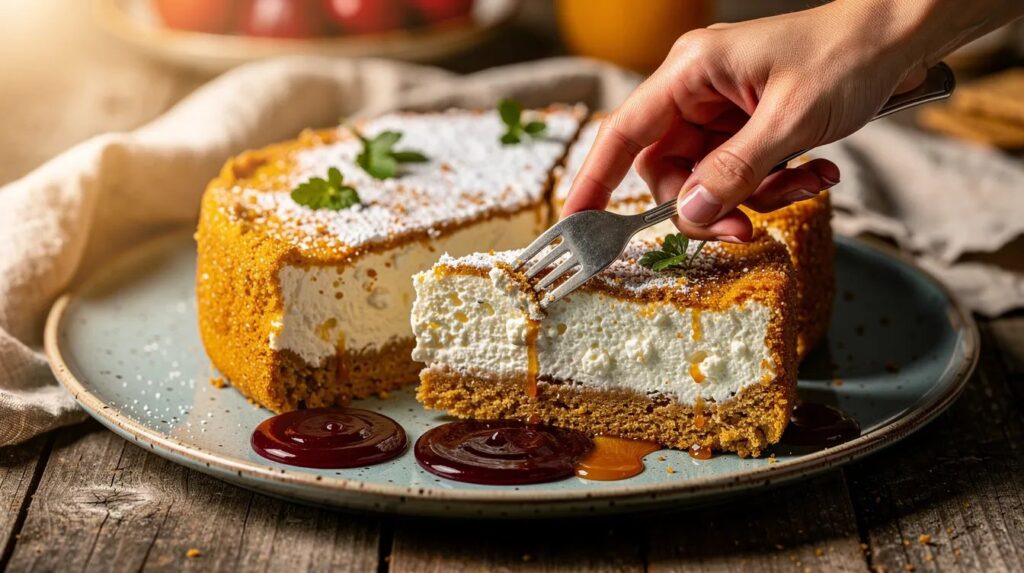
Spring is here, and the last thing anyone wants is to turn on the oven when the days are finally warming up. This 3-ingredient no-bake cottage cheese cake lands at exactly the right moment: light enough for the season, protein-packed enough to feel satisfying, and simple enough to pull together on a weeknight without breaking a sweat. Cottage cheese has been making a quiet comeback on American tables, moving well beyond its diet-food reputation into something genuinely worth eating.
What makes this version stand out is what it doesn't ask of you. No cream cheese, no gelatin sheets, no water bath, no anxiety about a cracked surface. Three ingredients, a blender, and a few hours in the refrigerator are all you need to make a set, sliceable cake with a clean tang and a texture somewhere between a New York cheesecake and a Japanese cotton cake — denser than mousse, lighter than the classic. Tie on your apron and clear some space in the fridge.
| Prep Time | 10 min |
| Chilling Time | 4 hours (overnight preferred) |
| Servings | 6 people |
| Difficulty | Easy |
| Cost | $ |
| Season | Spring — pairs well with fresh strawberries, sliced mango, or lemon zest |
Suitable for: Vegetarian · Gluten-free · High-protein · Low-carb
Ingredients
- 2 cups (16 oz) full-fat cottage cheese, small or large curd
- 3 large eggs
- 3 tablespoons honey (or pure maple syrup for a less floral sweetness)
Equipment
- High-speed blender or food processor
- 6-inch round springform pan or a standard loaf pan
- Parchment paper
- Rubber spatula
- Mixing bowl
- Refrigerator (minimum 4 hours of chilling time)
Preparation
1. Blend the cottage cheese until completely smooth
Pour the cottage cheese into your blender or food processor and blend on high for a full 60 to 90 seconds. Stop and scrape down the sides with a rubber spatula, then blend again for another 30 seconds. You are looking for a texture that is perfectly silky — no visible curds, no graininess when you rub a small amount between your fingers. This step is non-negotiable: any remaining texture will translate directly into a grainy finished cake. Full-fat cottage cheese blends more smoothly than low-fat versions and produces a richer, more cohesive result. If your blender struggles with thick mixtures, add a single tablespoon of the honey first to help it move.
2. Add the eggs and sweetener
Crack the three eggs directly into the blender with the smooth cottage cheese. Add the honey. Blend again on medium speed for about 20 to 30 seconds — just long enough to fully incorporate everything into a uniform, pale batter. Avoid over-blending at this stage: excessive agitation introduces too much air, which can cause the cake to puff dramatically in the oven and then collapse. The batter should be fluid, slightly thick, and a uniform ivory color throughout. Taste it now — this is your only chance to adjust sweetness before it sets.
3. Prepare your pan
Line the bottom of your springform pan or loaf pan with a circle or rectangle of parchment paper. There is no need to grease the sides — the cake will contract slightly as it chills and release cleanly on its own. If you are using a springform pan, make sure the latch is properly sealed; the batter is liquid enough to seep through a loose seal. A 6-inch round pan produces a cake about 1.5 inches tall with clean, attractive slices. A standard 9×5-inch loaf pan works equally well and gives you neat rectangular portions.
4. Bake low and slow — or skip the oven entirely
This recipe works two ways. Baked version: pour the batter into the prepared pan and bake at 325°F (160°C) for 35 to 40 minutes, until the edges are just set and the center still has a faint wobble — similar to how you would test a traditional cheesecake. Remove from the oven and allow it to cool completely at room temperature before refrigerating. True no-bake version: add 1 teaspoon of plain unflavored gelatin dissolved in 2 tablespoons of warm water to the blended batter, stir well, pour into the pan, and refrigerate directly for a minimum of 6 hours or overnight. Both methods produce a sliceable, stable cake; the baked version has a slightly firmer, more custardy texture, while the gelatin version stays softer and creamier throughout.
5. Chill, unmold, and serve
Once fully chilled, run a thin offset spatula or butter knife along the inside edge of the pan before releasing the springform latch. Lift the cake gently onto a flat serving plate. The surface will be pale and smooth — this is the canvas. In spring, a handful of fresh sliced strawberries or a spoonful of lemon curd spooned over the top right before serving transforms the appearance entirely. Slice with a sharp knife wiped clean between cuts for the neatest portions.
Chef's Tip
The quality of your cottage cheese matters more than anything else here. Look for a brand with a short ingredient list — milk, cream, salt, live cultures — and avoid versions with added starch or gum, which can interfere with the final texture. In spring, when strawberries are just coming into season across the South and California, fold two tablespoons of fresh strawberry purée into the batter before pouring it into the pan for a blush-pink cake with a subtle berry fragrance. For a savory version worth exploring, skip the honey entirely and add a pinch of sea salt, fresh chives, and cracked black pepper — the result makes an excellent companion to thinly sliced cucumbers and a glass of something cold and crisp.
Pairings & Serving Suggestions
The cake has a clean dairy tang and a gentle sweetness that works beautifully with bright, acidic accompaniments. The goal is contrast — something to cut through the richness of the eggs and cottage cheese.
A drizzle of raw wildflower honey and a scattering of toasted pistachios is the simplest approach. For a beverage, a glass of cold sparkling water with a squeeze of lemon keeps the palate fresh between bites. If you are serving this at a spring brunch, a light rosé from California or a dry Riesling from Washington State both complement the dairy notes without overwhelming them. For a non-alcoholic option, a hibiscus iced tea or a lightly sweetened mint lemonade works exceptionally well alongside the cool, set texture of the cake.
About This Recipe
Cottage cheese cakes belong to a long lineage of Eastern European curd-based desserts — Polish sernik, Russian tvorozhnik, and German Käsekuchen all share the same foundational logic: fresh, slightly acidic cheese, eggs, and a sweetener, baked or chilled until set. What has changed in the American version is the stripping away of everything nonessential. The no-bake format in particular draws from the practical kitchens of the mid-20th century, when gelatin set desserts were a staple of home cooking across the Midwest and South.
The current enthusiasm for cottage cheese as a primary ingredient rather than a sidekick reflects a broader shift in how Americans think about high-protein, whole-food eating. This three-ingredient cake fits comfortably at that intersection: it reads as a treat, functions as a high-protein snack, and requires almost no skill to execute. It is the kind of recipe that gets passed along in text messages rather than cookbooks — and that, in 2026, is exactly how a recipe survives.
Nutrition Facts (per serving, approximate values)
| Nutrient | Amount |
|---|---|
| Calories | ~130 kcal |
| Protein | ~11 g |
| Carbohydrates | ~9 g |
| of which sugars | ~8 g |
| Fat | ~5 g |
| Fiber | ~0 g |
Frequently Asked Questions
Can i make this cake ahead of time?
Absolutely — and it is actually better when made the night before. The texture firms up gradually over 8 to 12 hours, becoming cleaner to slice and more cohesive in flavor. Simply cover the pan tightly with plastic wrap or foil before refrigerating and unmold just before serving. It keeps well for up to three days in the refrigerator.
How do i store leftovers?
Store any remaining slices in an airtight container in the refrigerator for up to 3 days. The texture softens slightly after the first day but remains pleasant. Freezing is possible — wrap individual slices in plastic wrap, then foil, and freeze for up to one month. Thaw overnight in the refrigerator rather than at room temperature to preserve the texture.
What substitutions work in this recipe?
Honey can be swapped for maple syrup, agave nectar, or 2 tablespoons of granulated sugar dissolved with a splash of warm water. For an egg-free version, replacing the eggs is more complex — 3 tablespoons of cornstarch whisked into the batter plus the gelatin method is the most reliable approach, though the texture will be less custardy. In spring, a tablespoon of fresh lemon juice and half a teaspoon of lemon zest added to the batter gives the cake a noticeably brighter character that pairs especially well with the first strawberries of the season.
Why is my cake not setting properly?
The most common cause is insufficient chilling time. Four hours is a minimum — overnight is strongly preferred, particularly for the no-bake gelatin version. A second possibility is low-fat cottage cheese: the reduced fat content produces a thinner batter that sets less firmly. Full-fat cottage cheese with at least 4% milkfat gives the most reliable result. Finally, if you used the gelatin method, make sure the gelatin was fully dissolved in warm (not cold) water before being added to the batter.
Can i add a crust to this cake?
Yes, and it adds both texture and visual appeal without complicating the recipe significantly. A simple base of 1 cup of crushed graham crackers mixed with 3 tablespoons of melted butter, pressed firmly into the bottom of the pan and chilled for 20 minutes before adding the batter, works well. For a gluten-free option, crushed almond flour crackers or rolled oats toasted with a little coconut oil produce a similar result with a nuttier character.