



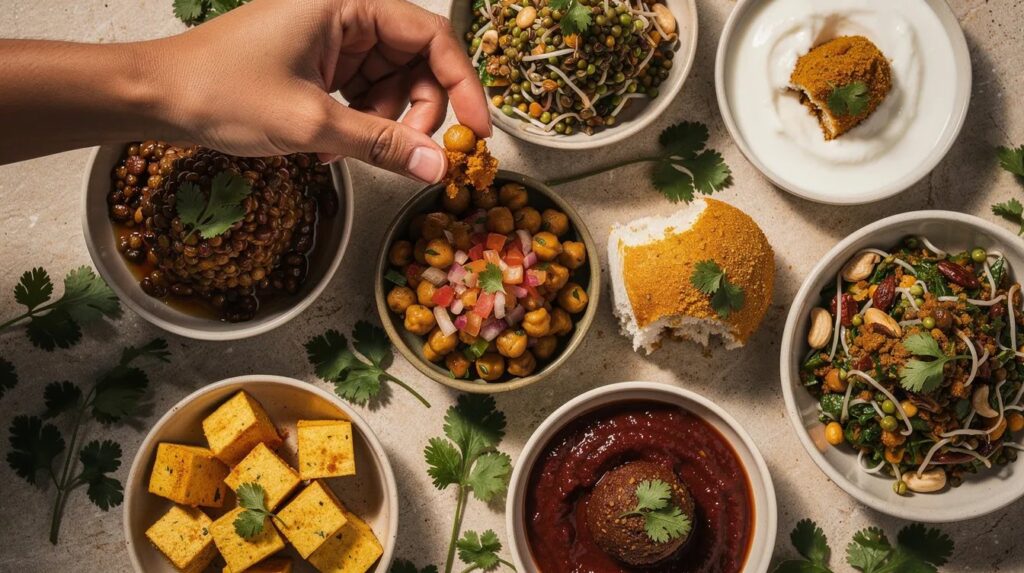
Spring is the season of renewal — and, for many Americans, a renewed commitment to eating with intention. Whether you've recently gone meat-free, are cutting back on animal protein, or simply want more variety in your snack rotation, Indian cuisine offers a remarkable answer. The pantry staples that form the backbone of traditional Indian cooking — chickpeas, lentils, paneer, yogurt, nuts — happen to be some of the most protein-dense vegetarian ingredients on the planet. And the best part? Not a single burner required.
These seven snacks draw from centuries of Indian culinary tradition, from the chaat stalls of Mumbai to the dairy-rich kitchens of Punjab. They're quick, satisfying, and built around real ingredients you can find at any well-stocked grocery store or Indian market. Each one delivers serious protein without the wait, the heat, or the cleanup. Read through to find your next afternoon staple.
1. Sprouted moong chaat
Sprouted moong — whole green mung beans left to germinate over two days — are a cornerstone of no-cook Indian eating. Sprouting increases the bioavailability of the beans' nutrients and dramatically boosts their protein content per gram. A standard serving (~1 cup of sprouted moong) provides approximately ~14 g of protein, along with a satisfying crunch that raw legumes rarely offer.
To assemble the chaat, toss sprouted moong with finely diced red onion, ripe tomato, cucumber, a squeeze of fresh lemon juice, chaat masala (a tart, cumin-forward spice blend), and a pinch of black salt. The combination is bright, slightly tangy, and textured. No stove. No oven. Just a bowl and a knife. In spring, a handful of fresh mint leaves — at their most fragrant right now — rounds the whole thing out.
2. Hung curd with roasted cumin dip (shrikhand-style)
Hung curd is whole-milk yogurt strained through cheesecloth until thick, dense, and almost cream-cheese-like in consistency. The straining process removes excess whey and concentrates the protein, bringing a standard cup of whole-milk yogurt to roughly ~15–18 g of protein once reduced by half in volume.
Stir in roasted cumin powder, a touch of honey, a pinch of cardamom, and black salt. The result sits somewhere between a savory dip and a dessert — deeply satisfying, high in protein, and ready in minutes. Serve alongside fresh-cut vegetables, whole-grain crackers, or simply eat it with a spoon. Straining overnight in the refrigerator is the only advance work required.
3. Roasted chana with chaat masala
This is the snack you reach for at 3 p.m. when focus is slipping. Roasted chana — dry-roasted split chickpeas — are sold pre-roasted in every Indian grocery store and many health food retailers. Per 100 g, they deliver approximately ~20 g of protein alongside significant fiber, making them one of the most efficient no-cook protein snacks available.
The preparation is minimal: toss roasted chana with chaat masala, a squeeze of lemon, and optionally a pinch of Kashmiri red chili for color and warmth. The texture is firm and nutty, somewhere between a crouton and a peanut. Keep a jar on your desk. It holds for weeks.
4. Paneer tikka bites (no-cook version)
Traditional paneer tikka is grilled. This version skips the grill entirely. Fresh paneer — Indian cottage cheese — requires no cooking to eat safely, and its dense, milky structure means it absorbs a marinade beautifully even without heat. A 100 g portion of paneer provides approximately ~18–20 g of protein.
Cut firm paneer into bite-sized cubes. Mix together thick yogurt, lemon juice, tandoori masala or a blend of cumin, coriander, turmeric, and smoked paprika, and a pinch of salt. Coat the paneer, let it marinate for at least 30 minutes in the refrigerator, and serve with sliced raw peppers and onion. The marinade tenderizes the surface slightly and the spices bloom against the milky, cool interior of the paneer. In spring, a scattering of fresh cilantro over the top makes visual and aromatic sense.
5. Sabudana and peanut bhel
Traditionally associated with fasting days in Maharashtra and Gujarat, this snack typically involves briefly cooking sabudana (tapioca pearls). The no-cook adaptation uses soaked-only sabudana — pearls left in cold water for 6–8 hours until they soften fully — combined with crushed roasted peanuts, which carry the protein load at approximately ~25 g per 100 g.
Combine the soaked sabudana (drained thoroughly), crushed roasted peanuts, grated fresh coconut, a squeeze of lime, green chili finely minced, and a pinch of sugar and salt. The texture shifts from chewy to crunchy within every bite. The peanuts carry the protein; the sabudana provides the satisfying starch. This one holds well for a few hours, making it a viable meal-prep snack for a busy spring week.
6. Peanut butter sattu balls
Sattu is roasted gram flour — one of the most underappreciated protein sources in Indian cuisine, with approximately ~22 g of protein per 100 g. It has a toasty, nutty depth that makes it uniquely suited to no-cook preparations. When combined with natural peanut butter, the protein content climbs further while the fat content helps bind everything together.
Mix sattu flour with natural peanut butter, a small amount of honey or jaggery powder, a pinch of cardamom, and enough water or milk to bring the mixture together. Roll into small balls and refrigerate for 20 minutes to firm up. Each ball is dense, slightly sweet, and genuinely filling. This is the kind of snack that replaces a protein bar — and tastes considerably better.
7. Greek-style raita with chickpeas
Raita is yogurt-based by design, but adding whole cooked chickpeas (from a can, drained and rinsed) transforms it from a condiment into a proper high-protein snack. A combined serving of thick yogurt and chickpeas can deliver approximately ~16–20 g of protein, depending on portion size and yogurt variety.
Stir together thick whole-milk yogurt, canned chickpeas, grated cucumber squeezed of excess moisture, roasted cumin powder, fresh mint, a pinch of black salt, and a small amount of garlic if desired. The result is cooling, creamy, and textured — satisfying in a way that thin, store-bought dips rarely achieve. Eat with toasted pita or whole-grain crackers, or simply with a spoon alongside a salad.
Building a no-cook indian snack pantry
Every snack on this list draws from the same core pantry: chickpeas (dried and canned), mung beans, paneer, whole-milk yogurt, roasted peanuts, sattu, and a short list of spices — chaat masala, cumin, coriander, turmeric, black salt. Stock these once and the seven snacks above rotate through your week with near-zero effort. Indian grocery stores carry all of them; most large supermarkets in the U.S. now carry the majority.
Spring is a natural moment to refresh the way you snack. Lighter days, more activity, and the particular appetite that comes with longer evenings make these high-protein, no-cook options not just practical but genuinely appealing. None of them require skill — only a little curiosity about ingredients that have fed people extremely well for a very long time.
Nutritional overview (approximate values per standard serving)
| Snack | Protein (approx.) | Key ingredient |
|---|---|---|
| Sprouted Moong Chaat | ~14 g | Sprouted mung beans |
| Hung Curd Dip | ~15–18 g | Strained whole-milk yogurt |
| Roasted Chana | ~20 g / 100 g | Dry-roasted chickpeas |
| No-Cook Paneer Tikka | ~18–20 g / 100 g | Fresh paneer |
| Sabudana Peanut Bhel | ~25 g / 100 g peanuts | Roasted peanuts |
| Sattu Peanut Butter Balls | ~22 g / 100 g sattu | Roasted gram flour |
| Chickpea Raita | ~16–20 g | Yogurt + chickpeas |
All values are approximate and vary based on portion size, brand, and preparation method.
Frequently asked questions
Where can I find sattu flour in the United States?
Sattu is available at most Indian grocery stores under that name, sometimes labeled as "roasted gram flour" or "roasted chickpea flour." It is also available through major online retailers. It should not be confused with raw besan (chickpea flour), which has a raw, starchy taste and is not suitable for no-cook preparations. Store sattu in an airtight container; it keeps for several months.
Can I sprout mung beans at home, and how long does it take?
Sprouting mung beans at home is straightforward. Soak whole green mung beans in water for 8–12 hours, then drain and place in a clean jar covered with cheesecloth secured with a rubber band. Rinse and drain twice a day and keep the jar at room temperature out of direct sunlight. Sprouts are typically ready within 2 days and can be stored in the refrigerator for up to 4 days.
Is fresh paneer safe to eat without cooking?
Fresh paneer purchased from a reputable source — a well-stocked supermarket or Indian grocery — is made from pasteurized milk and is safe to consume without cooking. It is similar in this respect to fresh mozzarella or ricotta. If you are immunocompromised, pregnant, or have specific dietary restrictions, consult a healthcare provider before consuming any unpasteurized dairy product. Always check the packaging date and refrigerate properly.
How do these snacks fit into a high-protein vegetarian diet?
Each snack on this list delivers between ~14 g and ~25 g of protein per serving depending on portion, making them comparable to many meat-based snacks. Combining complementary protein sources — legumes with dairy, or legumes with nuts — as several of these snacks do, helps provide a fuller amino acid profile. These snacks work well as mid-morning or afternoon options to bridge meals without adding excessive calories.
Can any of these snacks be prepared ahead for the week?
Several of these hold very well when meal-prepped. Roasted chana keeps for weeks in an airtight jar. Sattu balls refrigerate well for 4–5 days. Hung curd can be strained and stored for up to 3 days before seasoning. Sprouted moong is best assembled fresh daily, though the sprouts themselves keep refrigerated for 4 days. The paneer tikka bites are best eaten within 24 hours of marinating.