


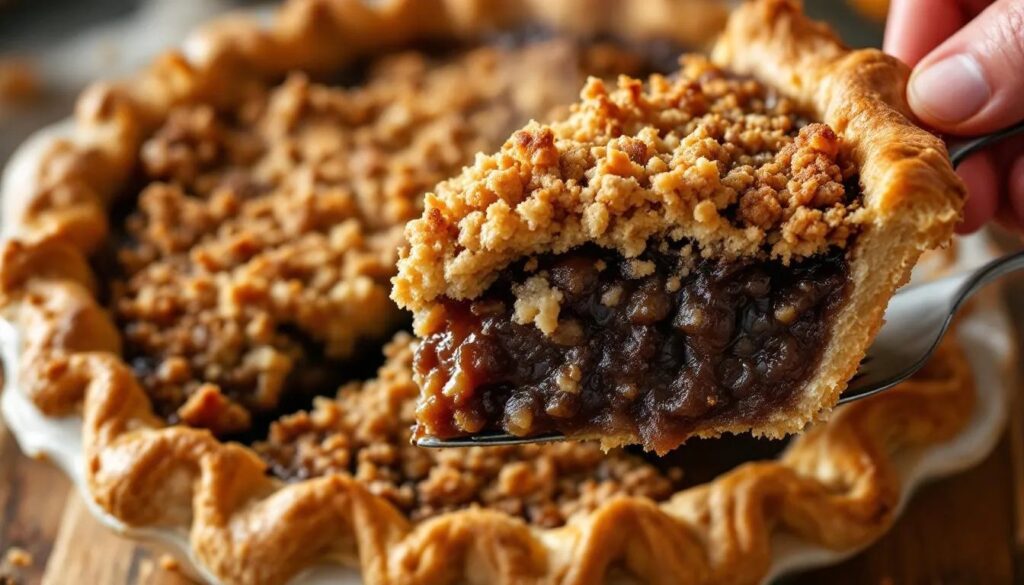
There is a particular kind of quiet that settles over an Amish farmer's market on a late March morning — wooden stalls lined with jars of amber molasses, the air carrying the low warmth of a nearby wood stove, and somewhere between the quilts and the sourdough loaves, a pie that most people walk past without knowing what they are missing. Shoofly pie is one of the oldest baked goods in the Pennsylvania Dutch tradition, and it arrives each spring at markets across Lancaster County with the same unhurried confidence it has always had. Molasses-dark, crumbly on top, and almost custard-soft beneath, it is not a pie that announces itself — it earns its place slowly, one bite at a time.
This particular version came from a conversation with a baker who had been making shoofly pie for longer than most food trends have existed. She used four ingredients — nothing more — and produced something that put every overly engineered version to shame. The ratio is precise, the technique is straightforward, and the result is a pie with that characteristic split texture: a wet, gooey molasses layer on the bottom and a sandy, brown sugar crumb layered across the top. Once you understand what each ingredient is doing, the recipe becomes something you carry in your hands rather than read from a page. Pull on your apron, and let's walk through it together.
| Prep time | 20 min |
| Bake time | 40 min |
| Rest | 30 min |
| Serves | 8 |
| Difficulty | Easy |
| Cost | $ |
| Season | All year · especially fitting in early spring |
Suitable for: Vegetarian
Ingredients
For the crumb topping
- 1 cup all-purpose flour
- ½ cup light brown sugar, firmly packed
- 3 tablespoons cold unsalted butter, cut into small cubes
For the wet bottom
- ¾ cup unsulfured dark molasses (Grandma's Original or a Lancaster-style brand if available)
- ¾ cup boiling water
- ½ teaspoon baking soda
For the crust
- 1 unbaked 9-inch pie shell (homemade shortcrust or good-quality store-bought)
Note on the "4 ingredients": the Amish baker counted the filling itself — flour, brown sugar, molasses, and baking soda. Butter was considered a kitchen staple, not a counted ingredient. Water is water. The shell was always assumed. That is her logic, and it holds.
Equipment
- 9-inch pie dish
- Medium mixing bowl
- Small mixing bowl
- Pastry blender or two forks
- Liquid measuring cup (heatproof)
- Wire cooling rack
Preparation
1. Preheat the oven and blind-bake your shell briefly
Set your oven to 375°F (190°C). Line your 9-inch pie dish with the unbaked pastry shell and crimp the edges as you prefer — a simple fork press works fine. Place the dish in the refrigerator for 10 minutes while the oven comes up to temperature. This brief chill firms the butter in the dough and helps the sides hold their shape when the filling goes in. You are not fully blind-baking here — no weights, no parchment — just a cold rest, which prevents excessive shrinkage without drying out the crust before it meets the wet molasses layer.
2. Make the crumb topping
Combine the flour and brown sugar in a medium bowl, whisking briefly to break up any lumps in the sugar. Add the cold butter cubes and begin working them into the flour mixture using a pastry blender — or simply rub the butter between your fingertips using quick, light movements. You are looking for a texture that resembles coarse, damp sand, with a few pea-sized butter fragments still visible throughout. Those small butter pockets will puff and crisp in the oven, giving the topping its characteristic crumble. Do not overwork: stop the moment the mixture clumps loosely when pressed. Set aside at room temperature.
3. Prepare the wet bottom mixture
Measure the molasses into a heatproof measuring cup or bowl. Bring ¾ cup of water to a full boil — this is not optional, the temperature is doing real work here. Pour the boiling water over the molasses and stir briefly to combine. Immediately add the baking soda and stir again: the mixture will foam up vigorously, turning from dark and dense to a lighter, slightly aerated liquid with a reddish-brown tint. This is the leavening reaction at work — the baking soda reacts with the natural acidity in the molasses to create the slightly risen, almost pudding-like texture that defines the wet bottom layer of a shoofly pie. Work quickly here; you want this poured before the foam settles.
4. Assemble the pie
Remove the cold pie shell from the refrigerator and place it on a sheet pan — this makes transferring it to the oven easier and catches any filling that may bubble over. Pour the hot molasses mixture carefully and evenly into the shell; it will fill it close to the rim. Now scatter the crumb topping over the surface in an even, generous layer, working from the outside edge inward. Do not press it down. The crumbs will partially sink into the molasses during baking — that is exactly what creates the distinct two-layer structure. The portion that stays on top will toast to a pale golden brown; the portion that sinks will absorb molasses and become soft and dense.
5. Bake and rest
Transfer the pie to the center rack of your preheated oven. Bake for 35 to 40 minutes, until the crumb topping is set and deeply golden at the edges and the filling no longer wobbles freely when you gently nudge the pan — a slight tremble at the very center is acceptable, as the residual heat will finish the job. If the edges of the crust are browning too fast, cover them loosely with a strip of foil after 25 minutes. Remove the pie to a wire rack and allow it to rest for a minimum of 30 minutes before slicing. Cutting too early will cause the wet bottom to run; patience here is the difference between a slice and a spoonful.
My baker's tip
The baker at the market always used dark unsulfured molasses, never blackstrap. Blackstrap is bitter and sharp — it overwhelms the soft, almost caramel depth that shoofly pie is built on. If you can find a Pennsylvania Dutch brand like Grandma's Original, use it; the flavor is noticeably rounder. In early spring, when maple syrup is being tapped fresh across the Northeast, you can replace up to two tablespoons of the molasses with fresh dark maple syrup for a subtler, woodsy sweetness that shifts the pie gently toward the season. Do not go further than two tablespoons — the molasses structure is what holds the wet bottom together.
Drinks & pairings
Shoofly pie carries intense, bitter-sweet molasses notes with a softly spiced undertone from the brown sugar — it needs a drink that can stand beside that depth without fighting it.
A strong brewed black coffee, served without sugar, is the traditional and honest pairing: the bitterness cuts through the sweetness and draws out the roasted grain notes in the molasses. A dark breakfast tea — Assam or an English Breakfast blend — works in the same direction, adding tannin where the coffee adds acid. For something warmer and more celebratory on a cool March afternoon, a small glass of cold-brew oat milk latte balances the richness without competing. If you prefer something spirited, a pour of aged bourbon alongside a warm slice turns the pie into an evening thing entirely.
About shoofly pie
Shoofly pie originates in the Pennsylvania Dutch communities of southeastern Pennsylvania — primarily among the Amish and Mennonite populations who settled the region in the 18th century. Its name is almost certainly linked to the flies it attracted when left to cool on window ledges: the sticky molasses filling required constant shooing. The pie developed as a practical solution to pantry scarcity — molasses was cheap, shelf-stable, and available year-round, making shoofly pie as much a winter and early spring staple as it was a summer one. There are written references to it in regional cookbooks as far back as the 1870s, though the recipe almost certainly predates those records considerably.
There are two recognized styles: wet-bottom and dry-bottom. The wet-bottom version — which this recipe produces — is characterized by that gooey, almost liquid molasses layer beneath the crumb. The dry-bottom version distributes the crumble throughout and has a more uniformly cake-like texture. Most Amish bakers in Lancaster County will defend the wet-bottom version fiercely and with complete justification. Outside Pennsylvania, shoofly pie remains largely unknown, which is a situation that deserves correction.
Nutritional values (per serving, approximate values)
| Nutrient | Amount |
|---|---|
| Calories | ~310 kcal |
| Protein | ~3 g |
| Carbohydrates | ~55 g |
| of which sugars | ~32 g |
| Fat | ~9 g |
| Fiber | ~1 g |
Frequently asked questions
Can shoofly pie be made ahead of time?
Yes, and it actually benefits from it. The pie sets more firmly after a few hours at room temperature, making cleaner slices possible. You can bake it the day before serving and store it loosely covered at room temperature overnight — the flavors deepen noticeably. Avoid refrigerating it before serving if you can, as cold firms the molasses layer to an almost rubbery texture.
How should leftover shoofly pie be stored?
Cover loosely with plastic wrap or a clean kitchen towel and store at room temperature for up to 2 days. For longer storage, refrigerate for up to 5 days — bring slices back to room temperature for 20 to 30 minutes before eating, or warm briefly in a low oven at 300°F (150°C) for 8 minutes to revive the crumb topping's texture.
What substitutions work in this recipe?
The molasses is structural as well as flavorful, so it cannot be eliminated entirely — but up to a third of it can be swapped for dark maple syrup or sorghum syrup for a regional variation. For a dairy-free version, replace the butter in the crumb topping with cold coconut oil cut into small pieces; the crumble will be slightly less cohesive but still effective. The all-purpose flour can be replaced with a 1:1 gluten-free baking flour without significant changes to texture.
Why does my wet bottom layer stay too liquid after baking?
Two common causes: the molasses mixture was not hot enough when poured, or the pie was underbaked and not given adequate resting time. Make sure the water is at a full rolling boil before combining it with the molasses, and allow the baked pie to rest on a rack for at least 30 minutes — preferably an hour — before cutting. The filling continues to set as it cools.
Is shoofly pie eaten warm or cold?
At room temperature is the Amish preference, and it is the right call. Warm, the wet bottom can be almost runny; cold, the molasses tightens too much. Sliced after a proper rest at room temperature, the two layers have distinct textures that hold their integrity on the plate. Some people add a spoonful of lightly whipped cream alongside — unsweetened, to let the pie speak for itself.