
Spring is prime steak season in the US — the grills are coming back out, the butcher counters are stocked with thick ribeyes and dry-aged strips, and the debate raging in every kitchen and backyard is the same one it's always been: butter or olive oil? Both have passionate defenders, and both will get a crust on a piece of beef. But they don't behave the same way in a hot pan, they don't taste the same on the plate, and they won't give you the same results depending on what cut you're working with.
This isn't a matter of personal preference alone — there's real science behind the smoke, the sear, and the fat. Understanding how each one interacts with high heat, with the proteins in the meat, and with your own palate will change how you cook steak permanently. What follows is a clear-eyed breakdown of both fats, their strengths, their limits, and exactly when to reach for each one.
The science of fat and heat
Every fat has a smoke point — the temperature at which it stops shimmering and starts breaking down, releasing acrid compounds and a thin blue smoke that signals the fat is no longer doing you any favors. This number matters enormously when searing steak, because a proper sear demands high heat: typically 400°F to 500°F (204°C to 260°C) at the pan surface.
Extra-virgin olive oil has a smoke point that hovers around 375°F to 405°F (190°C to 207°C), depending on its quality and acidity. Refined or "light" olive oil pushes closer to 465°F (240°C). Whole butter, by contrast, burns at a much lower threshold — around 300°F to 350°F (149°C to 177°C) — because of the milk solids and water it contains. Those milk solids brown fast and turn bitter before the pan even reaches searing temperature.
Neither fat, used alone in its pure form, is technically ideal for a screaming-hot sear. And yet both show up in the finest steakhouse kitchens in the country. The reason is technique.
The case for olive oil
Olive oil — particularly a refined variety, not your best cold-pressed bottle — is the workhorse fat for starting a sear. Its higher smoke point means you can preheat a cast-iron or carbon-steel pan until it's genuinely hot before adding the oil, and it won't immediately degrade. A thin coat is all you need: enough to conduct heat evenly across the surface and prevent the steak from adhering, not enough to fry it.
The flavor contribution of olive oil at high heat is minimal. Most of the volatile aromatic compounds that make a great extra-virgin oil worth $30 a bottle are destroyed by the time the pan hits searing temperature. This is actually a feature, not a flaw — you want the steak's own crust, developed through the Maillard reaction, to dominate. The Maillard reaction is the complex cascade of chemical browning that occurs when proteins and sugars on the surface of meat are exposed to high, dry heat, producing hundreds of flavor compounds responsible for that deep, savory crust.
Olive oil also contains oleic acid, a monounsaturated fat that is relatively stable under heat compared to polyunsaturated fats like those found in vegetable or sunflower oil. This stability means less oxidation, fewer off-flavors, and a cleaner result in the pan.
The case for butter
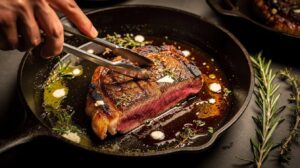
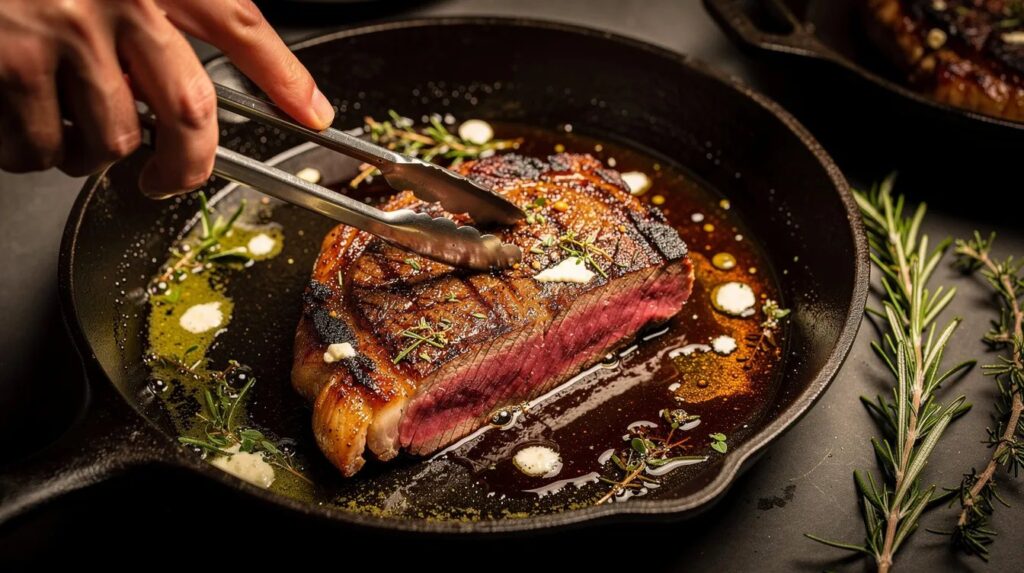
Butter doesn't belong at the start of a sear — it belongs at the end, and that changes everything. The technique is called basting, and it's what separates a home-cooked steak from a restaurant one. Once the steak has developed its crust on both sides and the internal temperature is approaching the target, the heat is reduced, a generous knob of butter goes into the pan along with aromatics — crushed garlic cloves, fresh thyme sprigs, maybe a rosemary branch — and the cook continuously spoons the foaming butter over the surface of the meat for 60 to 90 seconds.
The effect is layered. The butter's milk solids undergo their own Maillard reaction at moderate heat, producing noisette notes — toasted hazelnut, caramel, warm cream — that coat the crust with an aromatic richness olive oil simply cannot replicate. The fat also carries the garlic and herb flavors directly into the exterior of the steak. The result is a steak that tastes finished, complex, and complete in a way that no purely oil-seared steak achieves.
This is why butter is non-negotiable for many cooks working with ribeye, New York strip, or T-bone — richly marbled cuts where the additional fat amplifies rather than overwhelms.
Clarified butter and ghee: the best of both
There is a middle path that professional kitchens have used for decades: clarified butter, or its more shelf-stable cousin, ghee. Both are produced by cooking butter slowly to remove the water and milk solids, leaving behind pure butterfat with a smoke point of 450°F to 485°F (232°C to 252°C) — comfortably above searing temperatures.
Clarified butter combines the high-heat stability of oil with the rich, dairy-forward flavor of butter. Using it as the sole cooking fat means you get a sear and a baste in one, without switching fats mid-cook. For a leaner cut like a filet mignon, where there is little intramuscular fat to self-baste, starting and finishing in clarified butter is an approach worth adopting. It's also naturally lactose-free, which matters for some diners.
Which fat for which cut?
| Cut | Best Approach | Why |
|---|---|---|
| Ribeye | Olive oil to sear, finish with butter baste | High marbling benefits from aromatic butter; oil handles initial heat |
| New York Strip | Olive oil to sear, finish with butter baste | Firm texture and moderate fat take well to butter's noisette finish |
| Filet mignon | Clarified butter or ghee throughout | Lean cut needs fat enrichment from start to finish |
| Skirt or flank | Olive oil only, high heat, short cook | Thin cut cooks fast; butter adds unnecessary fat to an already intense sear |
| Flat iron | Olive oil to sear, light butter finish | Well-marbled but quick-cooking; small butter addition rounds the crust |
A note on quality
Neither fat performs well when it's cheap and poorly stored. For olive oil, choose a refined or light olive oil for cooking — not your finishing oil, which should be reserved for drizzling raw over a resting steak or into a sauce. For butter, a European-style butter with higher butterfat content (~82–84%) produces a more intense, less watery baste than standard American butter (~80%). Brands sourced from grass-fed cows tend to carry a deeper flavor that is perceptible even after high heat.
The pan matters as much as the fat. A well-seasoned cast-iron skillet retains heat evenly and creates the kind of sustained contact crust that stainless steel or nonstick pans rarely match. Whatever fat you choose, the pan temperature at the moment the steak hits the surface is the single biggest variable in your result.
The verdict
Butter and olive oil aren't rivals in a steak pan — they're partners at different stages of the same process. Olive oil handles the sear. Butter handles the finish. Used together in sequence, they produce a steak that is properly browned, aromatically complex, and richly coated. For cooks who want a single-fat approach, clarified butter or ghee is the most technically sound option, covering both functions without compromise.
The only wrong answer is using either fat at the wrong moment: whole butter in a screaming-hot pan from the start, or olive oil substituted for the butter baste at the end. Respect the heat, respect the timing, and both fats will do exactly what you need them to do.
Nutritional comparison (per 1 tablespoon, approximate values)
| Fat | Calories | Total Fat | Saturated Fat | Monounsaturated Fat | Smoke Point |
|---|---|---|---|---|---|
| Whole butter | ~102 kcal | ~11.5 g | ~7.3 g | ~3 g | ~300–350°F |
| Extra-virgin olive oil | ~119 kcal | ~13.5 g | ~1.9 g | ~9.8 g | ~375–405°F |
| Refined olive oil | ~119 kcal | ~13.5 g | ~1.9 g | ~9.8 g | ~465°F |
| Clarified butter / Ghee | ~112 kcal | ~12.7 g | ~7.9 g | ~3.7 g | ~450–485°F |
Frequently asked questions
Can I use extra-virgin olive oil directly to sear a steak?
You can, but the results are inconsistent. Extra-virgin olive oil's smoke point sits below ideal searing temperatures, meaning it will degrade and smoke before the pan is hot enough for a strong crust. If EVOO is all you have, use a small amount and accept that the pan heat will need to stay slightly lower. A refined olive oil or a neutral high-heat oil is a better technical choice for the initial sear.
When exactly should I add butter when cooking steak?
Add butter only after the steak has already developed a full crust on both sides — typically in the final 60 to 90 seconds of cooking. Reduce the heat to medium before adding the butter so the milk solids don't burn immediately. Add crushed garlic and herbs at the same moment and begin basting continuously, tilting the pan and spooning the foaming fat over the steak. Remove the steak from the heat to rest before the butter baste begins to brown past golden.
Is butter or olive oil healthier for cooking steak?
From a nutritional standpoint, olive oil carries a higher proportion of monounsaturated fats and no cholesterol, while butter is higher in saturated fat and dietary cholesterol. However, the quantities used in a typical steak cook are small enough that neither represents a significant health concern in the context of a balanced diet. The fat content of the steak itself — particularly in heavily marbled cuts — is a larger variable than the cooking fat. For those monitoring saturated fat intake, refined olive oil throughout is the leaner choice.
What herbs work best in a butter baste?
Fresh thyme and smashed garlic cloves are the classic pairing — thyme holds up to heat without turning acrid, and garlic infuses the butter quickly without burning if the heat is managed correctly. Fresh rosemary works well with leaner cuts like filet but can overpower a ribeye. A small sage leaf or two adds an earthy, slightly resinous note that pairs particularly well with dry-aged beef. Avoid delicate herbs like basil or parsley in the basting stage — add those raw to the rested steak instead.
Does the type of pan change which fat I should use?
Yes, indirectly. A cast-iron skillet retains heat so efficiently that it compensates somewhat for a fat's lower smoke point — the pan stays hot even after the oil is added, so the sear happens fast before significant degradation occurs. In a thinner stainless-steel pan, temperature drops more sharply when the steak hits the surface, which can cause sticking if the fat breaks down prematurely. For stainless steel, a slightly higher smoke-point oil — refined olive oil or avocado oil — provides more margin. Nonstick pans should never be used at the temperatures required for a proper steak sear, regardless of fat.