
When the air still carries a bite of late-March cool and comfort food holds its ground before spring truly takes over, there is one dish that has no business coming out of a cardboard box. Baked macaroni and cheese — the Southern kind, the kind made in a cast-iron dish by someone who learned it without a recipe card — operates on a completely different level than anything reconstituted from an orange powder packet. Across Texas, this dish is not a side: it is a statement, often the centerpiece of Sunday tables, church potlucks, and family reunions where the recipe is guarded more closely than any written heirloom.
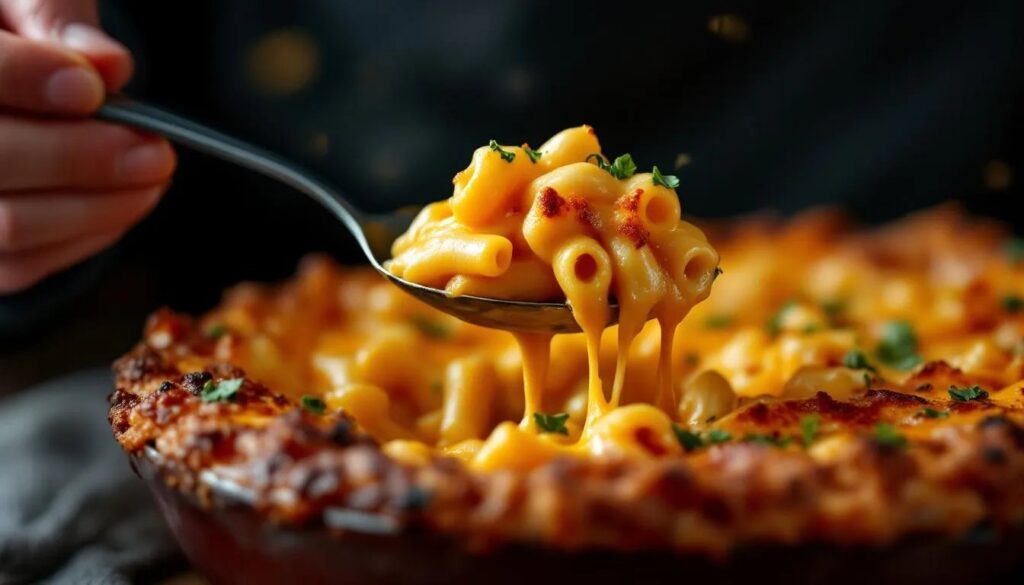
This version comes from a Texas grandmother who built her formula over decades: whole milk, sharp cheddar grated by hand, a custard base that sets into something between a soufflé and a gratin, with a burnished top that crackles when a spoon breaks through. It is neither the stiff diner block nor a loose stovetop sauce — it lands somewhere precise and deliberate. What follows is a full breakdown of her method, including the technique decisions that separate a forgettable bake from one people talk about at the drive home. Tie on an apron.
| Preparation | 20 min |
| Cooking | 45 min |
| Servings | 8 people |
| Difficulty | Medium |
| Cost | $$ |
| Season | Year-round comfort; ideal for late winter to early spring |
Suitable for: Vegetarian
Ingredients
For the pasta base
- 1 lb (450 g) elbow macaroni, dried
- 1 tbsp kosher salt (for pasta water)
- 1 tbsp unsalted butter (to toss with drained pasta)
For the custard
- 3 large eggs
- 2 cups (480 ml) whole milk, at room temperature
- 1 cup (240 ml) heavy cream
- 1 tsp dry mustard powder
- ½ tsp smoked paprika
- ½ tsp onion powder
- ¼ tsp cayenne pepper
- 1 tsp fine sea salt
- ½ tsp freshly ground black pepper
For the cheese layers
- 3 cups (340 g) sharp cheddar, grated by hand — block, not pre-shredded
- 1 cup (115 g) mild cheddar or Colby, grated by hand
- ½ cup (55 g) Gruyère or Fontina, grated (optional, adds depth)
- 4 tbsp (55 g) unsalted butter, cut into small cubes
For the topping
- ½ cup (55 g) sharp cheddar, reserved from above
- 2 tbsp unsalted butter, melted
- ½ cup (40 g) plain breadcrumbs (optional, for a crunchy crown)
Equipment
- Large stockpot
- Colander
- Large mixing bowl
- Whisk
- Box grater
- 9×13 inch (23×33 cm) baking dish, preferably ceramic or cast iron
- Aluminum foil
- Oven thermometer (recommended)
Preparation
1. Cook the pasta just short of done
Bring a large stockpot of water to a rolling boil and salt it aggressively — it should taste distinctly of the sea. Add the elbow macaroni and cook it for 2 minutes less than the package's minimum suggested time. This is not laziness: the pasta will continue to cook in the oven inside the custard, and if it enters the dish already soft, it will turn to mush before the top has time to brown. Drain the elbows through a colander, shake out the excess water thoroughly, then return them to the warm pot. Toss immediately with 1 tablespoon of butter to coat each piece and prevent clumping while you prepare the custard. The pasta should look slightly translucent at the center when you bite one — that is exactly right.
2. Build the custard base
In a large mixing bowl, crack the three eggs and whisk them until the yolks and whites are fully unified — no streaks remaining. Pour in the whole milk and heavy cream slowly, whisking as you go, to create a smooth, pale liquid. Add the dry mustard powder, smoked paprika, onion powder, cayenne, sea salt, and black pepper. Whisk again until the spices are fully incorporated and the mixture is uniform in color. The dry mustard here is not decorative: it potentiates — meaning it amplifies — the sharpness of the cheddar without adding any mustard flavor of its own. Smell the custard at this stage: it should be faintly sharp, faintly smoky, warm with spice but not aggressive. Taste and adjust salt if needed.
3. Grate all the cheese by hand
This step is non-negotiable. Pre-shredded cheese is coated in cellulose or potato starch to prevent clumping in the bag — that same coating inhibits melting in the oven, resulting in a grainy or oily texture rather than a smooth, cohesive pull. Using a box grater, work through the sharp cheddar, mild cheddar, and Gruyère. Keep ½ cup of the sharp cheddar separate — this is your topping cheese. The rest goes into a combined pile. The act of grating also warms the cheese slightly between your palms, making it more pliable and ready to melt evenly once it meets the heat.
4. Layer the baking dish
Preheat your oven to 350°F (175°C) and butter the baking dish generously on all interior surfaces. Spread roughly one third of the cooked macaroni across the bottom in an even layer. Scatter approximately one third of the combined cheese over it, then dot with a few small cubes of butter. Repeat — a second layer of pasta, a second layer of cheese, more butter dots. Add the final layer of pasta across the top. The layering creates distinct pockets of molten cheese throughout the interior of the dish rather than concentrating it all on top. Pour the custard mixture slowly and evenly over the entire surface, pausing to let it seep down through the layers. Press gently with the back of a spoon if needed — you want the liquid to reach every corner of the dish.
5. Add the topping and bake
Scatter the reserved sharp cheddar across the surface. If you are using breadcrumbs, toss them with the 2 tablespoons of melted butter and distribute them over the cheese in an even layer — they will form a shatteringly crisp golden crust as the dish bakes. Cover the dish loosely with aluminum foil and place it in the center rack of the preheated oven. Bake covered for 25 minutes, then remove the foil and continue baking for a further 18 to 22 minutes, until the top is deeply golden-brown and the custard is just set — it should quiver very slightly at the center when you nudge the dish, the way a well-made crème brûlée does at the edge of setting. A knife inserted 2 inches from the center should come out clean. Rest the dish for at least 10 minutes before serving: the custard continues to firm as it cools, and cutting too soon yields a soupy spoon rather than a clean scoop.
My chef's tip
The single most common mistake with baked mac and cheese is using cheese straight from the refrigerator. Cold cheese seizes when it hits the custard, creating uneven melting and a slightly greasy finish. Pull your block of cheddar out of the refrigerator at least 30 minutes before grating — room-temperature cheese melts cleanly and integrates into the custard without breaking. In early spring, when days are warming but evenings still cool, leaving the cheese on the counter while you prepare the other components works perfectly. And if you want a richer color on the top crust, switch the oven to broil for the final 90 seconds — but do not walk away.
Drink pairings
Baked mac and cheese has a rich, fatty, faintly smoky profile with the brightness of sharp cheddar cutting through. The pairing needs either enough acidity to lift the fat or enough body to match it without being swallowed by it.
A cold, well-carbonated pale ale or an American amber ale is the natural partner here — the bitterness of the hops cuts through the cheese in the same way a squeeze of lemon works on fried food. For a wine option, an unoaked or lightly oaked Chardonnay from California or Burgundy has the acidity and stone-fruit character to hold its own without competing. For a non-alcoholic pairing, a sparkling water with a wedge of lemon and a splash of apple cider vinegar provides exactly the same palate-cleansing function as a sip of pale ale.
More about this dish
Baked macaroni and cheese has roots that stretch back to 18th-century Europe — early versions appeared in English cookbooks well before it crossed the Atlantic — but it was in the American South that it evolved into something culturally distinct. In Black Southern cooking traditions, baked mac and cheese became a fixture at holiday tables, church suppers, and family gatherings, made with a custard-egg base that sets the dish apart from the stovetop roux-based versions more common in the North. The egg custard technique is the signature of the Southern approach: it produces a sliceable, cohesive texture rather than a flowing sauce.
In Texas specifically, the dish often skews bold: more cayenne, more smoked paprika, occasionally jalapeño folded into the layers. Regional variations exist from coast to coast — some versions incorporate Velveeta for its reliable melt, others use evaporated milk in place of cream, and a small number of old church-cookbook recipes call for sour cream to add tang. The boxed version that dominates grocery store shelves — and which has been a pantry staple since the 1930s — was designed for speed and shelf-life, not for the experience of eating. They are answering different questions entirely.
Nutritional values (per serving, approximate values)
| Nutrient | Amount |
|---|---|
| Calories | ~620 kcal |
| Protein | ~26 g |
| Carbohydrates | ~52 g |
| of which sugars | ~6 g |
| Fat | ~34 g |
| Fiber | ~2 g |
Frequently asked questions
Can this be assembled ahead of time?
Yes — and it actually benefits from it. Assemble the dish through the custard-pouring step, cover tightly with plastic wrap, and refrigerate for up to 24 hours before baking. The pasta absorbs some of the custard overnight, which produces an even creamier interior. When ready to bake, remove the dish from the refrigerator 30 minutes before it goes into the oven so it comes up to room temperature and bakes evenly. Add the topping cheese and breadcrumbs just before it goes in.
How should leftovers be stored and reheated?
Cover the dish tightly with foil or transfer portions to an airtight container. Leftovers keep in the refrigerator for up to 4 days. To reheat, add a small splash of whole milk over the portion, cover loosely with foil, and warm in a 325°F (160°C) oven for 15 to 20 minutes. This prevents the custard from drying out and restores much of the original creaminess. Microwave reheating is faster but results in a rubbery texture — the oven method is worth the extra time.
What substitutions or variations work well?
The cheese blend is flexible: Monterey Jack melts beautifully and adds a mild, buttery note; smoked Gouda in place of the Gruyère brings a deeper smokiness that works particularly well in cooler months. For a spicier Texas-style version, fold 2 diced pickled jalapeños into the pasta layers. If whole milk is unavailable, 2% milk works but produces a slightly less set custard — reduce the cream by 2 tablespoons to compensate. For a gluten-free version, use your preferred gluten-free elbow pasta and omit the breadcrumb topping or replace it with crushed gluten-free crackers.
Why does my baked mac and cheese turn out grainy or oily?
The two most common culprits are pre-shredded cheese and too-high oven temperature. Pre-shredded cheese contains anti-caking agents that prevent clean melting. Always grate from a block. If the oven runs hot — which many do, especially older models — the proteins in the cheese can separate from the fat before the custard sets, releasing grease rather than melting smoothly. An oven thermometer is a reliable diagnostic tool: if your oven reads 375°F when set to 350°F, that 25-degree difference is enough to break the custard.
Can this be made in individual ramekins instead of one large dish?
Absolutely. Divide the assembled layers among 8 oven-safe ramekins of roughly 8 oz (240 ml) capacity. Reduce the covered bake time to 18 minutes and the uncovered browning time to 10 to 12 minutes, watching closely after the foil comes off. Individual portions also make portion control straightforward and present beautifully for a dinner party where the dish plays a more prominent role than a family-style scoop from a casserole.