



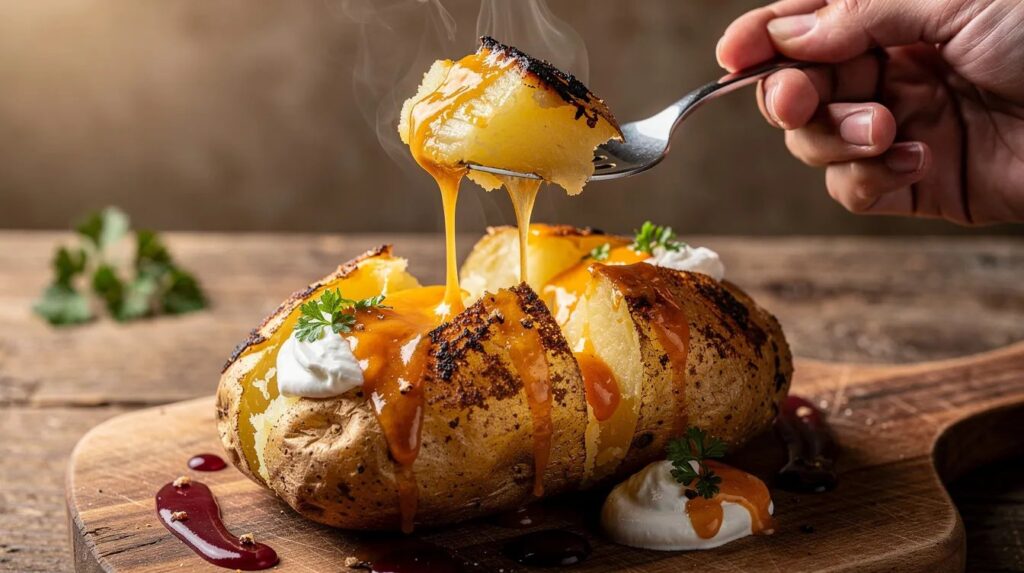
March is peak comfort food season in America — the kind of cold-lingers-in-the-air weeks when a baked potato feels less like a side dish and more like a statement. But if you've been reaching for the same tub of sour cream for the past decade, it's time to rethink your finishing move. There's a French technique that turns a humble russet into something genuinely extraordinary, and it starts with a sauce most home cooks have never thought to put near a potato.
The trick is sauce Mornay — a classic French béchamel enriched with Gruyère and Parmesan — spooned generously over a freshly split baked potato, then briefly passed under the broiler until the top blisters into a golden, lacey crust. It's richer than sour cream, more complex than shredded cheddar straight from the bag, and it clings to every fluffy ridge of the interior like it was made for exactly this purpose. Once you try it, the foil-wrapped routine you've been doing since college starts to feel like a rough draft.
| Prep time | 15 min |
| Cook time | 1 hr 10 min |
| Portions | 4 people |
| Difficulty | Easy |
| Cost | $$ |
| Season | Russet potatoes, Gruyère, fresh chives |
Suitable for: Vegetarian
Ingredients
For the baked potatoes
- 4 large russet potatoes (about 10–12 oz each), scrubbed clean
- 2 tablespoons olive oil or neutral vegetable oil
- Kosher salt, for coating the skin
- Freshly ground black pepper
For the Mornay sauce
- 2 tablespoons unsalted butter
- 2 tablespoons all-purpose flour
- 1 ½ cups whole milk, warmed
- ¾ cup Gruyère, freshly grated (about 2½ oz)
- ¼ cup Parmesan, freshly grated (about 1 oz)
- 1 pinch freshly grated nutmeg
- Salt and white pepper to taste
To finish
- 2 tablespoons fresh chives, thinly sliced
- Extra Gruyère for broiling, about ¼ cup
- Flaky sea salt, for serving
Equipment
- Rimmed baking sheet
- Wire cooling rack (optional, set over baking sheet)
- Medium heavy-bottomed saucepan
- Wooden spoon or silicone spatula
- Box grater
- Broiler-safe baking dish or the same rimmed baking sheet
- Instant-read thermometer (optional)
Preparation
1. Build a proper baked potato — start with dry heat
Preheat your oven to 425°F. While it comes to temperature, scrub your russet potatoes under cold water and pat them completely dry with a kitchen towel — moisture on the skin is the enemy of crispness. Pierce each potato six to eight times with a fork, going about an inch deep; this allows steam to escape and prevents any dramatic splitting during the long bake. Rub each one with a thin coat of olive oil and a generous pinch of kosher salt all over. Set them directly on a wire rack placed over a rimmed baking sheet, or simply on the oven rack itself with the baking sheet below to catch any drips. Baking them elevated on a rack allows hot air to circulate on all sides, producing that deeply cragged, paper-thin skin that shatters satisfyingly when you press it. Skip the foil entirely — foil traps steam and steams the skin soft rather than baking it crisp. Bake for 55 to 65 minutes, until a skewer or fork slides to the center with zero resistance and the internal temperature reads around 210°F.
2. Make the Mornay sauce — patience over high heat
About 15 minutes before the potatoes come out, begin the sauce. Melt the butter in a medium heavy-bottomed saucepan over medium heat. Once it foams and the foam subsides, add all the flour at once and stir constantly with a wooden spoon for 1 to 2 minutes. This step — called cooking the roux — eliminates the raw flour taste and is non-negotiable; the mixture should smell faintly nutty and turn a very pale straw color. Pour in the warmed milk in a slow, steady stream, whisking vigorously the entire time to prevent lumps from forming. The sauce will seize and thicken quickly at first; keep whisking and it will smooth out completely within a minute. Reduce the heat to low and cook, stirring frequently, for another 4 to 5 minutes until the sauce coats the back of a spoon and a line drawn through it with your finger holds cleanly — this is the nappe stage, the classic marker of a properly thickened béchamel. Remove from heat. Add the Gruyère and Parmesan in two or three additions, stirring between each until fully melted and glossy. Season with nutmeg, white pepper, and salt. Taste it — it should be savory, deeply cheesy, just barely silky on the tongue, with a ghost of warmth from the nutmeg.
3. Split, hollow slightly, and load
Remove the potatoes from the oven. Working carefully — they retain heat like small furnaces — cut a long slit down the top of each potato, then press both ends inward with a kitchen towel to crack and fluff the interior open. Use a fork to gently break up the top layer of flesh inside, creating a rough, crater-like surface. This irregular texture is key: it gives the Mornay sauce grooves and ridges to pool into rather than sliding off a flat surface. Season the exposed flesh with a pinch of flaky salt and a twist of black pepper. Place all four potatoes on a broiler-safe baking sheet or baking dish.
4. Sauce and broil
Switch your oven to broil on high. Spoon the Mornay sauce generously over each potato — roughly 3 to 4 tablespoons per potato — letting it settle into the cracked interior and cascade slightly over the edges. Scatter a small handful of the reserved Gruyère directly over the sauce on each potato. Slide the baking sheet under the broiler, positioning it 4 to 5 inches from the heating element. Broil for 3 to 4 minutes, watching closely the entire time. You're looking for the cheese to bubble energetically, then turn deep golden brown in patches — not uniformly tanned, but with those slightly charred, lacey blistered spots that concentrate flavor and add a faint bitterness to cut through the richness. Pull them the moment you see those dark spots forming; the line between perfectly broiled and burned is narrow and moves fast.
5. Finish and serve immediately
Transfer the potatoes to plates or a serving board. Scatter the sliced chives over each one — their gentle onion bite and fresh color do real work against the heavy, molten sauce. Finish with a pinch of flaky sea salt over the top. Serve within two or three minutes; the sauce continues to thicken as it cools, and the contrast between the crisp skin, steaming fluffy interior, and glossy bubbling cheese is at its best right now, in this window.
Chef's tip
Grate your Gruyère fresh from the block, every single time. Pre-shredded cheeses are coated with cellulose or starch to prevent clumping, and that coating interferes with the smooth melting that makes a Mornay sauce silky rather than grainy. For a spring variation, stir two tablespoons of very finely chopped fresh tarragon into the finished Mornay — it pairs beautifully with the nuttiness of the Gruyère and makes the whole dish feel lighter and more seasonal. A small splash of dry white wine added to the roux before the milk, cooked down for 30 seconds, adds a subtle acidity that keeps the sauce from feeling one-dimensional.
Wine pairing
The Mornay sauce brings enough richness and savory depth that you want a white wine with enough body to match it, but enough acidity to cut through the fat and refresh the palate between bites.
A white Burgundy — Mâcon-Villages or a village-level Pouilly-Fuissé — works beautifully: its notes of ripe pear, toasted hazelnut, and underlying minerality echo the nutmeg and Gruyère without competing with them. For a more accessible option, a California Chardonnay from a cool-climate region like Sonoma Coast or Santa Barbara brings similar structure with a touch more fruit. If you prefer to skip alcohol, a sparkling water with a squeeze of lemon and a few drops of white wine vinegar — served very cold — performs the same palate-cleansing role at the table.
The french technique behind this dish
Sauce Mornay is one of the sauces dérivées of classical French cuisine — a "daughter sauce" born directly from béchamel, one of the five French mother sauces codified by Auguste Escoffier in the early twentieth century. The Mornay variation, enriched with grated hard cheese, takes its name most likely from Philippe de Mornay, a sixteenth-century French statesman and theologian, though the true origin of the name is disputed among food historians. What's undisputed is its role in French home cooking: it's the sauce spooned over cauliflower gratin, the binding agent in croque-monsieur, the finishing layer on countless baked dishes that come out of French ovens each winter.
Pairing it with a baked potato is not something you'd find in a classic French cookbook — the baked potato as Americans know it is an Anglo-American tradition, popularized in the United States through steakhouse culture in the mid-twentieth century. But the marriage makes technical sense: the starchy, dry interior of a well-baked russet absorbs the sauce rather than letting it pool at the bottom, behaving almost like the bread in a gratin. The Mornay brings the European cheese-and-cream tradition directly to one of America's most beloved comfort foods, and the result sits cleanly in both worlds.
Nutrition facts (per serving, approximate values)
| Nutrient | Amount |
|---|---|
| Calories | ~520 kcal |
| Protein | ~18 g |
| Carbohydrates | ~58 g |
| of which sugars | ~6 g |
| Fat | ~24 g |
| Fiber | ~5 g |
Frequently asked questions
Can i make the Mornay sauce ahead of time?
Yes — the sauce can be made up to two days in advance and stored in an airtight container in the refrigerator. Press a sheet of plastic wrap directly against the surface of the sauce before sealing to prevent a skin from forming. When ready to use, reheat it gently in a saucepan over low heat, whisking in a splash of warm milk to restore its original consistency if it has thickened too much. Do not rush this over high heat, as the cheese proteins can seize and turn the sauce grainy.
How do i store and reheat leftover baked potatoes with Mornay sauce?
Store leftover topped potatoes in an airtight container in the refrigerator for up to two days. To reheat, place them on a baking sheet in a 375°F oven for 15 to 20 minutes until heated through, then finish under the broiler for 2 minutes to re-crisp the cheese topping. Microwaving is possible for speed, but the skin will soften and the cheese will not blister — the texture loss is significant enough that the oven method is worth the extra time.
What can i substitute for Gruyère?
Comté is the closest substitute in terms of flavor profile — same Alpine nuttiness, same excellent melting behavior. Emmental works in a pinch and is widely available, though it has a milder, slightly sweeter character. Fontina Val d'Aosta produces an exceptionally smooth, creamy Mornay with a more buttery flavor. Avoid pre-shredded mozzarella or cheddar blends, which contain anti-caking agents that can make the sauce grainy and separated. A sharp white cheddar, freshly grated, is the most accessible American substitute and produces a bolder, more assertive sauce.
Can i turn this into a full meal?
Absolutely. The potatoes become a complete dinner with relatively little added effort. Stir ½ cup of diced ham or crisped pancetta into the finished Mornay sauce before spooning it over the potatoes. A handful of wilted spinach or sautéed spring leeks stirred into the sauce adds a vegetable component that balances the richness. Topped with a soft-poached egg placed on the sauce just before serving, the dish crosses firmly into brunch territory — the yolk breaks into the cheese and creates something that no longer needs much explanation.
Does the type of potato matter?
It matters more than most people realize. Russet potatoes — also called Idaho potatoes — are the right choice here. Their high starch content and low moisture produce that signature dry, fluffy interior that absorbs the sauce rather than repelling it. Yukon Gold potatoes have a creamier, waxier texture that is wonderful in other preparations but tends to sit under the sauce rather than integrating with it. Red or fingerling potatoes are too small and too waxy for this technique to work properly. Size also matters: aim for potatoes of roughly equal weight so they finish baking at the same time.