



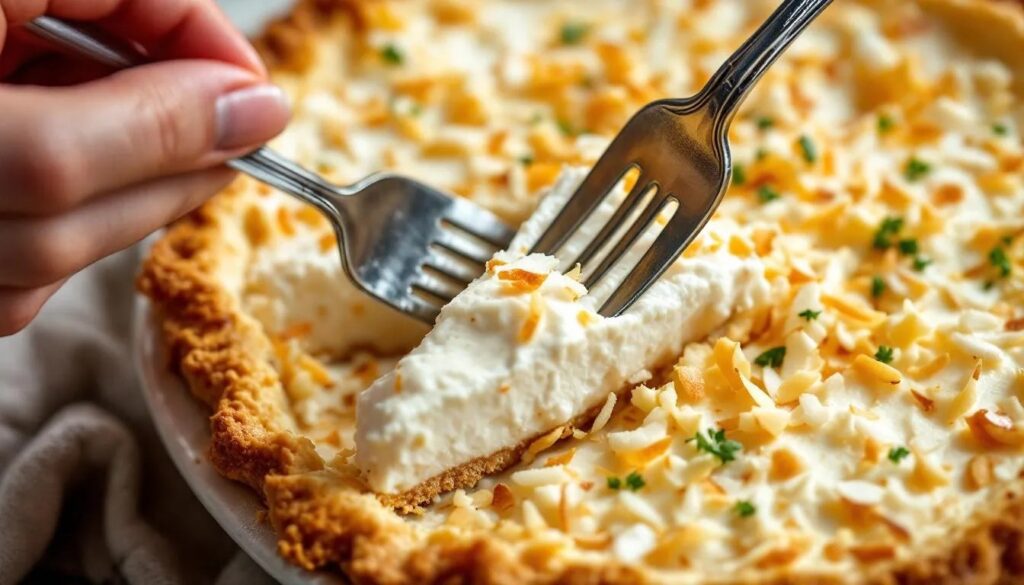
Every March in Kentucky, when the redbuds start to blush along the fence rows and the air still carries a cool edge from winter, certain recipes resurface with the urgency of family obligation. My great-aunt's coconut cream pie is one of them. She entered it at the Kentucky State Fair and came home with a ribbon — the kind that gets framed and hung in the kitchen, not stored in a drawer. The filling is dense with toasted coconut, the custard set just firm enough to slice cleanly without a single crack in the meringue.
This is not a shortcut recipe. It is not made with instant pudding or store-bought crust. Every component is built from scratch: a blind-baked all-butter pastry shell, a stovetop coconut custard thickened with egg yolks, and a Swiss meringue that browns in minutes under a broiler. What you get in return is a pie that tastes like it was made with deliberate intention — because it was. Tie on your apron and clear some counter space.
| Preparation | 40 min |
| Cooking | 35 min |
| Chilling | 3 hours minimum |
| Servings | 8 slices |
| Difficulty | Medium |
| Cost | $$ |
| Season | Early spring — pairs well with fresh citrus on the side; suitable year-round |
Suitable for: Vegetarian
Ingredients
For the pie crust
- 1 ¼ cups all-purpose flour
- ½ tsp fine salt
- 1 tsp granulated sugar
- ½ cup (1 stick / 113 g) unsalted butter, very cold, cut into ½-inch cubes
- 3–4 tbsp ice water
For the coconut custard filling
- 1 ½ cups sweetened shredded coconut
- 2 cups whole milk
- 1 cup full-fat coconut milk (canned, well shaken)
- ¾ cup granulated sugar
- ⅓ cup cornstarch
- ¼ tsp fine salt
- 4 large egg yolks
- 2 tbsp unsalted butter
- 1 tsp pure vanilla extract
For the meringue
- 4 large egg whites, at room temperature
- ¾ cup granulated sugar
- ¼ tsp cream of tartar
- 1 pinch fine salt
Equipment
- 9-inch pie dish
- Rolling pin
- Parchment paper and pie weights (or dried beans)
- Medium heavy-bottomed saucepan
- Whisk
- Stand mixer or hand mixer with whisk attachment
- Heatproof bowl (for Swiss meringue method)
- Instant-read thermometer
- Fine-mesh strainer
- Offset spatula
- Broiler or kitchen torch
Preparation
1. Make the pie crust
In a large bowl, whisk together the flour, salt, and sugar. Add the cold butter cubes and, using your fingertips or a pastry cutter, work the fat into the flour until the mixture resembles coarse breadcrumbs with a few pea-sized pieces of butter still visible. Those butter pockets are not mistakes — they are what create flaky layers during baking. Drizzle in ice water one tablespoon at a time, tossing with a fork after each addition, until the dough just comes together when you press a pinch between your fingers. It should not feel sticky or wet. Shape into a disk, wrap tightly in plastic wrap, and refrigerate for at least 30 minutes. Cold dough is cooperative dough: it rolls without springing back, and it holds its shape in the pan.
2. Blind-bake the crust
Preheat your oven to 375°F (190°C). On a lightly floured surface, roll the dough out to a 12-inch circle, about ⅛ inch thick. Transfer it gently to your pie dish — drape it over the rolling pin and unfurl it over the pan rather than lifting it by hand, which risks tearing. Press it into the bottom and up the sides without stretching. Trim the overhang to about ¾ inch beyond the rim, then fold it under and crimp with your thumb and forefinger. Line the crust with parchment paper, fill with pie weights, and bake for 20 minutes. Remove the weights and parchment, then return to the oven for another 10–12 minutes until the base is golden and fully dry to the touch — an underbaked bottom crust will turn soft under the custard. Let it cool completely on a wire rack before filling.
3. Toast the coconut
Spread the shredded coconut in a single layer on a dry baking sheet. Place it in the oven (still at 375°F) for 5–8 minutes, stirring once halfway through, until the flakes are an even amber-gold. Watch closely: shredded coconut can go from golden to scorched in under a minute. The toasted coconut develops a nutty, almost caramel-like depth that raw coconut never achieves — it is the aromatic backbone of the entire filling. Reserve a handful for garnish.
4. Cook the coconut custard
In your heavy-bottomed saucepan, whisk together the granulated sugar, cornstarch, and salt. In a separate bowl, whisk the egg yolks with the whole milk until smooth, then whisk this mixture into the dry ingredients in the saucepan. Pour in the coconut milk and stir to combine. Set the pan over medium heat and cook, whisking constantly and reaching into every corner of the pan, until the mixture thickens noticeably and begins to bubble — this takes approximately 10–12 minutes. The moment you see the first large, slow bubbles plop to the surface, cook for one full minute more while whisking vigorously. This additional minute cooks out the raw starch flavor and ensures the custard sets properly. Remove from heat, stir in the butter and vanilla extract until the butter is fully melted, then fold in the toasted coconut (reserving your handful for garnish). Pass the custard through a fine-mesh strainer if you prefer a perfectly smooth texture, though my great-aunt never did. Pour the filling into the cooled crust. Press a sheet of plastic wrap directly against the surface of the custard — this prevents a skin (a dried, rubbery film that forms as steam escapes) from developing. Refrigerate for at least 3 hours, or overnight.
5. Prepare the Swiss meringue
Combine the egg whites, sugar, cream of tartar, and salt in a large heatproof bowl set over a saucepan of barely simmering water — the bottom of the bowl must not touch the water. Whisk constantly by hand until the sugar has fully dissolved and the mixture reaches 160°F (71°C) on an instant-read thermometer; rubbing a little between your fingers should feel completely smooth, with no graininess. This step pasteurizes the egg whites, making the meringue food-safe without additional baking. Transfer immediately to your stand mixer and beat on high speed for 5–7 minutes until the meringue is glossy, holds stiff peaks, and the bowl feels cool to the touch. A properly made Swiss meringue is denser and more stable than the French variety — it pipes cleanly and holds its shape without weeping.
6. Top the pie and finish under the broiler
Remove the pie from the refrigerator. Peel off the plastic wrap. Spoon the meringue over the cold custard, spreading it all the way to the edges of the crust — this is important: meringue that does not make contact with the crust tends to pull away and weep as it cools. Use the back of a spoon or an offset spatula to create peaks and swirls across the surface. Position your oven rack in the upper third and set the broiler to high. Slide the pie under the broiler for 1–2 minutes, watching at all times, until the peaks are a deep caramel brown. Alternatively, use a kitchen torch in slow, sweeping passes. Scatter the reserved toasted coconut over the top immediately. Return the pie to the refrigerator for at least 30 minutes before slicing.
Chef's note
The single step most home bakers skip — and the one that matters most — is fully cooking the cornstarch. If you pull the custard from the heat the moment it thickens, the starch granules are still active and the pie will weep liquid after a few hours in the refrigerator. That extra full minute of bubbling, while you whisk aggressively, deactivates the starch and locks the texture in place. In early spring, when vanilla beans appear more frequently at specialty grocers, split one pod and steep it in the warm milk before you begin cooking the custard — scrape the seeds in and discard the pod. The difference in depth of flavor is worth every extra minute.
Pairings
A coconut cream pie is rich, sweet, and carries a distinct tropical fragrance underneath the toasted notes. What you want alongside it cuts through that richness without overwhelming the delicacy of the custard.
A lightly chilled Moscato d'Asti from Piedmont — low in alcohol, effervescent, with peach and apricot aromatics — is a natural counterpart: its acidity lifts the sweetness rather than amplifying it. A late-harvest Riesling from Alsace or the Finger Lakes works along the same lines, with more weight and a honeyed finish. For a non-alcoholic option, a fresh-brewed Ceylon black tea with a slice of lemon cuts through the fat of the custard cleanly and anchors the whole experience in the Kentucky tradition of pie and sweet tea — though in this case, unsweetened is the wiser choice.
About this pie
Coconut cream pie is a distinctly American invention, rooted in the mid-19th century when canned and desiccated coconut became widely available as tropical trade routes expanded. It flourished across the South and the Midwest, where county and state fairs became — and remain — genuine culinary competitions, not spectacles. The Kentucky State Fair, held annually in Louisville, has been running since 1902 and its baking competitions draw entries from home bakers across the Commonwealth who treat the ribbon with the same seriousness a chef might treat a Michelin star.
The coconut cream pie sits in a family of American custard pies that includes banana cream, Boston cream, and chocolate cream — all built on the same stovetop pastry cream foundation, varied by flavor and garnish. Regional distinctions exist: some versions in coastal areas incorporate fresh coconut milk pressed from cracked mature coconuts; others in the Midwest lean heavily on sweetened shredded coconut for texture. My great-aunt's version splits the difference — canned coconut milk for fragrance and fat, sweetened shredded coconut for body and that characteristic chew that identifies the pie immediately on the palate.
Nutritional information (per slice, approximate values)
| Nutrient | Amount |
|---|---|
| Calories | ~480 kcal |
| Protein | ~7 g |
| Carbohydrates | ~55 g |
| of which sugars | ~38 g |
| Fat | ~26 g |
| Fiber | ~2 g |
Frequently asked questions
Can this pie be made a day ahead?
Yes — and it is actually better for it. The custard needs a minimum of three hours to set, but an overnight rest in the refrigerator allows the flavors to fully marry and the filling to firm up to the ideal sliceable consistency. Add the meringue and broil it the day you plan to serve, then refrigerate for at least 30 minutes before cutting. Meringue does not hold well beyond 24 hours and may begin to weep or pull away from the crust if left too long.
How should leftover pie be stored?
Cover loosely with plastic wrap and refrigerate. The pie is best consumed within two days of assembly. Avoid pressing the wrap against the meringue — it will stick and pull the topping apart. Do not freeze this pie: the custard separates upon thawing and the texture becomes grainy and waterlogged.
What substitutions work if i don't have coconut milk?
You can replace the coconut milk with an equal quantity of whole milk and add 1 teaspoon of coconut extract to compensate for the loss of flavor — though the custard will be slightly less rich and the coconut character more perfumed than natural. Evaporated milk is another option: it adds body and a subtle caramel note that pairs well with toasted coconut. Avoid light coconut milk, which lacks the fat content needed to set a stable custard.
Why did my meringue weep?
Meringue weeping — that thin layer of liquid that pools between the custard and the topping — happens for two main reasons. First, the meringue was not sealed all the way to the edge of the crust, leaving gaps where moisture can accumulate. Second, the meringue may have been underbeaten, with sugar crystals that haven't fully dissolved. Using the Swiss meringue method described in this recipe — heating the whites and sugar to 160°F before whipping — dissolves the sugar completely and produces a more stable result that resists weeping significantly better than a standard French meringue.
Can I use a store-bought crust to save time?
A refrigerated all-butter pie crust (not the pre-formed kind in a foil pan) is a reasonable shortcut that will not dramatically compromise the final result. Blind-bake it according to the package instructions, making sure it is fully golden and dry before filling — the same rule applies. Pre-formed crusts in foil pans tend to be thinner and more prone to sogginess under a custard filling, so they are the least ideal option for this particular recipe.