



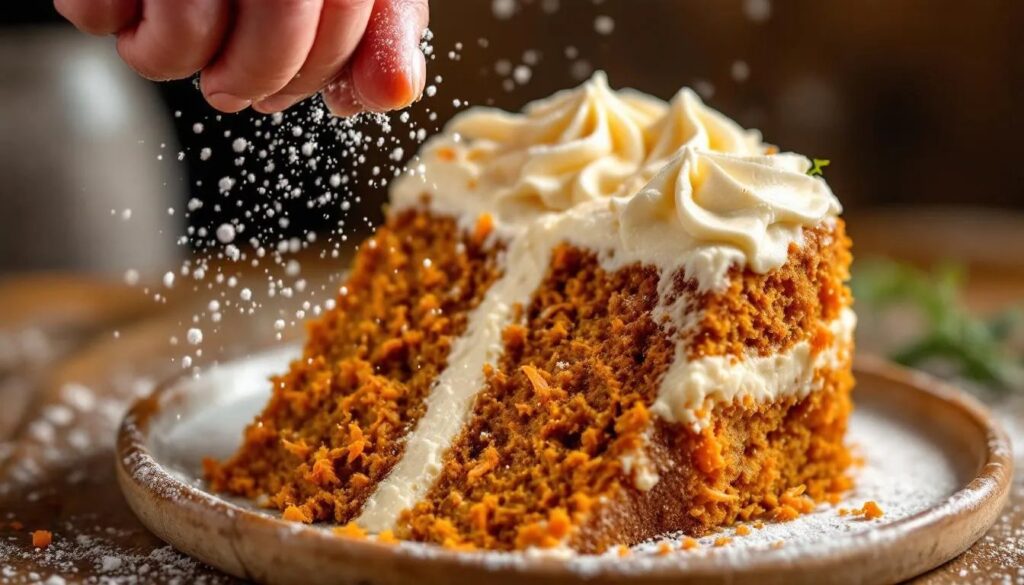
Easter weekend has a particular smell in my kitchen: warm spices, grated carrot releasing its earthy sweetness, a faint caramel note drifting from the oven. Every spring, as the days stretch longer and the market stalls fill with the first bunches of new-season carrots — slender, bright-orange, still dusted with soil — this cake reappears on my counter. It has never failed me. It has never needed improving. Five ingredients, a single bowl, and an oven set to a steady heat: that is all it takes.
My grandmother kept her recipe on a folded index card, tucked between a walnut tart and a ginger loaf in a battered tin box. The card is splattered with ancient batter, the handwriting slightly tilted. Over the years, I have tested a dozen variations — extra spices, different fats, cream cheese swirls — and I always come back to hers. This version is unapologetically simple, which is exactly what makes it extraordinary. Follow each step with attention, and by the time your guests arrive for Easter Sunday lunch, the cake will be cool, fragrant, and ready to hold the table.
| Preparation | 20 min |
| Baking | 45 min |
| Cooling | 30 min |
| Servings | 8 people |
| Difficulty | Easy |
| Cost | $ |
| Season | Spring new-season carrots, Easter |
Suitable for: Vegetarian · Dairy-free (without optional glaze)
Ingredients
- 3 cups (300 g) finely grated fresh carrots (approximately 4–5 medium carrots, peeled)
- 2 cups (250 g) all-purpose flour
- 1 cup (200 g) light brown sugar, firmly packed
- 3 large eggs, at room temperature
- ¾ cup (180 ml) neutral vegetable oil (sunflower or grapeseed)
Utensils
- Box grater or food processor with grating attachment
- Large mixing bowl
- Medium mixing bowl
- Balloon whisk
- Rubber spatula
- 9-inch (23 cm) round cake pan, at least 2 inches deep
- Parchment paper
- Cooling rack
- Toothpick or thin skewer
Preparation
1. Prepare your carrots and your pan
Preheat your oven to 350°F (175°C). This is not a step to rush past: a properly preheated oven ensures the batter begins to set immediately upon entering, producing an even, springy crumb rather than a dense, sunken centre. Line the base of your cake pan with a circle of parchment paper, then lightly coat the sides with a thin film of oil. Set it aside. Now grate your carrots. Use the fine side of a box grater and work steadily — the gratings should be almost fluffy, catching the light with a deep amber-orange glow. If you use the coarse side, the texture of the finished cake will be noticeably chunkier; some people prefer that, but my grandmother's version is tender, and the fine grate is the reason. Once grated, squeeze the carrot loosely between your palms over the sink to release excess moisture. You are not aiming to dry it out completely — a little residual moisture keeps the cake soft — but removing the bulk of the liquid prevents a soggy interior. Set the grated carrot aside in a small bowl.
2. Whisk the wet ingredients together
In your large mixing bowl, crack in the three eggs. Using your balloon whisk, beat them briskly for about one full minute — you want them slightly foamy, the yolks and whites fully combined, the mixture a pale, uniform yellow. Add the light brown sugar and continue whisking for another two minutes. The sugar will begin to dissolve into the eggs, and the mixture will thicken perceptibly, taking on a faintly caramel scent. Brown sugar carries natural molasses, which contributes both moisture and a gentle depth of flavor that white sugar simply cannot replicate. Now pour in the oil in a slow, steady stream, whisking the whole time. The emulsion will shift from thick and syrupy to a smooth, glossy ribbon. The moment you lift the whisk and the mixture falls back in a continuous, unbroken stream, you are ready for the next step.
3. Fold in the flour
Sift the flour directly into the wet mixture, holding the sieve about six inches above the bowl so the flour falls in a light, aerated curtain. Do not stir — instead, use your rubber spatula to fold: a technique involving a deep J-shaped movement that cuts through the centre of the batter, sweeps along the bottom of the bowl, and turns the mixture over itself. The objective here is to combine the flour without developing the gluten — the elastic protein network that, when overworked, produces a tough, chewy crumb. Fold until you can no longer see visible streaks of dry flour, but stop the moment that happens. The batter will look slightly thick, glossy, and very uniform. Over-mixing at this stage is the single most common error in cake-making; restraint is the technique.
4. Incorporate the carrots
Tip your grated carrot into the batter all at once. Fold again using the same J-movement — approximately twelve to fifteen strokes is usually sufficient. The carrot shreds will be evenly distributed throughout the batter, visible in every spoonful, turning the mixture a warm, russet orange. The batter will loosen slightly as the carrot releases its remaining moisture into the flour network. This is expected, and entirely correct. Pour the finished batter into your prepared cake pan, smoothing the top with the back of a spoon or an offset spatula. Give the pan a single, firm tap against the counter to release any large air pockets trapped beneath the surface.
5. Bake, test, and cool with patience
Slide the pan onto the centre rack of your preheated oven and close the door. Do not open it for the first 35 minutes. The batter needs undisturbed heat to build its structure; opening the door too early causes the centre to collapse as the temperature drops suddenly. After 35 minutes, begin checking: insert a toothpick into the very centre of the cake. If it comes out clean, or with just one or two moist crumbs clinging to it, the cake is done. If it comes out wet with raw batter, return the pan to the oven for a further 5 to 8 minutes and test again. When done, the surface should be a deep golden-brown, slightly domed, and pulling away from the sides of the pan by a millimeter or two. Set the pan on a cooling rack and wait a full 10 minutes before turning the cake out. Then remove the parchment paper and allow the cake to cool completely — a minimum of 20 more minutes — before cutting. Cutting into a warm cake compresses the crumb and loses the moisture you worked carefully to preserve.
My chef's tip
The quality of your carrots matters more than any other ingredient in this recipe. In late March and early April, seek out spring carrots at the farmers' market — younger, narrower, less woody than winter storage carrots, with a more concentrated sweetness. If your carrots are older and large, taste a raw piece before grating: if they seem bland, add a pinch of cinnamon and a tablespoon of orange zest to the batter along with the flour. Neither is in my grandmother's original recipe, but both honor its spirit. Finally, if you want a richer crumb, replace two tablespoons of the oil with two tablespoons of melted butter — the protein in the butter browns during baking and adds a faint nuttiness that pairs beautifully with the carrot's earthiness.
Serving suggestions & drinks
On its own, this cake needs very little accompaniment. Its crumb is moist and slightly dense, the sweetness restrained enough that it works at brunch, at teatime, or as a dessert without feeling excessive. The natural flavor profile — sweet root vegetable, brown sugar, a whisper of egg richness — calls for something that provides contrast in brightness or freshness.
A pot of lightly spiced chai is the simplest and most natural companion: the black tea cuts through the fat of the oil, and the cardamom echoes the cake's warm undertone. For a special Easter gathering, a glass of late-harvest Riesling from Alsace or the Finger Lakes offers honeyed apricot notes and high acidity that lifts each bite cleanly. For a non-alcoholic option, a cold-pressed carrot and ginger juice alongside a slice creates an almost theatrical continuity of flavor. If you choose to serve the cake with a cream cheese glaze — equal parts cream cheese and powdered sugar, thinned with a teaspoon of lemon juice — consider a bright sparkling water with a slice of lemon to refresh the palate between bites.
The story behind this cake
Carrot cake has a longer and more serious history than its cheerful reputation might suggest. The use of carrots in sweet baking dates back to medieval Europe, when sugar and honey were expensive and scarce: cooks discovered that carrots, with their naturally high sugar content, could carry the sweetness of a cake at a fraction of the cost. The technique survived in British baking through the Second World War rationing era, when sugar and butter were strictly limited, and carrot cake became a quietly patriotic act of improvisation. My grandmother was born in 1931, and her recipe bears the clear marks of that context: minimal ingredients, no butter, no frosting — nothing wasted, nothing unnecessary.
What has changed in the decades since is largely cosmetic. The American version of carrot cake — loaded with crushed pineapple, walnuts, raisins, and finished with a thick cream cheese frosting — became globally dominant in the 1970s and 1980s, and that is the version most people know today. The British and European traditions stayed leaner. My grandmother's recipe sits squarely in that older lineage: no fruit, no nuts, no frosting, just the vegetable and the batter. Both traditions are valid. This one simply happens to be older, quieter, and mine.
Nutritional values (per serving, approximate values)
| Nutrient | Amount |
|---|---|
| Calories | ~310 kcal |
| Protein | ~5 g |
| Carbohydrates | ~42 g |
| of which sugars | ~22 g |
| Fat | ~14 g |
| Fiber | ~2 g |
Frequently asked questions
Can this cake be made ahead of time?
Yes — and it is actually better the next day. Once fully cooled, wrap the cake tightly in plastic wrap and store it at room temperature overnight. The crumb continues to absorb moisture from the carrots as it rests, becoming softer and more cohesive by the following morning. For Easter Sunday, baking on Saturday afternoon is the ideal approach.
How should leftovers be stored?
At room temperature, well wrapped, this cake keeps for up to 3 days. If your kitchen is warm (above 75°F / 24°C) or if you have added a cream cheese glaze, refrigerate it in an airtight container. Bring refrigerated slices back to room temperature for at least 20 minutes before serving — cold fat mutes the flavor and firms the crumb unnecessarily.
What substitutions or variations are possible?
The flour can be replaced with a good-quality gluten-free all-purpose blend (one using xanthan gum for structure) without significant change to the texture. For a vegan version, replace the three eggs with three flax eggs (1 tablespoon ground flaxseed + 3 tablespoons water per egg, rested for 5 minutes until gelatinous). The oil can become melted coconut oil for a faint tropical note. In autumn, substitute half the carrots with finely grated butternut squash for a seasonal variation that works equally well with the same base batter.
Can this recipe be baked as muffins or a loaf instead of a round cake?
Both formats work well. For muffins, divide the batter among 12 lined cups and reduce the baking time to 20–22 minutes at the same temperature. For a loaf, use a standard 9×5 inch (23×13 cm) pan and increase the baking time to approximately 55–60 minutes, tenting the top loosely with foil for the last 15 minutes if it begins to color too deeply. Always test with a toothpick before removing from the oven.
Why does my carrot cake sometimes come out dense or soggy in the center?
The two most common culprits are excess moisture in the grated carrot and an under-preheated oven. Always squeeze the grated carrot firmly before adding it to the batter, and confirm your oven temperature with a standalone thermometer if possible — many domestic ovens run 15–25°F cooler than their dial suggests. A dense (but not wet) crumb is often simply the result of over-mixing the flour; fold with restraint and the texture will be noticeably lighter.