


Late March in the American South brings the first strawberries to farm stands along the highway — small, fragrant, and stained red all the way through, unlike the pale, oversized berries shipped from California in January. This is when strawberry shortcake evolves from a nostalgic idea to something worth making right. The version I learned in a Nashville kitchen belongs to a tradition most home bakers overlook. It skips the sponge cake and builds its foundation on a buttermilk drop biscuit — the kind often left on trays at church potlucks because it seems too plain, humble, and forgotten.
That biscuit is essential. Its craggy surface soaks up macerated strawberry juice without turning to mush. Its slight saltiness offsets the sweetness of fruit and cream in a way no sponge cake can. The technique is forgiving, the result is between a pastry and bread, and assembly takes less time than driving to a bakery. Once you understand why the biscuit works here — specifically a drop biscuit, minimally mixed and baked rough — you'll never go back to the shortcut version. So, tie on an apron.
| Preparation | 25 min |
| Cooking | 15 min |
| Resting | 30 min (strawberries macerating) |
| Servings | 6 people |
| Difficulty | Easy |
| Cost | $ |
| Season | Early spring strawberries, fresh heavy cream |
Suitable for: Vegetarian
Ingredients
For the drop biscuits
- 2 cups all-purpose flour
- 1 tablespoon baking powder
- 1 teaspoon fine sea salt
- 1 tablespoon granulated sugar
- 6 tablespoons cold unsalted butter, cut into small cubes
- ¾ cup full-fat buttermilk, cold
- 2 tablespoons heavy cream, for brushing
- 1 teaspoon coarse sugar or turbinado, for topping
For the macerated strawberries
- 1½ lbs fresh strawberries, hulled and sliced (about 4 cups)
- 3 tablespoons granulated sugar
- 1 teaspoon fresh lemon juice
- ½ teaspoon vanilla extract
For the whipped cream
- 1½ cups cold heavy whipping cream
- 2 tablespoons powdered sugar
- ½ teaspoon vanilla extract
Equipment
- Large mixing bowl
- Pastry cutter or two forks
- Baking sheet lined with parchment paper
- Medium bowl (for strawberries)
- Stand mixer or hand mixer with whisk attachment
- Rubber spatula
- Pastry brush
- Wire cooling rack
Preparation
1. Macerate the strawberries
Start here, because the strawberries need time. Slice the hulled berries into roughly ¼-inch pieces — thick enough to hold their shape, thin enough to release juice quickly. Transfer them to a medium bowl and add the granulated sugar, lemon juice, and vanilla extract. Toss gently with a spoon until every slice is coated. The sugar will draw moisture out of the fruit almost immediately: within 30 minutes you will have a pool of deep red syrup at the bottom of the bowl. This liquid isn't a byproduct — it's the sauce. Don't drain it. Cover the bowl loosely and leave it at room temperature while you make the biscuits. The maceration process softens the fruit slightly and concentrates its flavor, turning ordinary early-season strawberries into something intensely fragrant.
2. Make the biscuit dough — and resist the urge to overwork it
Preheat your oven to 425°F (220°C) and line a baking sheet with parchment. In a large bowl, whisk together the flour, baking powder, salt, and granulated sugar. Add the cold butter cubes and cut them into the flour using a pastry cutter or your fingertips, working quickly so the butter stays cold. Aim for a mixture that resembles coarse sand with visible pea-sized chunks of butter still present — those uneven butter pieces create the layered, flaky interior when they hit the oven's heat and release steam. Pour in the cold buttermilk all at once. Fold with a rubber spatula just until the dough comes together: eight to ten folds, no more. The dough will look shaggy and uneven, with dry patches at the edge of the bowl. That's correct. Overworked biscuit dough develops too much gluten and bakes into something tight and dense — the opposite of what you want.
3. Drop and bake the biscuits
Using a large spoon or a ¼-cup measuring cup, scoop rough mounds of dough onto the prepared baking sheet, spacing them about 2 inches apart. Don't shape or smooth them. The rugged, uneven surface — the crevices and peaks — is intentional: those edges will crisp and brown in the oven while the interior stays tender. Brush the tops lightly with heavy cream and scatter a pinch of coarse sugar over each. Slide the tray into the center rack of the preheated oven. Bake for 13 to 15 minutes, until the tops are deeply golden and the edges have set with a dry, slightly crisp look. You should smell a warm, slightly tangy bread aroma coming through the oven before they're done — that's the buttermilk browning. Transfer to a wire rack and let them cool for at least 10 minutes before splitting. A biscuit split too hot collapses under its filling.
4. Whip the cream
Pour the cold heavy cream into the bowl of a stand mixer fitted with the whisk attachment, or use a hand mixer. Begin on medium speed for about two minutes, then increase to medium-high. Add the powdered sugar and vanilla extract once the cream begins to thicken and show soft ribbons. Whip to soft peaks — the cream should hold its shape when the whisk is lifted but curl gently at the tip, not stand stiff. Over-whipped cream turns grainy and buttery; watch for the exact moment the texture goes from liquid to cloud-like and stop there. Keep refrigerated until assembly.
5. Assemble to order
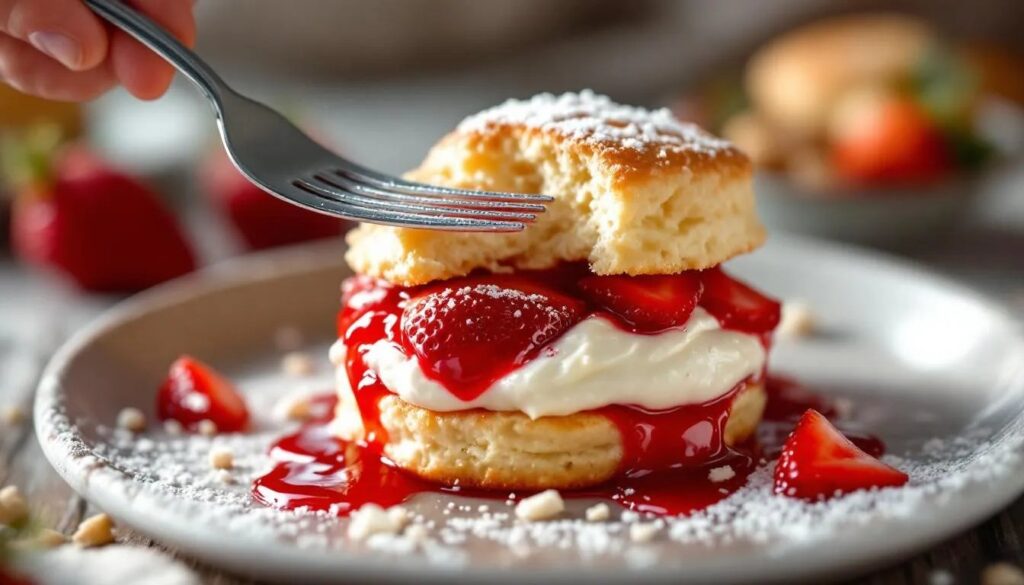
Split each biscuit horizontally with a serrated knife or simply pull it apart — the latter gives a more rustic, absorbent surface that drinks up more of the strawberry syrup. Set the bottom half on a plate, cut side up. Spoon a generous portion of macerated strawberries over it, making sure to include plenty of the pooled juice. Add a large dollop of whipped cream. Place the top half of the biscuit at a slight angle — not flat — so the layers are visible and the juice has somewhere to spill. Serve immediately: the assembly window is short and intentional.
My chef's tip
The one move that separates a forgettable strawberry shortcake from a memorable one is temperature contrast at assembly. The biscuits should be slightly warm — not hot, not cold — when they hit the plate. The strawberries should be room temperature, syrupy and fragrant. The whipped cream should be cold, straight from the refrigerator. That three-way contrast of warm, room-temperature, and cold is what makes each bite feel layered. In April and May, when strawberries are at their peak in the South, you can swap half the sugar in the maceration for a tablespoon of bourbon and a few fresh basil leaves. It sounds unusual; it works completely.
Drinks & pairings
The pairing challenge is the sweetness of ripe fruit against the richness of butter and cream. You need something with enough acidity to cut through, but nothing so tannic or structured that it overwhelms a delicate dessert.
A lightly sparkling Moscato d'Asti from Piedmont — low in alcohol, effervescent, with peach and apricot notes — is a near-perfect match: its natural sweetness mirrors the fruit without duplicating it exactly. A dry Crémant de Loire works as a more restrained alternative, its green apple crispness cleaning the palate between bites. For a non-alcoholic option, cold hibiscus iced tea with a squeeze of lemon echoes the berry notes and holds up surprisingly well against the cream.
About this dish
Strawberry shortcake has been an American fixture since at least the mid-19th century, when it appeared in cookbooks under various forms — some with biscuits, some with sponge cake, some with sweetened cornbread. The biscuit version has deeper roots in the South and the Midwest, where buttermilk baking was a daily practice and sweet yeast cakes were reserved for special occasions. Over time, particularly as packaged sponge cakes became widely available, the biscuit version faded from mainstream awareness. It never disappeared — it just became the version that older cooks made at home and younger cooks didn't recognize at the potluck table.
Nashville, like much of Tennessee, maintained a strong biscuit culture through generations of church suppers, diner counters, and family breakfasts. The drop biscuit specifically — as opposed to a rolled-and-cut biscuit — is considered the less refined sibling, quicker to make and easier to teach. What it gives up in uniform appearance, it returns in texture: wetter dough, more irregular crumb, a surface that behaves more like a sponge once the strawberry syrup hits it. Some versions across the region add a touch of black pepper to the dough, or brush the finished biscuit with brown butter. The recipe here stays close to the source.
Nutritional values (per serving, approximate values)
| Nutrient | Amount |
|---|---|
| Calories | ~420 kcal |
| Protein | ~6 g |
| Carbohydrates | ~48 g |
| of which sugars | ~18 g |
| Fat | ~23 g |
| Fiber | ~3 g |
Frequently asked questions
Can the biscuits be made ahead of time?
The biscuit dough can be scooped onto the baking sheet and refrigerated, unbaked, for up to 8 hours. Bake them directly from cold — you may need to add 1 to 2 minutes to the baking time. Already-baked biscuits can be stored in an airtight container at room temperature for up to 24 hours and warmed in a 300°F oven for 5 minutes before serving. Avoid refrigerating baked biscuits: the cold stales them quickly.
How should leftovers be stored?
Store each component separately. Macerated strawberries keep well covered in the refrigerator for up to 2 days — the syrup will continue to develop flavor. Whipped cream should be used the same day it is made; it can be re-whipped briefly if it has separated slightly. Assembled shortcakes don't keep: the biscuit absorbs the juice completely within an hour and loses its textural contrast.
What substitutions work well in this recipe?
If buttermilk is unavailable, combine ¾ cup whole milk with 2 teaspoons of white wine vinegar or lemon juice, stir, and let it sit for 5 minutes before using — it behaves identically in the dough. In summer, white peaches or nectarines can replace half the strawberries in the maceration with excellent results. For a dairy-free version, full-fat coconut milk (chilled overnight and the solid cream skimmed off) whips into a stable cream substitute, and plant-based butter works in the biscuit with minimal texture change.
Why use a drop biscuit rather than a rolled biscuit?
A rolled biscuit requires a more precise fat-to-flour ratio and a lightly floured surface to keep the dough from sticking — the handling itself risks developing gluten. The drop biscuit uses a slightly wetter dough that is mixed once and portioned directly, which means less chance of overworking. The resulting texture is more open and irregular, with a coarser crumb that absorbs the strawberry syrup from underneath while maintaining some structure on the surface. For this specific application, that absorbency is an advantage, not a flaw.
Can this be scaled up for a crowd?
The recipe doubles cleanly without any adjustments to ratios or technique. When baking a double batch, use two baking sheets positioned on the upper-middle and lower-middle racks, and rotate them halfway through baking to ensure even browning. The macerated strawberries scale particularly well and can be prepared up to a day ahead, making this a practical choice for a spring dinner party or Easter gathering.