

Late March in New York means the tail end of cold nights and the first urge to cook something low, slow, and deeply satisfying before spring fully takes over. Brisket sits at the center of that instinct — a cut that rewards patience, rewards technique, and, as it turns out, rewards a little unconventional thinking. A Brooklyn deli owner has been quietly doing something that sounds wrong on paper: braising brisket with cola. Not a splash. A generous pour, worked into a cooking liquid that slowly transforms over hours into something dark, lacquered, and borderline addictive.
This is not a gimmick. The carbonation dissipates within minutes of hitting a hot pan. What stays behind is the cola's backbone — caramel sweetness, faint spice, and just enough acidity to tenderize the meat and balance the richness of a well-marbled flat cut. The result is a brisket that pulls apart at the slightest nudge, with a braising liquid so deeply reduced it coats a spoon like gravy. Time to find a heavy pot and clear an afternoon.
| Preparation | 25 min |
| Cooking | 3 hrs 30 min |
| Rest | 20 min |
| Portions | 6–8 people |
| Difficulty | Medium |
| Cost | $$ |
| Season | Brisket flat, yellow onions, garlic — a late-winter-into-spring braise |
Suitable for: High in protein · Gluten-free (check cola label) · Dairy-free
Ingredients
For the brisket
- 1 flat-cut beef brisket, approximately 4–5 lbs (1.8–2.3 kg), fat cap trimmed to ¼ inch
- 2 tsp kosher salt
- 1 tsp freshly ground black pepper
- 1 tsp smoked paprika
- ½ tsp garlic powder
- 2 tbsp neutral oil (canola or vegetable)
For the braise
- 2 large yellow onions, halved and sliced thin
- 6 cloves garlic, smashed
- 2 tbsp tomato paste
- 1 cup (240 ml) beef broth, low-sodium
- 1 can (12 oz / 355 ml) cola — classic Coca-Cola preferred, not diet
- 2 tbsp Worcestershire sauce
- 1 tbsp apple cider vinegar
- 2 bay leaves
- 1 sprig fresh thyme
Equipment
- Large Dutch oven or heavy-bottomed oven-safe pot (at least 6 qt / 5.7 L)
- Tongs
- Sharp carving knife
- Cutting board
- Aluminum foil
- Fine-mesh strainer (optional, for finishing the sauce)
Preparation
1. Season and dry-rub the brisket
Remove the brisket from the refrigerator at least 45 minutes before cooking — bringing the meat closer to room temperature promotes even searing and prevents the exterior from overcooking before the center has time to warm. In a small bowl, combine the kosher salt, black pepper, smoked paprika, and garlic powder. Pat the brisket completely dry with paper towels — moisture is the enemy of a proper sear — then apply the rub on all sides, pressing firmly so the seasoning adheres to the surface rather than falling off in the pan. The meat should look uniformly coated, almost dusty.
2. Sear until deeply browned
Set the Dutch oven over high heat and add the oil. Wait until it begins to shimmer — the point at which the oil's surface ripples with heat but has not yet started to smoke. Lay the brisket fat-cap side down and do not move it. Searing works through the Maillard reaction, the chemical process by which amino acids and sugars on the meat's surface react at high temperature to form hundreds of flavor compounds. This requires sustained contact and time: 4 to 5 minutes per side, until each surface is deeply mahogany, almost approaching the color of dark chocolate. Sear the edges as well, holding the brisket upright with tongs for 1–2 minutes on each long edge. Remove to a plate.
3. Build the aromatic base
Lower the heat to medium. Add the sliced onions to the same pot, scraping up any browned bits with a wooden spoon — these are concentrated flavor that must not be discarded. Cook the onions, stirring occasionally, for 12 to 15 minutes until they are fully softened, golden, and beginning to caramelize at the edges. Add the smashed garlic and cook for 2 more minutes until fragrant. Push everything to the side and add the tomato paste directly to the center of the pot. Let it cook undisturbed for 1 to 2 minutes, until it deepens from bright red to a rusty brick color — this step blooms the paste, removing raw acidity and building a richer, more rounded flavor base.
4. Deglaze with cola and build the braising liquid
Preheat the oven to 325°F (160°C). Pour in the cola — expect a vigorous bubbling as the carbonation reacts to the hot surface. This is normal and brief. Stir to combine with the tomato paste and onions, then add the beef broth, Worcestershire sauce, apple cider vinegar, bay leaves, and thyme sprig. The liquid should come roughly halfway up the side of the brisket when returned to the pot; add a splash more broth if needed. Nestle the brisket back in, fat-cap side up. The fat will slowly render downward through the meat as it braises, self-basting from above.
5. Braise low and slow in the oven
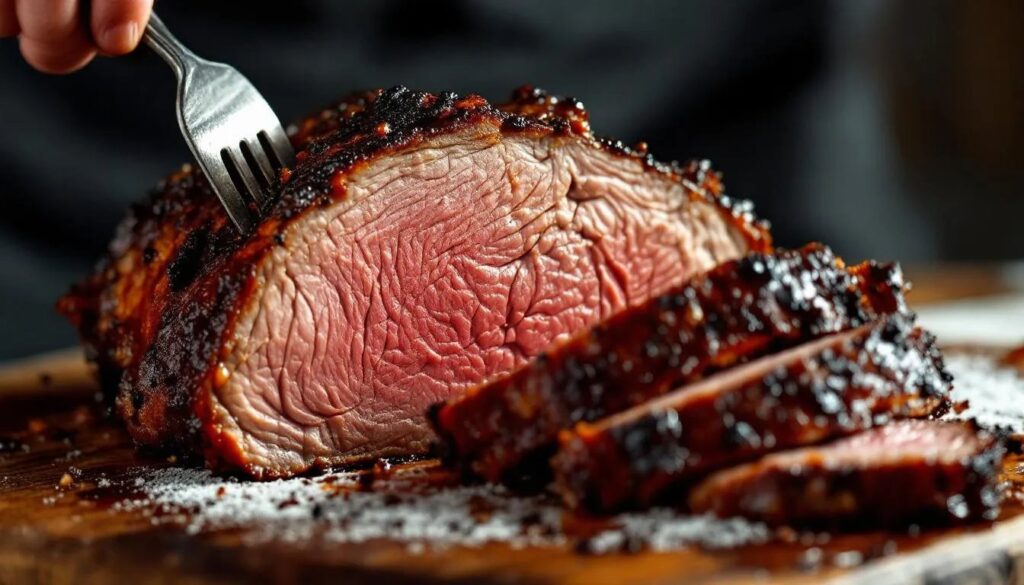
Cover the Dutch oven with its lid and transfer to the preheated oven. Braise for 3 hours to 3 hours 30 minutes, checking at the 2.5-hour mark. The brisket is done when a fork inserted into the thickest part meets almost no resistance and the meat begins to yield with gentle pressure. This stage should not be rushed: brisket contains a high proportion of collagen-rich connective tissue, and it is only around the 195–205°F (90–96°C) internal temperature range that this collagen fully converts to gelatin, giving the braising liquid its body and the meat its characteristic silkiness.
6. Rest, slice, and reduce the sauce
Remove the brisket from the pot and transfer to a cutting board. Tent loosely with aluminum foil and allow to rest for at least 20 minutes — resting allows the muscle fibers to relax and reabsorb juices that would otherwise flood the cutting board. Meanwhile, skim any visible fat from the surface of the braising liquid and place the pot back over medium-high heat. Reduce the liquid for 8 to 12 minutes, stirring occasionally, until it thickens enough to coat the back of a spoon. Remove bay leaves and thyme. Slice the brisket against the grain — perpendicular to the direction of the long muscle fibers — in slices roughly ¼ inch thick. Serve with the reduced braising sauce spooned generously over the top.
Chef's tip
This brisket is genuinely better the next day. Once cooled, the sliced meat can be returned to its braising liquid, refrigerated overnight, and reheated gently covered at 300°F (150°C) for 25 minutes. The flavors meld further, the sauce deepens, and the texture firms just enough to hold a clean slice. If you are cooking for a dinner party, make it the day before — you will have less stress and a more complex result. As spring markets begin to fill out, try adding a handful of quartered carrots and a parsnip to the braise for a slightly sweeter, more vegetable-forward version.
Wine and drink pairings
The braising liquid, built on caramelized onions, cola's dark sweetness, and beef fat, calls for a red wine with enough structure to stand up to the richness without amplifying its sweetness.
A Zinfandel from Sonoma County — with its characteristic notes of dried cherry, black pepper, and leather — locks naturally into the smoky, caramelized character of the brisket. A Malbec from Mendoza works equally well, offering plum depth and firm tannins that cut through the fat. For a non-alcoholic option, a sparkling water with a squeeze of lemon cleanses the palate effectively between bites without competing with the meat's complexity.
The story behind this technique
Cola-braised brisket has roots in mid-20th century American Jewish home cooking, particularly in communities where brisket served as the centerpiece of Passover and Shabbat tables. Home cooks — working without elaborate pantries — discovered that cola brought a reliable sweetness and tenderizing acidity that could replicate the complexity of a wine braise at a fraction of the cost. The technique spread quietly through delis and family recipes, passed without much formal documentation, surviving precisely because the results were too good to abandon.
Brooklyn's deli culture occupies a particular place in American food history: these are kitchens shaped by Ashkenazi tradition, by the economics of feeding working-class neighborhoods, and by a cook's instinct to use whatever works. Today, the technique sits comfortably between nostalgic comfort food and unexpected culinary logic — a reminder that some of the most effective cooking moves are the ones that look strange until you taste them. With Passover falling in spring 2026, the timing for this recipe could not be more natural.
Nutritional values (per serving, approximate values)
| Nutrient | Amount |
|---|---|
| Calories | ~520 kcal |
| Protein | ~48 g |
| Carbohydrates | ~14 g |
| of which sugars | ~11 g |
| Fat | ~28 g |
| Fiber | ~1 g |
Frequently asked questions
Does the cola make the brisket taste sweet or like soda?
No — and this is the key point. The carbonation evaporates almost immediately on contact with heat, and the sugar in the cola caramelizes and integrates into the braising liquid alongside the onions, Worcestershire, and beef broth. The finished brisket has a subtle depth with a dark, slightly sweet undertone, but it reads as umami-forward and savory rather than candy-like. Tasters who do not know the ingredient is there rarely guess it.
Can this brisket be made ahead of time?
It is strongly recommended. Brisket braised a day in advance and refrigerated in its cooking liquid improves noticeably: the fat solidifies on the surface for easy removal, the flavors concentrate, and the meat firms up enough to slice cleanly. Reheat covered in a 300°F (150°C) oven for 25 to 30 minutes, adding a splash of broth if the liquid has thickened too much during chilling.
What cut of brisket works best?
The flat cut (also called the "first cut") is preferred here — it is leaner, slices more evenly, and holds its shape better through a long braise. The point cut (or "second cut") is fattier and more marbled, which some cooks prefer for its richer texture; it works well in this recipe but will yield a less uniform slice. A full packer brisket — both cuts together — can also be used if cooking for a larger crowd, but will require a larger pot and an additional 30 to 45 minutes of braising time.
Can the cola be substituted?
Classic cola is preferred for its specific balance of caramel, phosphoric acid, and spice. Dr Pepper is a popular and effective alternative, adding a slightly more complex, cherry-adjacent sweetness. Root beer produces a subtler, more herbal note. Diet cola is not recommended — the artificial sweeteners do not caramelize the same way and can leave a slightly bitter aftertaste in the reduced sauce.
How should leftovers be stored?
Sliced brisket should be stored submerged in its braising liquid in an airtight container in the refrigerator for up to 4 days. This prevents the slices from drying out and allows the meat to continue absorbing flavor. For longer storage, the brisket freezes well in its liquid for up to 3 months; thaw overnight in the refrigerator before reheating gently.