



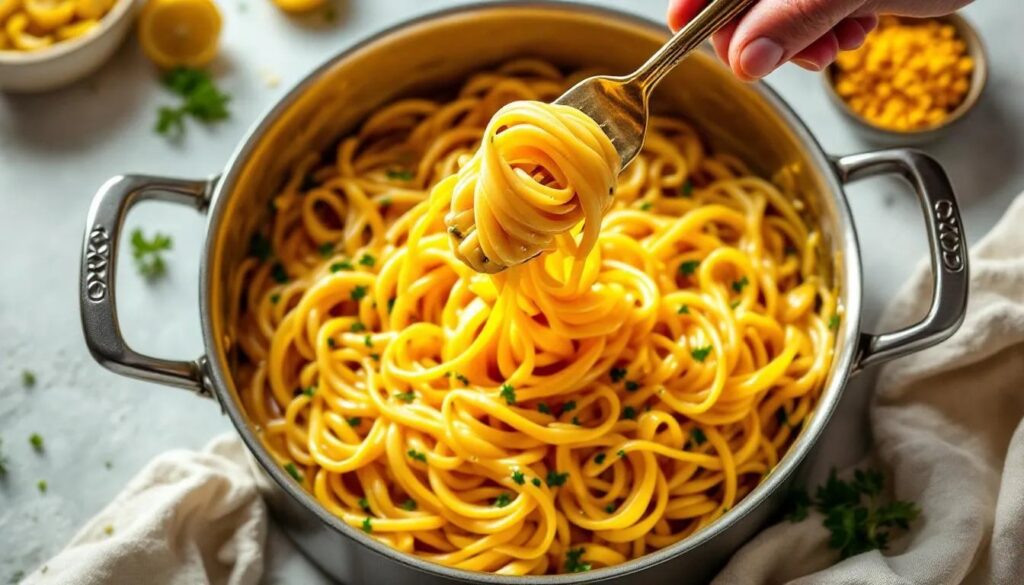
Late March sits right at the hinge of the year — the days are stretching, the markets are waking up, and after months of heavy, slow-cooked dinners, the body quietly starts asking for something brighter. This creamy lemon pasta answers that call without asking much in return: one pot, fifteen minutes, and a handful of ingredients most people already have on hand. The lemon does the heavy lifting here, cutting through the richness of the cream with just enough acidity to keep every forkful from feeling too indulgent.
What makes this version worth remembering is a technique borrowed from restaurant kitchens — cooking the pasta directly in the sauce, so the starch released from the noodles thickens everything naturally, without a single extra step. The result is a sauce that clings, coats, and holds together in a way that feels deliberate and precise. No colander, no draining, no timing two pans at once. Pull out a wide, deep skillet or a heavy-bottomed saucepan, and let's get started.
| Preparation | 5 min |
| Cooking | 15 min |
| Servings | 4 people |
| Difficulty | Easy |
| Cost | $ |
| Season | Unwaxed lemons, fresh parsley, spring garlic |
Suitable for: Vegetarian
Ingredients
- 12 oz linguine or spaghetti
- 3 cups vegetable or chicken broth, low-sodium
- 1 cup heavy cream
- 1 cup water
- 3 cloves garlic, thinly sliced
- 1 unwaxed lemon — zest and juice (approximately 3 tbsp juice)
- 1 oz Parmesan, finely grated, plus more to finish
- 2 tbsp unsalted butter
- 1 tsp fine sea salt, plus more to taste
- ½ tsp black pepper, freshly cracked
- Small handful of flat-leaf parsley, finely chopped
- 1 tsp olive oil
Equipment
- Wide, deep skillet or heavy-bottomed saucepan (at least 12 inches / 30 cm wide)
- Microplane or fine grater
- Wooden spoon or silicone spatula
- Tongs
- Citrus juicer or reamer
Preparation
1. Build the cooking liquid
Pour the broth, cream, and water into the skillet and set it over medium-high heat. Add the sliced garlic, the salt, the pepper, and the olive oil. Stir briefly to combine. You're not making a sauce yet — you're building a seasoned environment in which the pasta will cook and absorb flavor from the very first minute. The cream doesn't need to reduce at this stage; it simply needs to come up to a vigorous simmer. Watch for the moment small, active bubbles break continuously across the surface — that's your signal to move to the next step. This usually takes about 3 to 4 minutes over medium-high heat, depending on your stove.
2. Add the pasta and cook uncovered
Slide the dry pasta into the simmering liquid, fanning it out so the strands separate as much as possible before the liquid tightens around them. Using tongs, turn the pasta every 60 to 90 seconds — this prevents the noodles from sticking to the base of the pan and ensures even cooking throughout. As the pasta cooks, it will release starch directly into the cream and broth, and you'll see the liquid gradually transform from thin and brothy to something silkier and more cohesive. This is called amidonnage — the natural thickening of a cooking liquid through the starch released by starches such as pasta, rice, or gnocchi. Keep the heat at a steady medium to medium-high throughout; too low and the liquid won't reduce properly, too high and the cream may separate. The pasta should cook for approximately 10 to 12 minutes, reaching an al dente texture — firm at the center when bitten, never mushy, never chalky.
3. Finish with lemon and butter
Once the pasta is just shy of fully cooked and the sauce has tightened to a consistency that coats the back of a spoon, reduce the heat to low. Add the lemon zest first — it carries the aromatic oils from the peel and distributes a floral, bright fragrance through the sauce before the acidity of the juice arrives. Then add the lemon juice, the butter, and the grated Parmesan. Stir vigorously with the wooden spoon for about 30 seconds, moving the pasta through the sauce in broad, sweeping motions. The butter will mount into the sauce — emulsifying with the cream and starch to create a glossy, cohesive finish that holds together even as it cools slightly. Taste carefully: the salt level, the brightness of the lemon, the richness of the cream should all feel balanced, with no single element dominating. Adjust with a pinch of salt or a few extra drops of lemon juice if needed.
4. Plate and finish
Divide the pasta between warm bowls using tongs, lifting and twisting to create a slight mound at the center of each plate. Spoon any sauce remaining in the pan over the top. Finish with extra Parmesan grated directly over the bowl, a small pinch of freshly cracked black pepper, and the chopped flat-leaf parsley. The parsley isn't decoration — its clean, faintly peppery flavor adds a counterpoint to the richness of the sauce that makes the whole dish feel considered rather than hasty. Serve immediately; cream-based pasta sauces set quickly and taste best the moment they leave the pan.
Chef's tip
The single most common mistake with one-pot pasta is adding too much liquid too early, which leaves the sauce thin and watery by the time the pasta is cooked. Stick to the quantities given, and trust the process — the sauce will look almost too loose at the 8-minute mark, then tighten considerably in the final 3 minutes as the starch concentration increases. At this time of year, when unwaxed Meyer lemons are still available at specialty grocers alongside the first spring citrus, use them: they're less sharp than standard lemons, with a floral quality that suits a cream sauce beautifully. If you can find spring garlic — the young, mild bulbs that appear in farmers markets from late March onward — use it here in place of regular garlic. Slice it thinly and it will dissolve almost completely into the sauce, adding sweetness without sharpness.
Wine pairing
A cream and lemon sauce needs a white wine with enough body to stand up to the richness, but enough acidity to mirror the citrus. The pairing should feel like the wine was cooked into the dish.
A white Burgundy — a village-level Mâcon-Villages or a Chablis Premier Cru — brings the mineral tension and restrained fruit that works best here. Chablis in particular, with its characteristic flint and green apple notes, echoes the lemon without competing with it. A Vermentino di Sardegna is a more affordable option: citrus-forward, slightly saline, and fresh enough to cut cleanly through the cream. For a non-alcoholic alternative, a sparkling water with a squeeze of fresh lemon and a few drops of white grape juice served very cold achieves a similar contrast at the table.
About this dish
One-pot pasta first entered the mainstream conversation sometime around the early 2010s, when home cooks began experimenting with the idea that pasta didn't need to be boiled in a separate, generously salted pot of water to cook properly. The technique has older precedents — Italian pasta risottata, for instance, involves cooking pasta directly in broth using the same method as risotto, drawing out starch progressively to create a creamy, self-saucing result. That tradition, practiced in southern Italian households for generations, sits at the root of this kind of recipe.
The addition of lemon to cream-based pasta is not new either. Across the Amalfi Coast, where lemon cultivation is woven into the landscape and the economy, pasta al limone has long been a staple — sometimes made with just butter, lemon, and aged cheese, sometimes enriched with cream, sometimes with a thread of fresh basil. This recipe leans on that southern Italian template while embracing the one-pot logic as a practical concession to modern weeknight cooking. The result sits somewhere between tradition and efficiency: not an innovation, exactly, but a well-considered simplification.
Nutritional information (per serving, approximate values)
| Nutrient | Amount |
|---|---|
| Calories | ~620 kcal |
| Protein | ~16 g |
| Carbohydrates | ~72 g |
| of which sugars | ~4 g |
| Fat | ~29 g |
| Fibre | ~3 g |
Frequently asked questions
Can this be made ahead of time?
One-pot pasta is best eaten immediately after cooking, when the sauce is at its most fluid and glossy. If you need to prepare it in advance, cook the pasta 2 minutes short of done, then cool it quickly and refrigerate. When ready to serve, reheat gently in a skillet with a splash of broth or water over medium-low heat, stirring constantly until the sauce re-emulsifies and the pasta finishes cooking through. Add the lemon juice and butter only at this reheating stage, not before — both lose their impact if they sit in the sauce for too long.
How should leftovers be stored?
Transfer any leftovers into an airtight container and refrigerate within two hours of cooking. They will keep for up to 2 days. The sauce will thicken considerably once cold — this is normal. Reheat on the stovetop with 2 to 3 tablespoons of water or broth per portion, stirring over medium-low heat until the sauce loosens and the pasta is heated through. Avoid the microwave if possible; the cream tends to separate unevenly with that kind of direct, uneven heat.
What substitutions work well in this recipe?
Heavy cream can be replaced with full-fat coconut cream for a dairy-free version — it won't taste of coconut in the finished dish, but it will add a subtle sweetness that works well with the lemon. For a lighter result, a mixture of half-and-half and a tablespoon of cream cheese achieves a similar consistency with less fat. The Parmesan can be swapped for Pecorino Romano, which is sharper and saltier — use slightly less. In spring, adding a handful of blanched peas or a few spears of thinly sliced asparagus in the final minute of cooking turns this into a more complete one-pot meal without breaking the simplicity of the method.
Which pasta shapes work best for this method?
Long, thin shapes — linguine, spaghetti, tagliolini — work particularly well because they release starch evenly and tangle together in a way that holds the sauce. Avoid short, tubular shapes like penne or rigatoni for this specific technique: they take longer to cook, release starch unevenly, and the sauce tends to pool inside the tubes rather than coating the exterior. If you only have short pasta on hand, reduce the cooking liquid slightly and stir more frequently to compensate.
Can this recipe be made gluten-free?
Yes, with one important adjustment: gluten-free pasta releases less starch than standard wheat pasta, which means the sauce may not thicken as naturally during cooking. To compensate, reduce the total liquid by about ¼ cup at the start, and expect to cook the pasta for slightly less time — most gluten-free noodles overcook quickly. Check the texture from about the 8-minute mark onward. A teaspoon of cornstarch dissolved in a tablespoon of cold water, stirred in during the final minute, can help achieve the sauce consistency that the wheat starch would otherwise provide.