



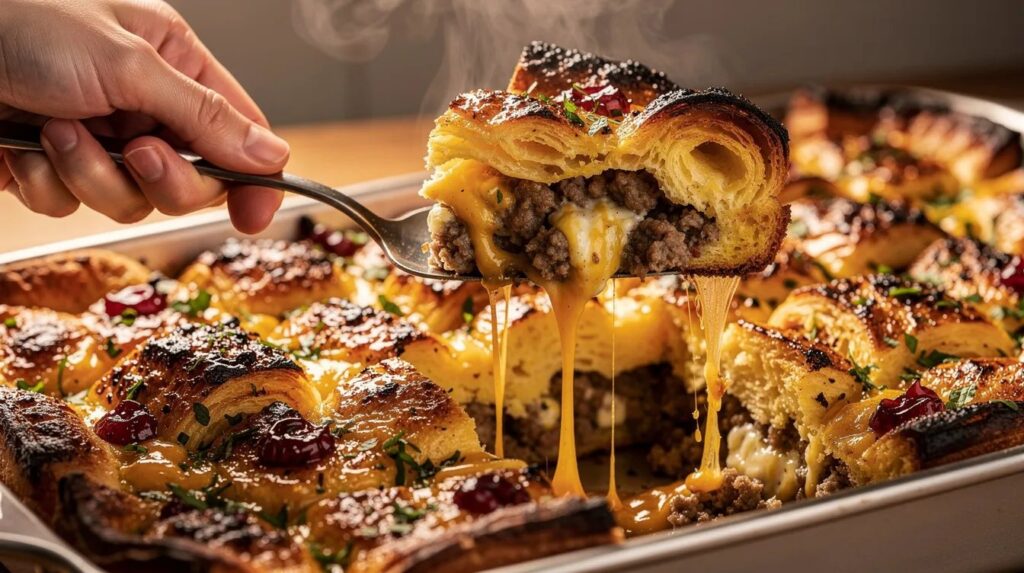
March mornings have a way of pulling you in two directions at once — the days are getting longer, the air carries the first hints of spring, and yet the alarm still goes off before sunrise. A breakfast that practically builds itself in the pan, feeds a crowd without fuss, and comes out of the oven golden and puffed: that's exactly where this casserole lands. Pillsbury Crescent Rolls, pressed flat into a baking dish, form a buttery, flaky base that absorbs every bit of egg custard, melted cheese, and savory sausage baked above it — no separate dough-making, no rolling pin, no flour dusting the counter at 7 a.m.
This recipe solves the eternal weekend problem of feeding a table of hungry people without standing over a stovetop scrambling eggs in batches while the coffee goes cold. Everything goes into one dish, slides into the oven, and emerges as a unified, sliceable breakfast that holds together cleanly on the plate. It is the kind of recipe worth memorizing — because once you make it, someone will ask for it every Easter Sunday, every holiday morning, and every time family stays the night.
| Prep Time | 15 min |
| Cook Time | 35 min |
| Portions | 8 servings |
| Difficulty | Easy |
| Cost | $$ |
| Season | Spring — early March; great for Easter brunch |
Suitable for: Nut-free · High-protein
Ingredients
For the crescent roll base
- 2 cans (8 oz each) Pillsbury Crescent Rolls (refrigerated, original variety)
For the filling
- 1 lb breakfast sausage, bulk (pork, mild or spicy — your preference)
- 8 large eggs
- ½ cup whole milk
- 1 cup shredded sharp cheddar cheese, divided
- ½ cup shredded Monterey Jack cheese
- ½ medium yellow onion, finely diced
- ½ medium green bell pepper, finely diced
- 1 tsp garlic powder
- ½ tsp black pepper, freshly ground
- ½ tsp kosher salt
- 1 tbsp unsalted butter or nonstick cooking spray (for the pan)
Equipment
- 9×13-inch baking dish (glass or ceramic)
- Large skillet (10–12 inch)
- Mixing bowl (large)
- Whisk
- Wooden spoon or spatula
- Knife and cutting board
- Measuring cups and spoons
- Aluminum foil
Preparation
1. Preheat the oven and prepare the baking dish
Set your oven to 375°F (190°C) and allow it to come to full temperature before the dish goes in — an oven that isn't fully preheated will cause the crescent dough to cook unevenly, leaving you with a pale, doughy bottom and an overcooked top. While the oven heats, grease a 9×13-inch baking dish generously with butter or nonstick spray, making sure to coat the sides and corners. This step protects the crescent dough from sticking and ensures the finished casserole releases in clean, firm slices rather than crumbling apart.
2. Press the crescent roll dough into the base
Open both cans of Pillsbury Crescent Rolls — the familiar soft pop of the pressurized tube is practically a kitchen sound of its own — and unroll all the dough onto a clean surface. The dough comes perforated into triangles; the goal is to pinch the seams together to form one unified sheet. Press and stretch the dough gently across the entire bottom of the prepared baking dish, working it into the corners with your fingertips. The layer should be roughly even, about ¼ inch thick, and should cover the full base without any gaps. This buttery sheet will parbake — partially cook — under the filling, absorbing the egg custard from above while maintaining enough structure to form a cohesive crust beneath. Do not pre-bake it alone; it bakes simultaneously with the filling and that is intentional.
3. Cook the sausage and vegetables
Place a large skillet over medium-high heat and add the bulk breakfast sausage, breaking it apart immediately with a wooden spoon into small, rough crumbles — pieces no larger than a marble will distribute evenly through the finished casserole. Cook for 6 to 8 minutes, stirring occasionally, until the sausage is fully browned and cooked through with no pink remaining. Listen for the sizzle to quiet slightly as the fat renders out — that shift in sound signals that the browning phase is well underway. Transfer the cooked sausage to a plate lined with paper towels, leaving behind about 1 tablespoon of the rendered fat in the pan. Return the pan to medium heat and add the diced onion and bell pepper. Cook for 3 to 4 minutes, stirring frequently, until the onion turns translucent — soft and glossy without any browning — and the bell pepper softens slightly. Season with a pinch of salt. Remove from heat and set aside.
4. Whisk the egg custard
In a large mixing bowl, crack all 8 eggs and add the milk, garlic powder, black pepper, and kosher salt. Whisk vigorously for 60 to 90 seconds until the mixture is completely uniform — no visible streaks of white, no unincorporated yolk. The goal is a homogeneous custard that will set evenly across the entire casserole. Adding milk rather than cream keeps the texture tender without making the eggs dense or rubbery; the proteins in whole milk contribute just enough richness to balance the sausage fat and cheese. Stir in ¾ cup of the shredded cheddar and all of the Monterey Jack into the egg mixture — this cheese melts into the custard during baking and distributes the flavor throughout rather than concentrating it only on top.
5. Layer and assemble
Scatter the cooked sausage evenly over the crescent dough base, followed by the softened onion and bell pepper. Spread everything in a single, relatively level layer — uneven mounding creates hot spots where the egg sets faster and can crack. Pour the egg and cheese mixture slowly and evenly over the top, allowing it to settle into all the gaps and surround the sausage. The liquid should come close to — but not over — the edges of the dough. Scatter the remaining ¼ cup of shredded cheddar across the surface for a golden, lightly browned top crust.
6. Bake to a golden, set finish
Slide the assembled dish into the center rack of the preheated oven. Bake for 30 to 35 minutes, until the egg is fully set across the entire surface — not just the edges. To test doneness, insert a thin knife or skewer into the center of the casserole: it should come out clean, with no wet egg clinging to it. The top should be deep golden, the cheese bubbled and lightly browned at the edges, and the crescent base should have puffed and cooked through. If the top browns before the center is set, tent loosely with aluminum foil and continue baking for 5-minute increments. Pull from the oven and allow to rest for at least 5 minutes before cutting — resting lets the custard firm completely and makes slicing significantly cleaner.
My chef's tip
The single move that most people skip — and shouldn't — is pressing the crescent roll seams completely shut before adding any filling. If the perforated lines remain open, the egg custard seeps through the dough during baking and the base never fully sets. Spend an extra thirty seconds running your fingertips firmly along every seam. For spring brunches, swap the green bell pepper for finely diced asparagus spears — March is peak asparagus season across much of the United States, and the slightly grassy, vegetal note cuts through the richness of the sausage beautifully. Add them raw directly to the assembly step; they'll cook through in the oven without turning soft.
Pairing suggestions
A casserole this hearty, salty, and rich calls for something bright and slightly acidic alongside it — flavors that cut through the fat rather than echo it.
A well-chilled dry sparkling wine — a domestic brut from California or a Spanish Cava — works well for a celebratory Easter morning table: the effervescence and citrus acidity reset the palate between bites. For a non-alcoholic alternative, a glass of fresh-squeezed grapefruit juice or a lightly sweetened iced green tea achieves the same effect. A strong black coffee — medium or dark roast — is the most natural companion of all, its slight bitterness a straightforward counterweight to the buttery dough.
Background on this dish
The American breakfast casserole as a category traces its roots to church potluck culture — the need to bring something substantial, transportable, and able to feed twenty people without arriving cold. Egg-and-sausage bakes have appeared on Midwestern holiday tables since at least the 1970s, typically built on bread or hash browns as a base. The pivot to Pillsbury Crescent Rolls came later, driven by the convenience of refrigerated dough that had become a pantry staple across the country by the 1980s and 1990s.
What made Crescent Rolls stick as a casserole base — rather than staying in their original role as a side-dish bread — is structural: the laminated, butter-layered dough holds its shape under a wet egg filling in a way that regular sandwich bread cannot. The result sits closer to a savory galette than a traditional strata. Today, variations circulate widely, built around everything from cream cheese and ham to sun-dried tomatoes and feta, but the sausage-and-cheddar combination remains the version that shows up at the most breakfast tables — and disappears the fastest.
Nutrition facts (per serving, approximate values)
| Nutrient | Amount |
|---|---|
| Calories | ~420 kcal |
| Protein | ~22 g |
| Carbohydrates | ~24 g |
| of which sugars | ~5 g |
| Fat | ~27 g |
| Fiber | ~1 g |
Frequently asked questions
Can this casserole be assembled the night before?
Yes — and it actually bakes slightly better when assembled ahead. Press the crescent dough into the greased dish, add the cooked sausage and vegetables, then pour the egg mixture over the top. Cover tightly with plastic wrap and refrigerate overnight, up to 12 hours. The next morning, remove the dish from the refrigerator 20 minutes before baking to take the chill off, then bake as directed. Expect to add 3 to 5 minutes to the bake time since the filling will be cold.
How should leftovers be stored and reheated?
Allow the casserole to cool completely, then cover the dish tightly with plastic wrap or foil and refrigerate for up to 4 days. Individual slices can also be wrapped and frozen for up to 2 months. To reheat, place a slice on a microwave-safe plate and heat on medium power for 60 to 90 seconds — full power tends to make the egg rubbery. For a crispier result, reheat in a 350°F oven for 10 to 12 minutes or in an air fryer at 325°F for 5 to 6 minutes.
What substitutions work well in this recipe?
The sausage can be swapped for cooked and crumbled bacon, diced Canadian bacon, or a plant-based breakfast sausage for a meat-free version. Sharp cheddar can be replaced with Gruyère, pepper Jack, or smoked gouda depending on the flavor profile you're after. For a lower-fat option, substitute turkey breakfast sausage and use 2% milk in place of whole. In spring, diced asparagus, spinach, or fresh chives make excellent vegetable additions that reflect what's best at market right now.
Can I use homemade dough instead of Pillsbury Crescent Rolls?
Homemade dough works, but the recipe is specifically calibrated around the thickness, fat content, and baking behavior of the refrigerated Pillsbury product. If substituting homemade dough, use a buttery, enriched dough rolled to approximately ¼ inch — similar to a rough puff or a simple butter pastry. Avoid lean doughs like pizza dough, which will bake up chewy and dense rather than light and flaky beneath the filling.
My casserole came out watery in the center — what went wrong?
Excess moisture is almost always traced to one of two sources: vegetables that weren't cooked before adding them (raw onions and peppers release significant water during baking), or an oven that ran below temperature. Make sure all vegetables are pre-cooked and excess moisture is released in the skillet before layering. An oven thermometer is the most reliable way to confirm your oven's true temperature — many home ovens run 15 to 25°F lower than the dial indicates, which significantly extends the time needed to set the egg custard fully.