

Walk through any grocery store or farmers market this week, and you will notice something unusual on the asparagus display: the price tags have quietly come down. Bundles that cost upward of $4.99 just a month ago are now sitting closer to $2.49 in many parts of the country, and some supermarkets are running two-for-one promotions that feel almost too good to be true. This is not a glitch in the system. It is late March, and asparagus season is opening at full speed across the major growing regions of North America and Europe, flooding the market with fresh supply just as temperatures begin to rise.
Understanding why prices move the way they do with asparagus helps you shop smarter, cook better, and make the most of a window that closes faster than most people expect. Within weeks, the price will creep back up as domestic harvests slow and the market shifts back toward imports. Right now, however, is the moment to stock up, experiment, and eat asparagus every single night if you feel like it.
Why asparagus prices fall in late march
Asparagus is one of the few vegetables that behaves like a financial instrument. Its price is almost entirely governed by a narrow harvest calendar. The spears emerge from the ground only once a year per crown, pushed up by warming soil temperatures after a dormant winter. When multiple growing regions hit their peak simultaneously — which happens every year in the last ten days of March and the first three weeks of April — supply spikes sharply while demand adjusts more slowly. The result is a predictable, annual price drop that buyers who pay attention can plan around.
In the United States, the primary growing regions in California's Central Valley and parts of Washington State are currently at or near peak output. Imported Peruvian asparagus, which dominates shelves from November through February, starts losing its competitive price advantage once domestic volumes climb. Retailers respond by discounting to move inventory quickly, since asparagus has a short shelf life and any unsold bundle that sits for three days becomes unmarketable. That pressure to clear stock benefits the shopper directly.
In the United Kingdom and much of Western Europe, British and Spanish asparagus are not yet in full swing — British asparagus season typically opens around late April — but Spanish and French production is ramping up, and wholesale prices are already easing noticeably compared to February. Markets in Paris, London, and Amsterdam are beginning to see the first white asparagus from the Rhine Valley and Alsace, which signals the true start of the European asparagus calendar.
Green, white, or purple: what to buy this week
Three distinct types are worth knowing before you reach for the first bundle you see.
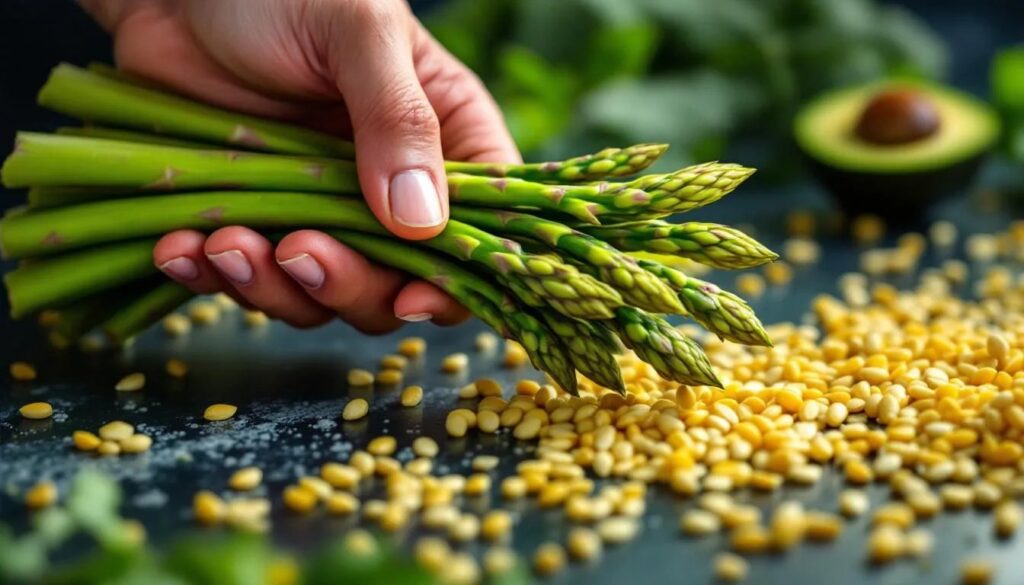
Green asparagus is the most widely available right now and the most versatile in the kitchen. Look for spears with tightly closed, compact tips — they should feel almost like a small flower bud, slightly moist but not slimy. The cut end at the base should appear fresh, not chalky or dried out. Thickness is a matter of preference: thin spears cook faster and work beautifully in salads or quick sautés, while thicker spears hold up better to roasting and grilling.
White asparagus is the seasonal luxury of the moment in Europe, grown underground or under black plastic sheeting to prevent chlorophyll from developing. It tastes earthier, slightly bitter, and more delicate than green. Peeling is not optional — the outer layer is genuinely tough and fibrous, unlike green asparagus where peeling is mostly cosmetic. If you find white asparagus at your market this week, the price will likely be higher than green, but you are paying for a product that is only available for about six weeks per year.
Purple asparagus is the rarest of the three. It contains higher levels of anthocyanins, which give it a visually striking color that fades significantly during cooking. The flavor is somewhat sweeter and less grassy than green. Eat it raw in thin slices over a salad or shave it over burrata to keep the color and the crunch.
How to store asparagus so it actually stays fresh
Asparagus begins losing moisture and sweetness from the moment it is cut. The single most effective storage method is to treat it like cut flowers: trim the base by about half an inch, stand the bundle upright in a glass or jar with an inch of cold water, and keep it in the refrigerator. Loosely drape a plastic bag over the tips. Stored this way, asparagus will stay crisp and flavorful for four to five days. Laying it flat in a crisper drawer, the default approach for most people, accelerates wilting and flavor loss within two days.
If you want to freeze a surplus, blanch the spears for two minutes in boiling salted water, transfer immediately to ice water, drain thoroughly, and freeze in a single layer before transferring to bags. Frozen asparagus loses its snappy texture but works perfectly in soups, frittatas, and pasta dishes.
What to cook with asparagus this week
The best cooking decisions right now lean into the season rather than fight it. Asparagus at peak freshness needs very little intervention. A dry skillet over high heat with a light coating of olive oil and a generous pinch of flaky salt produces spears that are charred at the tips, tender through the center, and intensely flavored in about six to eight minutes. No blanching. No steaming. The direct heat concentrates the sugars and creates a slight bitterness at the edges that tastes nothing like overcooked cafeteria asparagus.
Pairing asparagus with eggs is one of the most intuitive seasonal combinations. A soft-boiled egg alongside grilled spears and a mustard vinaigrette is a complete meal that takes under fifteen minutes. Alternatively, fold lightly cooked asparagus cut into one-inch pieces into a frittata with fresh goat cheese and lemon zest — the combination of grassy spear, tangy cheese, and bright citrus is a reliable weekly staple through April.
For a more composed plate, asparagus works exceptionally well in a warm salad with shaved Parmesan, a soft-cooked egg, and anchovy dressing. The salt of the anchovy amplifies the vegetable's natural umami without overpowering it. Add toasted hazelnuts for texture and the dish moves from side to centerpiece.
If you are looking at white asparagus, the classic preparation remains relevant for a reason: poach the peeled spears gently in salted water with a small piece of butter and a pinch of sugar for eight to twelve minutes depending on thickness, then serve with hollandaise or a simple brown butter with capers. The restraint of the preparation lets the flavor of the vegetable speak clearly.
The price window and what comes next
The current drop in asparagus prices is real but temporary. By mid-April, domestic harvests in California typically begin tapering as temperatures climb too high for ideal growing conditions, and the market shifts toward mid-Atlantic states and Michigan, where volumes are smaller. By May, retail prices in many markets return to or exceed pre-season levels. In Europe, the British season will peak in late April and early May, keeping prices lower in the UK through that period before they rise again in June.
Shopping asparagus now, in volume, and cooking it through the week is one of the more reliable seasonal advantages available to any home cook. The price signal is clear. The quality is at its annual peak. The recipes are straightforward. There is no better week to eat asparagus than the one you are in right now.
A quick guide to what to look for at the market
| Type | Peak availability | Best use | Price level (late March) |
|---|---|---|---|
| Green asparagus | Now — mid-April | Grilling, roasting, pasta, salads | Low ($2–$3/lb) |
| White asparagus | Now — mid-May (Europe) | Poaching, hollandaise, warm salads | Medium-high ($5–$8/lb) |
| Purple asparagus | Limited, now | Raw, shaved, quick sauté | Medium ($4–$6/lb) |
Nutritional profile: why asparagus earns its reputation
| Nutrient | Per 100 g (raw) |
|---|---|
| Calories | ~20 kcal |
| Protein | ~2.2 g |
| Carbohydrates | ~3.9 g |
| Fiber | ~2.1 g |
| Folate (B9) | ~52 µg (~13% DV) |
| Vitamin K | ~41 µg (~34% DV) |
| Vitamin C | ~5.6 mg |
All values are approximate. Asparagus is notably high in folate, relevant for pregnancy and cell repair, and in inulin, a prebiotic fiber that supports gut microbiome diversity. It is also one of the few dietary sources of asparagine, an amino acid that plays a role in the nervous system. The vegetable is naturally very low in calories and sodium, making it compatible with virtually any dietary pattern.
Questions about asparagus this season
How long will asparagus prices stay low?
In most U.S. markets, the current pricing window typically holds through mid-to-late April, after which domestic California harvests taper and prices begin recovering. In the UK and northern Europe, the low-price window generally runs from late April through late May as British and French asparagus peak. Shopping in volume now and blanching and freezing a portion is a practical way to extend the value.
Do you need to peel green asparagus?
For green asparagus, peeling is generally unnecessary and often counterproductive — it removes the thin outer layer where much of the flavor sits. The exception is very thick green spears where the lower third of the stalk can be fibrous; a light peel on the bottom two inches of those spears improves texture. White asparagus, by contrast, must always be peeled, as its outer layer is genuinely tough and slightly bitter even after cooking.
Why does asparagus affect the smell of urine?
Asparagus contains asparagusic acid, a sulfur-containing compound that the body metabolizes into volatile sulfur compounds — primarily methanethiol and dimethyl sulfide — which are excreted through urine. The process happens quickly, often within 15 to 30 minutes of eating. Interestingly, not everyone can detect the odor: the ability to smell it is genetically determined, linked to specific variants in olfactory receptor genes. There is no nutritional concern associated with this effect.
Can people on blood thinners eat asparagus freely?
Asparagus is relatively high in Vitamin K, which plays a role in blood clotting. People taking warfarin or other vitamin K-dependent anticoagulants are typically advised to keep their vitamin K intake consistent rather than eliminating foods high in it. A moderate, regular serving of asparagus — rather than a sudden large increase — is generally manageable, but anyone on anticoagulant therapy should confirm portion guidance with their healthcare provider.
What is the best way to cook asparagus without losing nutrients?
High-heat, short-duration cooking methods — roasting, grilling, or quick sautéing — preserve the most nutrients while improving flavor through caramelization. Boiling asparagus in large amounts of water causes significant leaching of water-soluble vitamins, particularly folate and vitamin C. If you prefer a softer texture, steaming for three to four minutes is a better alternative to boiling. Eating asparagus raw, thinly shaved, retains the full nutritional profile and works well in salads when the spears are young and tender.