


Walk into any kitchen in the South Carolina Lowcountry on a slow Sunday afternoon, and the smell hits you before you even open the door — braised greens, pork fat, and something sharp, almost bright, cutting through the richness like a knife through butter. That sharp note is vinegar, and it has been finishing pots of collard greens across the American South for generations. It is not an accident, not a shortcut, and not a matter of personal taste alone. It is technique, rooted in flavor science and culinary tradition in equal measure.
Three Charleston chefs — each with a different relationship to Lowcountry cooking — sat down to explain exactly why that splash of vinegar belongs in the pot, when to add it, which kind to reach for, and what it is actually doing to the greens on a chemical and sensory level. What follows is part recipe, part food science, part family history. Apron on.
| Preparation | 20 min |
| Cook time | 1 hr 30 min |
| Servings | 6 people |
| Difficulty | Easy |
| Cost | $ |
| Season | Collard greens, smoked ham hock, apple cider vinegar |
Suitable for: Dairy-free · Gluten-free
Why vinegar? The short answer from the chefs
Collard greens are Brassica oleracea, the same species as kale and cabbage, and they carry a characteristic bitterness that comes from glucosinolates — sulfur-containing compounds that break down during cooking into pungent, sometimes harsh flavors. Long braising in salted water or stock softens the leaves and mellows much of that bitterness, but it does not eliminate it entirely. That is precisely where vinegar steps in.
One Charleston chef who grew up eating her grandmother's greens every Sunday says, "Acid is a flavor corrector. It doesn't sour the dish. It wakes it up. You had an hour and a half of richness from the pork — the vinegar resets your palate." Acidity interacts directly with the bitter compounds remaining in the leaves, suppressing their perception on the tongue through a mechanism food scientists describe as taste modulation: sour and bitter signals compete for the same neural pathways, and sour typically wins.
A second chef, who trained in classical French kitchens before returning to his Lowcountry roots, frames it differently but arrives at the same conclusion. "Every braise needs a finish that lifts it. With beef, you might add a splash of wine. With greens, your grandmother used the vinegar she always had on the shelf — apple cider vinegar, most likely — and it performed the same function. It is deglazing the dish, in a sense, even after the pot is off the heat."
The third chef, who runs one of Charleston's most celebrated soul food counters, puts it most plainly: "Without acid, collard greens taste flat and heavy, no matter how good your pot likker is. With it, they taste finished."
The science behind the splash
Acetic acid — the active compound in all vinegars — does three things when added to a pot of braised greens. First, it suppresses bitterness perception, as described above. Second, it heightens salivation, which primes the palate to taste the underlying flavors of the greens themselves: their slight sweetness, their vegetal depth, their meaty backdrop from the pork. Third, and perhaps most visually obvious, it brightens the color of the greens. Long cooking turns collards a deep, almost army-green color. A splash of acid at the end shifts that hue toward a slightly more vivid green, making the finished dish look as alive as it tastes.
There is also a textural consideration. Acid added during cooking would toughen the cell walls of the greens, slowing the breakdown of pectin and leaving them firmer than desired. This is why every one of the three chefs agrees on the same rule: add the vinegar only at the very end of cooking, never at the start. The greens should already be fully tender — collapsing gently when pressed with a spoon — before the vinegar goes in.
Which vinegar, and how much
The short answer is apple cider vinegar, always unfiltered if you can find it. Its acidity (~5% acetic acid) is well-balanced by residual natural sugars from the fermented apple juice, which means it adds brightness without harshness. It also carries a faint fruitiness that complements rather than clashes with the pork and the earthiness of the greens.
That said, the three chefs diverge interestingly here. One swears by cane vinegar, a less common style produced from fermented sugarcane juice, with a slightly milder, rounder acidity that she describes as "more Southern, more ancestral." Another reaches for hot pepper vinegar — a traditional Lowcountry condiment of small hot peppers steeped in white vinegar — which adds both acid and a slow, building heat. The third, the classically trained one, sometimes finishes with a small amount of sherry vinegar when cooking for restaurant service, noting that its oxidative depth pairs well with the smokiness of the ham hock.
White distilled vinegar works and was historically common, but its flavor is sharper and more one-dimensional. Use it if it is what you have; don't reach for it first if you have alternatives.
As for quantity: 1 to 2 tablespoons for a pot serving 6 is the standard starting point. Add 1 tablespoon, stir, taste, wait 30 seconds, then decide whether the pot needs more. The vinegar should be perceptible as brightness, not as sourness.
Ingredients
- 2 lbs fresh collard greens, stems removed, leaves stacked and sliced into wide ribbons
- 1 smoked ham hock (about 1 lb), or 4 oz smoked bacon cut into lardons
- 1 medium yellow onion, sliced thin
- 4 cloves garlic, smashed
- 4 cups chicken stock or water
- 1 tsp red pepper flakes
- 1 tsp kosher salt, plus more to taste
- ½ tsp freshly ground black pepper
- 1–2 tbsp apple cider vinegar (unfiltered preferred), added at the very end
- 1 tsp granulated sugar (optional, balances the acid if the greens are particularly bitter)
Ustensils
- Large, heavy-bottomed pot or Dutch oven (at least 6-quart capacity)
- Sharp chef's knife and cutting board
- Wooden spoon or silicone spatula
- Ladle
- Tongs
Preparation
1. Render the fat and build the base
Place the Dutch oven over medium heat. If using bacon lardons, add them directly to the dry pot and render them slowly for about 6 to 8 minutes, until the fat is liquid and the pieces are lightly golden but not crisp — you want the fat, not the crunch. If using a ham hock, add 1 tablespoon of neutral oil first. Once the fat is rendered or the oil is shimmering, add the sliced onion and cook, stirring occasionally, for about 10 minutes. The onion should sweat rather than brown: soft, translucent, and beginning to smell sweet. Add the smashed garlic and red pepper flakes and stir for another 90 seconds, just until the garlic is fragrant. This foundation — fat, allium, spice — carries the depth through the entire long braise.
2. Add the greens gradually
Collard greens have significant volume when raw. Add them to the pot in three or four batches, using tongs to fold each addition into the hot fat and aromatics. Each batch will begin to wilt within 1 to 2 minutes, creating space for the next. Don't rush this step. Taking the time to coat each leaf in the rendered fat before adding liquid means the finished greens will carry a deeper, more integrated flavor rather than simply tasting boiled. Once all the greens are in the pot and have collapsed enough to fit, season with the salt and black pepper.
3. Braise low and slow
Add the ham hock (if using) and pour in the stock or water. The liquid should come about halfway up the greens — not submerging them entirely, as they will continue to release their own moisture. Bring the pot to a gentle boil over medium-high heat, then reduce to a low simmer. Cover with the lid slightly ajar. Cook for 1 hour to 1 hour 30 minutes, checking every 20 minutes and pressing the greens down gently. They are done when the leaves are completely yielding, a deep olive-green, and the pot likker — the precious cooking liquid — has reduced to a rich, glossy, lightly smoky broth. If the pot runs dry before the greens are tender, add water ½ cup at a time.
4. Finish with vinegar
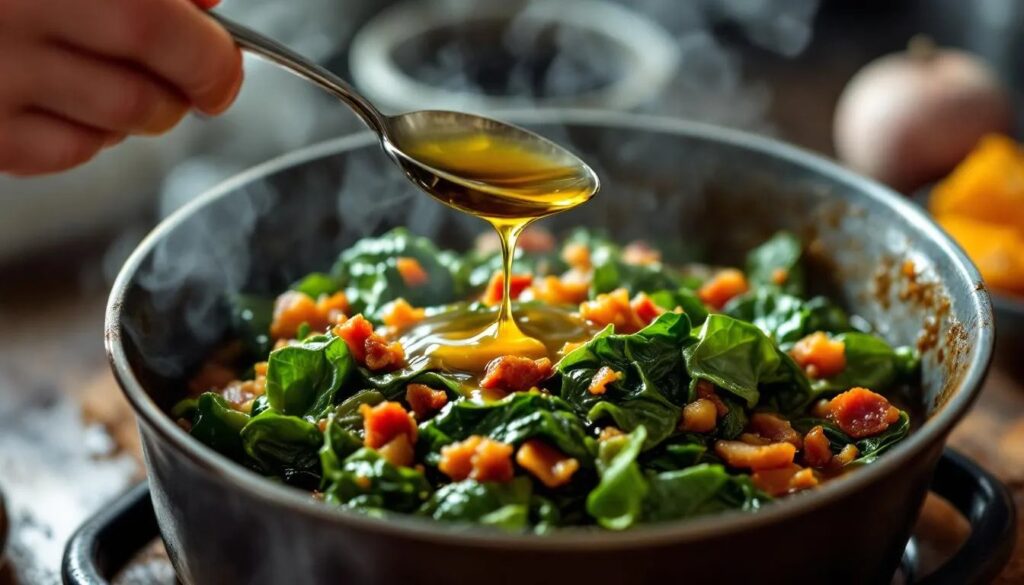
Remove the ham hock. Pull any meat off the bone, shred it coarsely, and return it to the pot. Taste the greens. Note the bitterness and the richness before you add the acid. Now add 1 tablespoon of apple cider vinegar, stir well, and taste again after 30 seconds. The change will be immediate and unmistakable: the flatness lifts, the bitterness recedes, and the individual flavors of pork, greens, and seasoning come into focus. Add the second tablespoon if the pot still feels heavy. Add the optional teaspoon of sugar if the acidity feels sharp rather than bright. Adjust salt. Serve directly from the pot with a ladle of pot likker spooned over the top.
Chef's note
The pot likker — the dark, smoky, slightly acidified broth left in the bottom of the pot — is arguably more valuable than the greens themselves. Don't discard it. Serve it alongside the greens in a small cup for drinking, use it to cook dried beans, or freeze it in portions to add depth to any winter braise. As March gives way to the warmer months, younger, more tender collard greens come to market and need only about 45 minutes of braising time. The vinegar rule stays the same regardless of the season: always last, always tasted, never measured by eye.
Food pairings
Collard greens braised with ham hock are a deeply savory, smoky, slightly acidic dish. They need accompaniments that are starchy enough to absorb the pot likker and mild enough to let the greens remain the center of attention.
The classic pairing is hot water cornbread or skillet-baked cornbread — the corn's natural sweetness counterbalances the bitterness of the greens beautifully. For a drink, a cold glass of sweet tea works along the same logic: slight sweetness, slight tannin, temperature contrast. If you prefer something with more complexity, a lightly chilled Beaujolais-Villages — fruity, low-tannin, with a natural acidity that mirrors the vinegar finish — handles the smokiness of the pork without overwhelming it. A dry hard cider made from unfiltered apples echoes the apple cider vinegar and makes a natural non-alcoholic adjacent option.
History and context
Collard greens have been cultivated in the American South since at least the 17th century, arriving via both European colonists — who brought seeds from the same Brassica family long eaten in Portugal and West Africa — and through enslaved Africans who recognized in the plant something close to the leafy greens central to West African cooking. On plantations, enslaved cooks were given the cuts of pork that white households did not prize: trotters, ears, hocks, neck bones. The long braise was born of necessity — these cuts require time and liquid to become palatable — and the technique of finishing with vinegar almost certainly has roots in West African culinary tradition, where fermented and acidic condiments were used to season and balance cooked greens.
By the 19th century, collard greens braised with smoked pork had become deeply embedded in Lowcountry and Appalachian food culture alike. The dish crossed racial lines in the kitchen even when nearly everything else did not. Today, Charleston chefs — trained in the city's recent culinary renaissance — speak about collard greens with a seriousness previously reserved for stocks and sauces. The vinegar finish, once a grandmother's instinct, is now a subject of genuine culinary inquiry.
Nutritional information (per serving, approximate values)
| Nutrient | Amount |
|---|---|
| Calories | ~210 kcal |
| Protein | ~18 g |
| Carbohydrates | ~11 g |
| of which sugars | ~3 g |
| Fat | ~10 g |
| Fiber | ~5 g |
| Vitamin K | ~600 µg (~500% DV) |
| Vitamin C | ~35 mg (~40% DV) |
Frequently asked questions
Can you prepare collard greens ahead of time?
Collard greens are one of the few dishes that genuinely improve with time. The flavors deepen as the greens sit in the pot likker overnight. Cook them the day before, refrigerate the entire pot, and reheat gently over low heat. Add a small splash of fresh vinegar just before serving to re-brighten the finish, since acid perception fades slightly with prolonged storage.
How should leftover collard greens be stored?
Store greens and pot likker together in an airtight container in the refrigerator for up to 4 days. They can also be frozen for up to 3 months — the texture softens further after freezing, but the flavor holds well. Freeze in portions with enough pot likker to cover, and thaw overnight in the refrigerator before reheating.
What can be substituted for the ham hock?
Smoked turkey wings or smoked turkey necks are the most common substitute and produce a braise that is nearly identical in depth. For a fully plant-based version, use 2 tablespoons of smoked paprika, a strip of kombu added to the cooking liquid, and a small piece of dried chipotle pepper — together they approximate the smokiness and umami that the pork provides. The vinegar finish remains equally important in the meatless version, perhaps even more so.
Which type of vinegar is best if apple cider vinegar is unavailable?
Cane vinegar is the closest in flavor profile and is worth seeking out in specialty Southern or Filipino grocery stores, where it is often sold under the name sukang maasim. White wine vinegar works well as a neutral, clean alternative. Avoid balsamic vinegar — its sweetness and thickness throw the balance of the dish in an entirely different direction.
Why are my collard greens still bitter after a long cook?
Several factors can cause persistent bitterness: greens harvested before the first frost of the season tend to be more bitter, since cold weather converts some of their starches to sugars; older, very large leaves have a higher concentration of glucosinolates than younger ones; and insufficient salt in the cooking liquid can prevent proper flavor development. The vinegar finish will address residual bitterness significantly, and the optional teaspoon of sugar acts as a secondary corrector if needed.