
Out on the open range, weather doesn't negotiate. A Wyoming ranch cook who has spent decades feeding crews through blizzards that drop wind chills to -30°F and high desert summers that push past 117°F in the shade has learned one thing above all else: fire, fat, and timing are the only tools that matter when the thermometer becomes the enemy. Spring 2026 may be arriving across most of the country — with its unpredictable cold snaps still biting at dawn and afternoon heat already building across the Southwest — but the lessons from extreme-weather cooking apply whether you're managing a Dutch oven over mesquite coals or trying to keep a camp stove lit in a March windstorm.
What follows are six hard-earned techniques from a cowboy cook who has fed wranglers, hunters, and wildfire crews under conditions most home kitchens can't imagine. These are not theoretical tips. They come from years of feeding people who cannot afford a bad meal because the next one might be eight hours away and twenty miles out. Each trick translates just as well to a weekend campfire, a power outage, or an emergency kitchen situation as it does to a cattle drive.
Build your fire for the food, not for the warmth
The most common mistake in extreme-cold cooking is building a fire that's too big, too fast. A roaring blaze looks reassuring at -30°F wind chill, but it burns unevenly, scorches the outside of food while leaving the center raw, and collapses before a proper bed of coals can form. The technique that works: build a small, tight fire with dense hardwood — oak, hickory, mesquite — and let it burn down for 40 to 45 minutes before placing a single pot over it. The goal is a consistent coal bed, not a flame. Coals radiate steady, predictable heat that wind disrupts far less than open flame. In frozen conditions, pre-warm your Dutch oven by setting it near — not over — the developing fire for the first 20 minutes. Cold cast iron placed directly over heat can crack, and a cracked pot in a blizzard is a serious problem.
Fat is your primary fuel in freezing temperatures
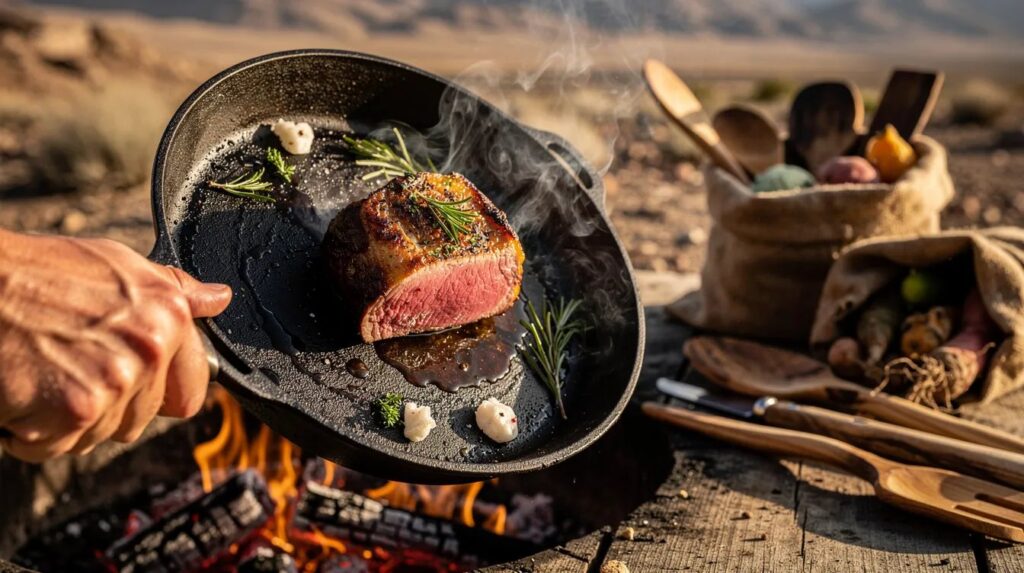
The body's caloric demand in extreme cold is roughly 25 to 50% higher than in moderate temperatures, depending on physical output and wind exposure (approximate values). This isn't just a nutritional consideration — it's a cooking priority. In sub-zero wind chills, fat-forward meals aren't indulgent; they're functional. Beef tallow rendered the night before in a covered skillet, lard kept in a sealed tin near body heat so it stays pliable, bone broth with a thick layer of congealed fat left intact — these are the survival cooking staples that cold-weather cowboy cooks have relied on for over a century. Fat also acts as a flavor carrier and moisture seal when cooking over unpredictable open heat. A cast iron skillet greased generously with tallow holds temperature longer and transfers heat more evenly than a dry pan ever will.
In extreme heat, cook before dawn or after sundown
At 117°F ambient temperature, cooking during daylight hours compounds every problem. Food spoils faster. The cook overheats. Metal handles become burn hazards. Fires become difficult to control when air temperature is already above the boiling point in certain humidity conditions. The discipline practiced by cowboy cooks in the Sonoran Desert and the high desert plateau of Nevada and Utah is simple: prep everything the night before, start the fire at 4:30 a.m., and have the meal ready before the sun clears the ridge. In the afternoon, rely on no-cook foods — hard cheese, cured meats, sourdough flatbread, dried fruit with salted nuts — that require zero heat to deliver calories and protein. Any cooking that must happen mid-day goes underground: a Dutch oven buried in a pit of coals covered with two inches of dry soil holds cooking temperature for up to six hours with no additional fuel and no surface heat exposure.
Master the dutch oven stack for both extremes
A Dutch oven with a lipped lid is the single most versatile piece of survival cooking equipment ever designed, and the stacking technique — placing lit coals on top of the lid as well as beneath the pot — is what transforms it from a simple pot into a precision oven. In cold weather, the ratio shifts toward more coals on top (roughly two-thirds above, one-third below) because ground cold pulls heat downward through the pot's base. In extreme heat, the opposite applies: rely more on bottom coals and limit the top coals to maintain a moderate internal temperature without risking a burn. A 12-inch Dutch oven using this method can hold a sustained 325°F to 375°F internal temperature stable enough to bake cornbread, braise short ribs, or slow-cook a pot of beans — regardless of whether the outside air is frozen or scorching.
Use salt as a preservation tool, not just a seasoning
In conditions where refrigeration doesn't exist and ice is either unavailable or a safety hazard, salt does the work. A dry brine — coating raw meat generously with coarse salt and leaving it uncovered in a cool, shaded spot — draws out surface moisture, creates a protective pellicle, and significantly extends the window before spoilage begins. At high heat, this technique buys roughly 4 to 6 additional hours of safe holding time for beef or pork (approximate values, dependent on initial meat temperature and air circulation). In freezing conditions, salt-heavy rubs on meat also lower the surface freezing point slightly, keeping the outer layer pliable enough to sear properly even when the internal temperature of the cut is still very cold. Salt-cured egg yolks — a technique that takes 72 hours of burial in equal parts salt and sugar — become shelf-stable flavor bombs that can be grated over any hot dish when fresh eggs aren't an option.
Never cook into the wind — position is everything
This is the trick that experienced outdoor cooks describe as the one thing they wish they'd understood from the first day. Fire position relative to wind direction governs everything: fuel consumption, temperature consistency, smoke management, and cooking time. The rule is to place the fire source so that prevailing wind blows across the coals at a low angle, not directly into them or directly away. A crosswind feeds coals steadily without flaring them. Cooking into an upwind position causes the fire to burn too hot and unevenly; cooking in a full downwind position starves the fire of oxygen. In blizzard conditions or high-desert afternoon winds, build a three-sided windbreak from stones, packed snow, or even a rolled tarp staked at an angle — but always leave the crosswind side partially open. The difference in fuel efficiency alone, across a week-long cattle drive, can amount to 30% less wood consumed using proper positioning versus cooking blind to the wind.
The gear that makes it possible
None of these techniques require specialized equipment beyond a few fundamentals that any serious outdoor cook should own. A 12-inch and 10-inch Dutch oven, both with lipped lids rated for coal cooking. A long-handled lid lifter — never use bare hands on a coal-loaded lid. A cast iron skillet, pre-seasoned with tallow rather than vegetable oil for higher smoke-point durability. A meat thermometer that reads accurately in both extreme cold and heat: many standard instant-read thermometers lose accuracy below 14°F and above 122°F ambient, so verify the operating range before relying on one in the field. A sealed tin of rendered fat, kept close to body warmth in cold conditions. And a fire steel, because lighters fail at temperature extremes in ways that a simple ferro rod does not.
Why these tricks matter beyond the range
The American cowboy cook tradition is often romanticized, but the practical knowledge embedded in it is genuinely sophisticated. The chuck wagon cook — historically called the cookie — was often the highest-paid person on a cattle drive, outearning many of the wranglers, because the ability to feed people well in brutal conditions was understood to be a technical skill, not a domestic afterthought. These six techniques represent a fraction of that accumulated knowledge, but they cover the scenarios most likely to challenge anyone cooking outdoors in the extreme weather patterns that have become increasingly frequent across the American West and Southwest. Early spring 2026 is already producing the kind of temperature swings — near-freezing mornings and unseasonably warm afternoons — where this knowledge stops being interesting and starts being practical.
Questions about extreme-weather cooking
Can a regular camp stove replace a fire in -30°F wind chills?
Most standard propane and butane camp stoves lose significant fuel efficiency below 20°F and can fail to ignite entirely below 0°F. Isobutane-blend canisters perform somewhat better in cold but are still unreliable at extreme wind chills. For genuinely harsh winter conditions, a wood-burning fire with a proper coal bed is more dependable than any canister-based stove. If you must use a stove, keep the fuel canister inside a jacket or sleeping bag until the moment of use, and shield the burner from wind on at least three sides.
How do you keep food from freezing before it can be served in sub-zero conditions?
The technique used by experienced cold-weather cooks is to serve directly from the heat source into pre-warmed vessels — metal bowls or enamel cups held near the fire for several minutes before filling. High-fat meals also hold temperature longer than lean, water-heavy dishes, which is another reason fat-forward cooking dominates in freezing conditions. For transport from fire to table in a large crew setting, insulated canvas bags — similar to the historical bread bags used on chuck wagons — can extend the safe serving window by 15 to 20 minutes even in extreme cold.
What foods are safest to prepare in 115°F+ heat without refrigeration?
Dried and cured items are the safest: hard jerky, salt-cured meats, hard aged cheeses, dried beans (cooked overnight in a buried Dutch oven), sourdough flatbreads, and high-salt preserved eggs. Fresh meat should be cooked within 1 to 2 hours of slaughter or opening in temperatures above 110°F, and nothing cooked should be held at ambient temperature for more than 30 minutes before serving. Acidic preparations — a vinegar-based slaw, pickled vegetables, citrus-marinated proteins — have slightly better holding stability than neutral-pH foods, because acid slows bacterial proliferation at the surface.
Is cast iron really better than other materials for extreme-weather cooking?
For open-fire and coal cooking specifically, cast iron outperforms stainless steel, aluminum, and enamel-over-steel in durability and heat retention at temperature extremes. Its mass allows it to absorb and redistribute heat from an uneven coal bed far more effectively than thin-gauge alternatives. The caveat is cold: as noted above, pre-warming is non-negotiable in freezing conditions to avoid thermal shock cracking. A well-seasoned, thick-walled cast iron Dutch oven from an established manufacturer — Lodge, Smithey, or a vintage Wagner — will outlast any modern lightweight cookware in hard field use.
How do you manage cooking fuel when supplies are limited over multiple days?
The most important fuel conservation strategy is the retained-heat cooking method: bring a pot to full boil or searing temperature over the fire, then wrap the vessel in wool blankets or bury it in a hay-lined insulated box for the remainder of the cook time. A pot of beans brought to a hard boil for 15 minutes, then transferred to an insulated wrap, will be fully cooked in 3 to 4 hours with no additional fuel. This technique, sometimes called fireless cooking or hay-box cooking, was standard on cattle drives and in military field kitchens precisely because it cuts fuel consumption by 60 to 70% on long-cook items (approximate values).