


Wild garlic season runs from late March through May, and right now the forests and riverbanks of the English countryside are carpeted with its broad, glossy leaves and that unmistakable sharp, green scent. Chefs have long prized it, but bartenders are catching up fast. Carlo Scotto — the Italian-born chef behind Bear in London — has translated that forager's instinct directly into a martini, turning one of spring's most fleeting ingredients into a drink that smells of rain-wet woodland and tastes of something far more precise and clean.
This wild garlic martini is not a gimmick. The allium note sits deep in the background, herbal and grassy rather than pungent, lifted by the cold minerality of a well-chilled gin and anchored by the salinity of a dry vermouth. What you end up with is something that bridges the kitchen and the bar in a way very few cocktails manage. The recipe below is Scotto's own, adapted for the home bartender with the right technique and a little patience.
| Preparation | 15 min |
| Infusion time | 2 hours (minimum) |
| Yield | 1 cocktail |
| Difficulty | Intermediate |
| Cost | $$ |
| Season | Wild garlic (March–May), spring herbs |
Ingredients
For the wild garlic–infused gin
- 200 ml London Dry gin (a high-juniper expression such as Beefeater or Tanqueray works well)
- 6 fresh wild garlic leaves (Allium ursinum), rinsed and patted dry
For the martini
- 60 ml wild garlic–infused gin (prepared above)
- 15 ml extra-dry vermouth (Noilly Prat or Dolin Dry)
- 5 ml cold wild garlic brine (see method), or dry olive brine as a substitute
- 1 wild garlic flower or a single small leaf, to garnish
- Ice, for stirring — large, dense cubes preferred
Equipment
- Sealed glass jar or airtight container (at least 300 ml capacity)
- Fine mesh strainer or cheesecloth
- Mixing glass (at least 500 ml)
- Bar spoon
- Cocktail strainer (Hawthorne or julep)
- Chilled martini glass or coupe
- Kitchen scale or jigger
Preparation
1. Infuse the gin with wild garlic
Place the six wild garlic leaves in a clean glass jar. Pour over the 200 ml of gin and seal immediately — the volatile sulfur compounds that give wild garlic its character begin to dissipate the moment the leaves are cut or bruised, so speed matters here. Store the jar at room temperature, away from direct light, for a minimum of two hours. Taste at the two-hour mark: the gin should carry a clear, green, allium note — herbal and clean, not sharp or aggressive. If the infusion feels too subtle, leave it for another hour. Beyond four hours the flavor can tip toward bitterness, so check regularly. Once satisfied, strain the gin through a fine mesh strainer or cheesecloth into a clean bottle or jug, pressing gently on the leaves to extract maximum flavor without introducing cloudiness. The infused gin keeps refrigerated for up to four days.
2. Prepare the wild garlic brine (optional but recommended)
Blanch two or three additional wild garlic leaves in lightly salted boiling water for no more than fifteen seconds, then transfer immediately to ice-cold water to halt the cooking — this process is called shocking, and it locks in the chlorophyll green while softening the raw edge. Drain the leaves and blend them with 50 ml of cold water and a small pinch of fine sea salt. Strain through cheesecloth, pressing firmly. The resulting liquid should be bright, pale green and faintly saline. It adds both seasoning and an aromatic depth to the finished drink that brine from a jar simply cannot replicate. Keep it cold until service.
3. Chill the glass
Place your martini glass or coupe in the freezer at least twenty minutes before serving. A properly chilled vessel is not a nicety — it is structural. A martini begins to warm and dilute within seconds once poured, and a cold glass extends the window of optimal drinking by several minutes. If you are short on time, fill the glass with ice and cold water while you stir, then discard before pouring.
4. Stir the cocktail
Fill your mixing glass two-thirds full with large, dense ice cubes. Measure and add the wild garlic gin, the dry vermouth and the wild garlic brine. Using a long bar spoon, stir with a smooth, circular motion — the back of the spoon should glide against the inside wall of the glass — for approximately 45 to 60 rotations. The objective here is dilution and temperature simultaneously: a properly stirred martini reaches around -6°C and gains roughly 20 to 25% dilution from the melting ice. Shorter stirring produces a harsh, under-integrated drink; over-stirring generates excess water that flattens the aromatics. The liquid should look silky and slightly viscous when it is ready.
5. Strain and garnish
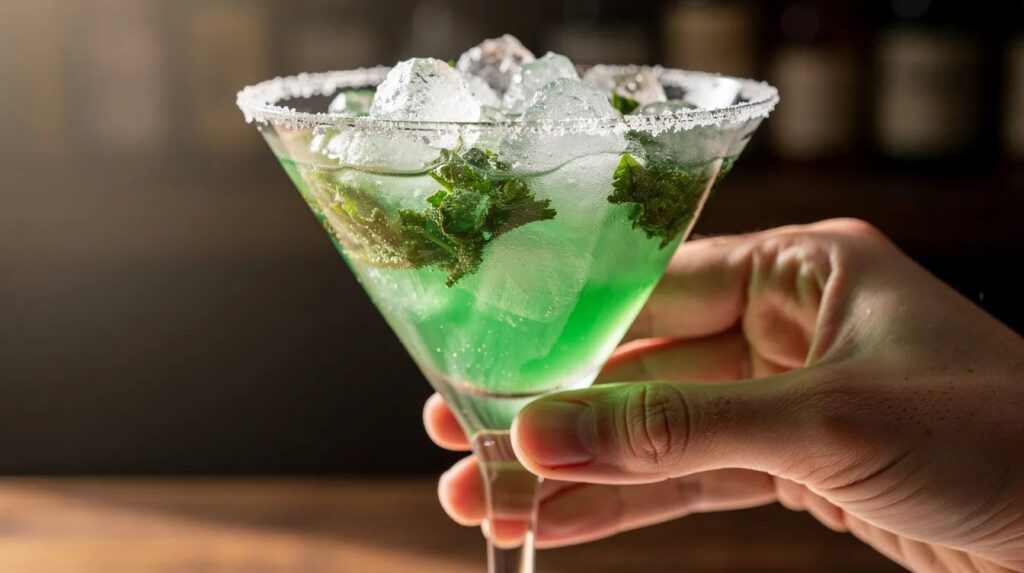
Place the Hawthorne or julep strainer over the mixing glass and pour in a single, controlled motion into the chilled coupe or martini glass. The cocktail should arrive cold and perfectly clear — or very faintly green if your brine carried strong color. Lay a single wild garlic flower or a small, pristine leaf across the rim of the glass. The garnish is not decorative in the superficial sense: as the drinker lifts the glass, that raw green scent rises first, priming the palate for what follows.
A note from Carlo Scotto
Wild garlic behaves like a very temperamental herb — it wants to be handled cold and fast. I always keep the leaves refrigerated right until the moment I use them, and I never chop them before infusing: the whole leaf releases its oil more slowly, more evenly. At Bear, we pair this martini with a small dish of dressed white asparagus, another great early-spring ingredient that shares that same grassy, mineral register. If you can find white asparagus at the market this week, try a thin strip laid over the glass instead of the flower.
Pairing notes
A wild garlic martini has a herbal, dry, faintly sulphurous profile that calls for food with texture and fat to balance its sharp clarity. Think along the lines of rich, saline or umami-forward small plates rather than anything sweet or heavily acidic.
At table, it pairs naturally with a plate of sourdough with cultured butter, a smoked salmon blini or a simple dressed asparagus — the asparagus connection is one Scotto returns to often, and with good reason. The drink also holds its own alongside a raw bar moment: oysters on ice, a little mignonette, the brine of the sea meeting the brine of the forest. For a non-alcoholic companion, a cold infusion of cucumber, lemon thyme and a pinch of salt over ice carries a similar mineral freshness.
About this recipe and Bear restaurant
Carlo Scotto opened Bear in London to relatively quiet surroundings before word of his cooking — precise, Italian-rooted, deeply seasonal — spread quickly through the city's food circles. The restaurant takes its name from the wild garlic species itself: Allium ursinum, sometimes called bear's garlic, named for the brown bears of Northern Europe that were said to seek it out after hibernation as a first spring food. That piece of natural history is embedded in the restaurant's identity, and the wild garlic martini is its most direct expression as a drink.
The martini as a format has been through endless reinvention — dirty, espresso, pornstar — but the move toward botanical infusions reflects a broader shift in bar culture, where the division between kitchen and bar has grown increasingly porous. Scotto's version is grounded in technique rather than novelty: it uses a classic structure, a classic ratio, and asks a single seasonal ingredient to do the work of distinguishing it from everything else on the menu. That restraint is precisely what makes it worth making at home.
Approximate nutritional values (per serving)
| Nutrient | Amount |
|---|---|
| Calories | ~165 kcal |
| Carbohydrates | ~1 g |
| of which sugars | ~0.5 g |
| Protein | ~0 g |
| Fat | ~0 g |
| Alcohol | ~19 g (approx. 2.4 standard units) |
Frequently asked questions
Can I make the infused gin in advance?
Yes, and it is actually preferable to do so. Infusing the gin the evening before a dinner party means you have full control over timing and can taste and adjust at leisure. Strain and refrigerate the infused gin as soon as it reaches the flavor you want, then keep it sealed and cold for up to four days. The flavor does soften slightly over time, so use it within 48 hours for the most vivid result.
Where do I find fresh wild garlic in the United States?
Wild garlic (Allium ursinum) is native to Europe and not commonly foraged in North America, though it does grow in parts of the Northeast and Pacific Northwest. In the US, the most accessible substitute is ramps (Allium tricoccum), which are in season at almost exactly the same time — look for them at farmers markets from late March through May. The flavor is slightly more assertive than wild garlic, so use four leaves rather than six for the infusion and taste frequently.
What gin works best for this recipe?
A classic London Dry with prominent juniper is the right base — its dryness and herbal backbone support the wild garlic without competing with it. Avoid heavily floral or citrus-forward contemporary gins, which can clash with the allium note. Beefeater, Tanqueray and Gordon's all work well at this price point. If you want to spend more, Hayman's London Dry or a small-batch juniper-led expression will add complexity without overwhelming the infusion.
Can I make this without the wild garlic brine?
Absolutely. The brine adds seasoning and an extra herbal layer, but a well-made wild garlic gin martini is complete without it. If you want the slight salty-saline dimension, a small measure of good-quality dry olive brine — from Castelvetrano olives if possible — is a reasonable substitute. Start with 3 ml rather than 5, as olive brine can dominate quickly.
How do I know if my wild garlic is safe to forage?
Wild garlic is sometimes confused with lily of the valley (Convallaria majalis) and autumn crocus, both of which are toxic. The key identifier is smell: crush a leaf between your fingers and it should produce an unmistakable, strong garlic scent. If there is no garlic smell, do not use it. Foraging guides recommend checking the leaf shape — wild garlic leaves are bright green, smooth, broadly oval and emerge directly from the ground — and always cross-referencing with a reliable regional foraging resource or expert before consuming anything you have picked yourself.