


Cinnamon rolls are one of those baked goods that seem straightforward on the surface — flour, butter, sugar, cinnamon — yet the gap between a mediocre batch and a truly extraordinary one comes down to a handful of decisions most home bakers never think to question. Ree Drummond, the self-taught cook behind The Pioneer Woman brand, built her reputation not on French technique or culinary school theory, but on honest, generous cooking rooted in feeding hungry ranch hands and a large family in rural Oklahoma. Her cinnamon rolls became famous precisely because they taste richer, softer, and more indulgent than anything you'd pull from a standard recipe card. Spring is settling in, the mornings still carry a chill worth countering with something warm from the oven, and this is the recipe that earns its place on the kitchen counter.
What makes Drummond's version genuinely different is a single ingredient almost universally absent from classic American cinnamon roll recipes: heavy cream poured directly over the assembled, risen rolls before they go into the oven. The cream seeps into the gaps between the spirals, steams as it bakes, and transforms the texture from the inside out — producing a pull-apart softness that no amount of extra butter in the dough alone can replicate. This guide walks through the full recipe with every technique explained, including why that cream works at a chemical level, and how to get consistent results every time you bake it.
| Preparation | 30 min |
| Rest | 2 hrs (rising) |
| Baking | 20–25 min |
| Servings | 12 large rolls |
| Difficulty | Medium |
| Cost | $$ |
| Season | Year-round — particularly suited to cool spring mornings |
Suitable for: Vegetarian
Ingredients
For the dough
- 4 cups (480 g) all-purpose flour, plus extra for dusting
- 1 packet (7 g / 2¼ tsp) active dry yeast
- 1 cup (240 ml) whole milk
- ⅓ cup (75 g) unsalted butter, cut into cubes
- ¼ cup (50 g) granulated sugar
- ½ tsp fine sea salt
- 2 large eggs, at room temperature
For the filling
- 1 cup (200 g) packed light brown sugar
- 2½ tbsp ground cinnamon
- ⅓ cup (75 g) unsalted butter, very soft (not melted)
The secret ingredient
- ¾ cup (180 ml) heavy cream, warmed to room temperature
For the maple cream cheese frosting
- 225 g (8 oz) full-fat cream cheese, at room temperature
- 1½ cups (180 g) powdered sugar, sifted
- ¼ cup (60 ml) whole milk
- 1 tsp pure maple extract (or 2 tsp real maple syrup)
- Pinch of sea salt
Equipment
- Stand mixer with dough hook attachment (or large mixing bowl and hands)
- Large mixing bowl for proofing
- Rolling pin
- 9×13-inch (23×33 cm) baking pan
- Pastry brush or small ladle
- Wire cooling rack
- Instant-read thermometer (optional but recommended)
- Dental floss or serrated knife for slicing rolls
Preparation
1. Activate the yeast and scald the milk
Warm the milk in a small saucepan over low heat until it reads 110°F (43°C) on an instant-read thermometer — this is the temperature at which active dry yeast becomes fully functional without being killed. If you go above 120°F (49°C), the heat will destroy the yeast and your dough will not rise. Pour the warm milk into the bowl of your stand mixer, sprinkle the yeast over the surface, and add a pinch of the measured sugar. Stir once with a fork and let it sit for 5 to 10 minutes. You are looking for a bloom — a foamy, slightly domed surface that signals the yeast is alive and active. If nothing happens after 10 minutes, the yeast is dead and the batch should be started again with a fresh packet. While the yeast blooms, melt the cubed butter into the warm milk if you haven't already — add it now, off the heat, so it softens and integrates smoothly into the liquid base.
2. Build and knead the dough
To the bloomed yeast mixture, add the remaining sugar, the salt, and the two eggs. Fit the stand mixer with its dough hook and begin adding the flour, one cup at a time, on low speed. Once all the flour is incorporated, increase the speed to medium and knead for 6 to 8 minutes. The dough should pull cleanly away from the sides of the bowl and feel smooth and slightly tacky — not sticky, not stiff. If it clings to your fingers and leaves residue, add flour one tablespoon at a time. Tacky is desirable here: it means a higher hydration dough that will bake into a softer crumb. Over-flouring is the most common reason home-baked cinnamon rolls turn out dense and bread-like rather than pillowy. When kneading by hand, work the dough on a lightly floured surface using the heel of your palm, folding and pressing for a full 10 minutes.
3. First rise
Shape the dough into a smooth ball and transfer it to a lightly oiled large bowl. Cover tightly with plastic wrap or a clean kitchen towel and place in a warm, draft-free spot. The oven with just the light on works well, as does the top of a refrigerator. Let the dough rise until it has doubled in volume, approximately 1 hour to 1 hour 30 minutes depending on the ambient temperature. It's important to avoid rushing this part— proper fermentation develops flavor compounds that make the difference between a roll that is simply sweet and one that has a more complex flavor.
4. Prepare the filling and roll out the dough
While the dough completes its first rise, mix the light brown sugar and ground cinnamon together in a small bowl until fully combined. Have your softened butter ready — it should be spreadable but not greasy or liquid, the consistency of room-temperature peanut butter. Once the dough has doubled, turn it out onto a lightly floured surface and press it gently to degas (release the accumulated carbon dioxide). Using a rolling pin, roll the dough into a rectangle approximately 15 inches wide and 10 inches tall (38×25 cm). Spread the softened butter across the entire surface right to the edges, then scatter the cinnamon sugar evenly on top, pressing it lightly into the butter with your palms so it adheres rather than spilling when you roll.
5. Roll, slice, and arrange
Starting from the long (15-inch) edge, roll the dough tightly toward you, keeping even tension across the full width so the spiral stays uniform. Pinch the seam closed along the length of the log. To cut without compressing the rolls — which would destroy the spiral layers — use a 30 cm length of unflavored dental floss: slide it under the log, cross the two ends over the top, and pull in opposite directions to slice cleanly through. Cut 12 rolls approximately 1¼ inches (3 cm) thick. Arrange them cut-side up in a lightly buttered 9×13-inch baking pan, leaving small gaps between each roll to allow for the second rise. Cover with plastic wrap and allow to rise for a further 45 minutes to 1 hour, until the rolls have puffed and are just touching each other.
6. Add the heavy cream — the step that changes everything
Once the rolls have completed their second rise, preheat your oven to 375°F (190°C). Here is Drummond's defining move: warm the heavy cream gently until it is no longer cold (room temperature or slightly above), then pour it slowly and evenly over the top of all the risen rolls. Use a pastry brush or the back of a spoon to guide it into the gaps between rolls. The cream will pool around the bases and settle between the spirals. During baking, this cream heats rapidly, generating steam that keeps the interior moist while the fat content enriches every layer it touches. The bottom of the pan develops a lightly caramelized, almost custard-like crust — a texture that no standard recipe achieves. Don't skip this. Don't substitute half-and-half. Heavy cream is the point.
7. Bake
Bake the rolls on the center rack for 20 to 25 minutes, until the tops are golden brown and the internal temperature of the center roll reads 190°F (88°C). The edges will color faster than the center, which is normal. If they begin to darken too quickly after 15 minutes, tent loosely with aluminum foil. Remove from the oven and let the rolls cool in the pan for exactly 5 minutes before frosting — not longer, or the frosting will simply slide off, but not shorter, or it will fully melt and disappear into the rolls rather than forming a coating.
8. Make and apply the frosting
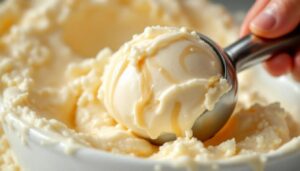
Beat the room-temperature cream cheese with the powdered sugar, milk, maple extract, and pinch of salt until completely smooth — a stand mixer on medium takes about 2 minutes; by hand with a wooden spoon takes 4 to 5 minutes of sustained effort. The frosting should be pourable but thick, falling in a slow ribbon from the spoon. Pour generously over the warm rolls, letting it run into every crevice and gap. It will partially melt into the rolls and partially set on top as it cools, creating two distinct textural layers: a soaked interior and a soft, opaque coating on the surface.
Chef's tip
For an even more pronounced tang in the dough, replace the first rise with an overnight cold proof in the refrigerator. After shaping the rolls and placing them in the pan, cover tightly and refrigerate for 8 to 12 hours. The following morning, remove them from the refrigerator and allow them to come to room temperature and complete their second rise for about 1 hour before adding the cream and baking. The slower fermentation develops acidity and complexity in the dough that accelerated room-temperature rising simply cannot produce. This is also the practical method for serving fresh cinnamon rolls at breakfast without a 6 a.m. start time.
Drink pairings
The dominant notes here are warm spice, caramelized sugar, lactic cream, and the slight sharpness of cream cheese — a profile that calls for something with enough body to hold its own without overwhelming the sweetness.
A freshly brewed medium-roast pour-over coffee with tasting notes of hazelnut or brown sugar is the natural companion — the slight bitterness cuts the fat and resets the palate between bites. A latte with oat milk works equally well for a milder contrast. For a non-caffeinated option, a cup of spiced chai mirrors the cinnamon notes in the rolls and extends the warmth of the experience across the whole morning.
The story behind the recipe
Ree Drummond began publishing her recipe for cinnamon rolls on her blog in the mid-2000s, and it quickly became one of the most shared baking recipes in the early era of food blogging. Its reputation rested partly on scale — early versions called for making rolls in quantities of four dozen at a time, suited to feeding large groups on her ranch — and partly on the unabashed generosity of every measurement. The heavy cream technique itself draws on a tradition found in certain Midwestern and Southern American home kitchens, where enriching baked goods with an additional dairy pour before baking was common knowledge passed between generations rather than written in cookbooks.
The combination of a yeasted enriched dough with cream and a maple-inflected frosting places this recipe in the lineage of Scandinavian enriched sweet breads — particularly the Swedish kanelbulle and the Danish kanelsnegl — which arrived in the American Midwest with waves of immigrant communities in the nineteenth and early twentieth centuries. Those traditions emphasized tenderness above all else, achieved through high-fat dairy at multiple stages of preparation. Drummond's version is decidedly American in its proportions and sweetness level, but the instinct behind it is the same: fat equals tenderness, and tenderness is what turns a simple baked roll into something people remember.
Nutritional values (per roll, approximate values)
| Nutrient | Amount |
|---|---|
| Calories | ~520 kcal |
| Protein | ~8 g |
| Carbohydrates | ~68 g |
| of which sugars | ~38 g |
| Fat | ~24 g |
| Fiber | ~2 g |
Frequently asked questions
Can the rolls be assembled the night before?
Yes — this is actually the recommended approach for breakfast service. After placing the sliced rolls in the pan, cover tightly with plastic wrap and refrigerate overnight. The following morning, remove the pan and let the rolls sit at room temperature for 45 minutes to 1 hour until they have visibly puffed. Pour the heavy cream over them at this point, then bake as directed. The cold fermentation adds a subtle depth to the flavor that same-day rolls don't quite achieve.
How should leftover rolls be stored?
Store fully cooled, frosted rolls in an airtight container at room temperature for up to 2 days. For longer storage, wrap individual rolls tightly in plastic wrap and freeze for up to 6 weeks. To reheat from frozen, place an unwrapped roll on a microwave-safe plate and heat for 45 to 60 seconds — the texture recovers well because the high fat content in both the dough and the cream layer prevents the crumb from drying out during freezing. Refrigerating unfrosted rolls is not recommended, as cold temperatures accelerate staling in enriched yeast doughs.
What substitutions work in this recipe?
The heavy cream can be replaced with full-fat coconut cream for a dairy-free version — the fat content is comparable and the effect is nearly identical, with a very faint coconut note in the background. For the frosting, dairy-free cream cheese works well provided it is at room temperature before beating. Substituting lower-fat dairy in the cream pour (half-and-half, whole milk) is technically possible but produces a noticeably less tender, less rich result — the fat content is the functional ingredient, not an optional flourish. Brown sugar in the filling can be swapped for coconut sugar for a slightly less sweet, more mineral-edged flavor profile.
Why did my rolls turn out dense instead of soft?
The three most common causes are: flour was added in excess during kneading (the dough should remain slightly tacky), the yeast was inactive before mixing began (always test with warm liquid and sugar first), or the rolls were under-proofed on the second rise (they need to visibly touch each other in the pan before baking). Dense rolls that are otherwise well-flavored almost always indicate insufficient rise time rather than a problem with the dough itself.
Can the maple extract in the frosting be replaced?
Pure maple extract can be replaced with 2 teaspoons of real maple syrup (Grade A or Grade B, the latter giving a stronger flavor), 1 teaspoon of pure vanilla extract for a more neutral sweetness, or ½ teaspoon of ground cinnamon for a version that echoes the filling. The maple note in the frosting is not traditional in the original Drummond recipe — her most iconic version uses a straightforward powdered sugar and butter glaze — but it adds a layer that complements the cinnamon particularly well in cooler seasons.