



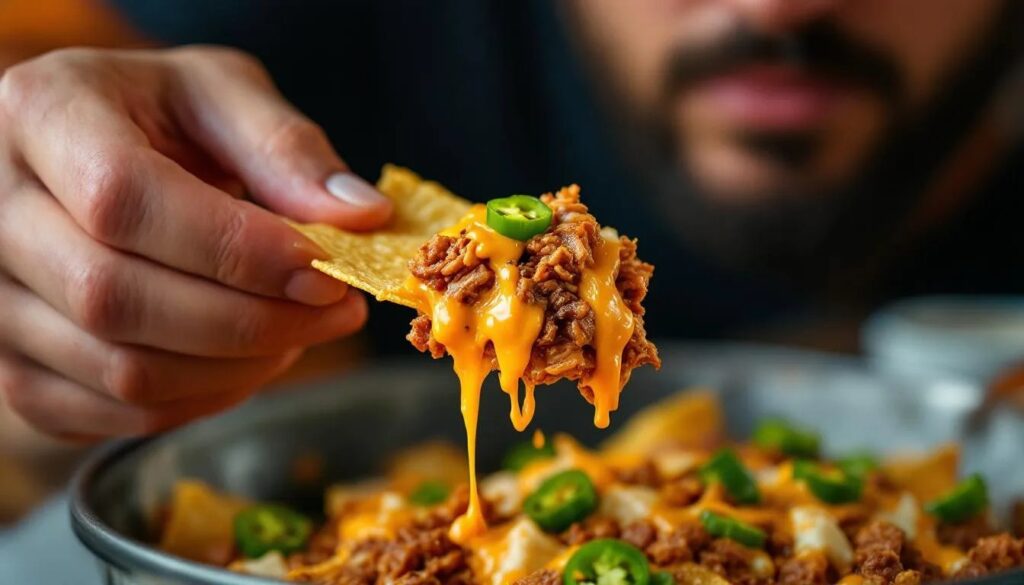
March Madness brings a particular kind of chaos to living rooms across the country — brackets busted by halftime, couches packed shoulder to shoulder, and the constant question of what to put on the table that can survive three hours of frantic dipping without going soggy. Guy Fieri's Trash Can Nachos answer that problem with the kind of controlled mayhem the Mayor of Flavortown has always specialized in: a towering cylinder of tortilla chips, layered from the inside out, built around a can that lifts away to reveal a mountain of toppings that somehow stay crisp all the way to the last chip. This late March, with the tournament in full swing and the first warm evenings of spring arriving, it's exactly the kind of showstopper that earns its place on the coffee table.
The genius of the Trash Can method isn't the spectacle — though the reveal does stop conversation mid-sentence — it's the architecture. Every chip gets contact with toppings. Every bite has protein, cheese, heat, and acid in the same mouthful. This recipe stays close to Fieri's original spirit while making a few practical adjustments for the home cook: a cast-iron skillet for the beef, a proper pickled jalapeño situation, and a queso built from scratch that holds its texture long after the opening tip-off. Grab your apron and find a can you're willing to sacrifice to the cause.
| Preparation | 25 min |
| Cook Time | 30 min |
| Portions | 6–8 people |
| Difficulty | Medium |
| Cost | $$ |
| Season | Spring — fresh jalapeños, scallions, avocado, limes |
Ingredients
For the seasoned beef
- 1.5 lbs ground beef (80/20 fat ratio for flavor)
- 1 tsp ground cumin
- 1 tsp smoked paprika
- 1 tsp garlic powder
- ½ tsp onion powder
- ½ tsp chipotle powder
- 1 tsp kosher salt
- ½ tsp black pepper, freshly cracked
- 2 tbsp neutral oil (avocado or canola)
For the scratch queso
- 2 tbsp unsalted butter
- 2 tbsp all-purpose flour
- 1 cup whole milk, warmed
- 8 oz sharp cheddar, freshly grated (never pre-shredded — the anti-caking agents kill meltability)
- 4 oz Monterey Jack, freshly grated
- 1 can (4 oz) diced green chiles
- ½ tsp cumin
- Salt to taste
For the build
- 1 large bag (13–16 oz) thick-cut tortilla chips — restaurant-style, sturdy enough to stand upright
- 1 can (15 oz) black beans, drained and rinsed
- 1 cup pickled jalapeños, drained
- 1 cup pico de gallo, freshly made or good quality store-bought
- 2 ripe avocados, diced — spring's avocados are finally at their peak
- ¾ cup sour cream
- 4 scallions, thinly sliced on the bias
- 1 lime, cut into wedges
- Fresh cilantro, to finish
Utensils
- One large, clean, empty aluminum can (28-oz tomato can or similar) — remove both ends completely and wash thoroughly
- Large cast-iron skillet or heavy-bottomed pan
- Medium saucepan for the queso
- Box grater
- Large rimmed baking sheet or serving platter
- Whisk
- Tongs
Preparation
1. Prepare the can and your workspace
Using a can opener, remove both the top and bottom lids of a large aluminum can — a 28-oz tomato or crushed tomato can works perfectly. Wash the inside thoroughly with hot soapy water, dry completely, and check the interior rim carefully for any sharp metal edges. Run your finger along the inside rim and, if needed, use a small pair of pliers to press down any jagged points. Set the prepared can aside on your serving platter. This is not just a gimmick: the can acts as a structural mold that forces the chips into a dense vertical cylinder, ensuring every layer gets loaded with toppings before the reveal. Set up your platter in the center of the table before you start building — you won't want to move it once assembled.
2. Cook the seasoned beef
Place your cast-iron skillet over high heat and let it get genuinely hot — a drop of water should skitter and evaporate on contact. Add the oil, then the ground beef in a single mass. Resist the urge to stir immediately. Let it sit undisturbed for 2–3 minutes until a deep, dark sear forms on the bottom — this Maillard reaction (the browning of proteins and sugars at high heat) is where the flavor lives. Break the meat apart with a wooden spoon, then season with cumin, smoked paprika, garlic powder, onion powder, chipotle powder, salt, and black pepper. Continue cooking, stirring occasionally, until no pink remains and the beef has crispy, caramelized bits throughout, about 8–10 minutes total. Drain any excess fat, leaving just enough to keep things moist. Transfer to a bowl and keep warm.
3. Build the scratch queso
In a medium saucepan over medium heat, melt the butter until it foams. Add the flour all at once and whisk constantly for 60–90 seconds — you're cooking out the raw flour taste while building a roux (a cooked fat-and-flour base that thickens sauces). The mixture should smell faintly nutty and turn a very pale blond. Pour in the warm milk in a slow, steady stream, whisking without stopping to prevent lumps. The sauce will seize up dramatically at first — keep whisking. Within 3–4 minutes it will smooth out into a thick, glossy béchamel. Remove from heat. Add the grated cheddar and Monterey Jack in two additions, stirring between each until fully melted and silky. Fold in the diced green chiles and cumin. Season with salt. The queso should coat the back of a spoon and hold its line when you run a finger through it — thick enough to cling to chips, fluid enough to pour. Keep warm on the lowest heat setting, stirring occasionally.
4. Dice the avocado and pico de gallo
Cut the avocados in half, remove the pits, and score the flesh into ½-inch cubes while still in the skin. Scoop out with a large spoon. Spring avocados from California and Mexico are at their richest right now — the flesh should be a deep, buttery yellow-green with no stringy fibers. Squeeze a few drops of lime juice over the diced avocado to slow oxidation and add brightness. Keep your pico de gallo and pickled jalapeños close at hand. Slice the scallions on the bias (at a 45-degree angle) to create longer, more elegant pieces with a slightly milder bite than a blunt cut.
5. Assemble the Trash Can Nachos
Place the clean aluminum can upright in the center of your serving platter. Pack a single layer of tortilla chips standing upright inside the can, arranged around the interior wall like a crown, then pack more flat chips into the center to fill any gaps. Spoon a generous layer of seasoned beef down into the chips. Add a layer of black beans. Ladle queso directly into the cylinder, letting it seep down through the crevices between the chips. Add a handful of pickled jalapeños. Pack another layer of chips on top and press down gently — the goal is density, not neatness. Repeat the process: beef, beans, queso, jalapeños. Finish with a final chip layer. The can should be packed full and slightly domed at the top.
6. The reveal and final dress
With one hand stabilizing the platter and the other gripping the top rim of the can firmly, lift the can straight up in one smooth, confident motion. The chips and toppings will hold their shape for a dramatic 3–4 seconds before slowly settling and tumbling outward across the platter — this is the moment. Immediately spoon the fresh pico de gallo over the top, scatter the diced avocado, drizzle a final heavy pour of queso over everything, and finish with the sliced scallions and torn cilantro. Add sour cream in spoonfuls across the top. Serve the lime wedges alongside. The whole table should be reaching for the platter before you've put the can down.
Chef's Note
The single move that separates a good nacho situation from a great one is grating your own cheese. Pre-shredded cheese contains cellulose and potato starch to prevent clumping — those same agents prevent it from melting smoothly into queso. Buy a block and use a box grater; it takes four minutes and the queso will be noticeably silkier. If you want to take the heat level up a notch for a late-March crowd that's already on edge after a buzzer-beater, steep a dried ancho chile in the warm milk for 15 minutes before building the roux — it adds a dark, fruity heat that doesn't announce itself until the third bite.
What to drink alongside
The queso and chipotle-spiced beef need something with enough acidity and effervescence to cut through the fat, and enough body to hold up to the smokiness.
A cold, crisp Mexican lager — Modelo Especial or Pacifico — is the textbook pairing, its light carbonation scrubbing the palate clean between bites. If you're leaning toward something with more complexity, a Margarita on the rocks (blanco tequila, fresh lime, a touch of agave) mirrors the citrus in the pico de gallo and amplifies the heat from the jalapeños rather than fighting it. For a non-alcoholic option, a agua fresca made with cucumber and lime achieves the same cooling, acidic effect.
The story behind the trash can nachos
Guy Fieri developed his Trash Can Nachos as a signature dish at his restaurant concept, designed specifically to solve the nacho's oldest structural problem: the sad, dry chip at the bottom of the pile that never saw a drop of cheese or a sliver of topping. The solution — building the nachos inside a cylindrical mold — was borrowed loosely from construction techniques and street food presentation, and it became one of the most photographed dishes associated with Fieri's brand. The name is part provocation, part promise: it sounds like chaos and delivers abundance.
Nachos themselves have a documented origin story from 1943, when a maître d' named Ignacio "Nacho" Anaya improvised a snack for a group of American military wives at a restaurant in Piedras Negras, Mexico, by melting cheese over tortilla chips and topping them with pickled jalapeños. The distance from that improvised plate to a 28-ounce can filled with layers of beef, queso, and pico de gallo is roughly 80 years and one television personality with an extraordinary talent for turning stadium food into an event.
Nutritional values (per serving, approximate values, based on 8 servings)
| Nutrient | Amount |
|---|---|
| Calories | ~680 kcal |
| Protein | ~34 g |
| Carbohydrates | ~52 g |
| of which sugars | ~5 g |
| Fat | ~38 g |
| Fiber | ~7 g |
Frequently asked questions
Can I prepare any components in advance?
The seasoned beef can be cooked up to two days ahead and stored in an airtight container in the refrigerator — reheat it in a skillet over medium heat with a splash of water to loosen it before assembling. The queso can also be made a day in advance and reheated gently over low heat with a splash of milk, whisked back to a smooth consistency. Dice the avocado and slice the scallions no more than two hours before serving to keep them fresh. The assembly itself should happen immediately before serving — the nachos do not hold once built.
What if I can't find a large aluminum can?
A 28-oz tomato can is the standard, but any similarly sized cylindrical container with both ends removed will work — some cooks use a clean PVC pipe section or a purpose-built nacho ring mold sold online. The critical dimensions are roughly 4 inches in diameter and 5–6 inches tall. If you're in a pinch, you can skip the mold entirely and build the nachos in a standard layered fashion on the baking sheet, though you'll lose the reveal moment and some of the structural integrity that keeps the bottom chips loaded.
How do I keep the chips from going soggy?
Two things work in your favor here: restaurant-style thick-cut chips resist moisture far better than thin varieties, and the cylindrical build means the queso and beef sit between chips rather than pooling on top of them. The key is to assemble and serve immediately — these nachos are not meant to sit. If you're hosting a crowd and need to build multiple rounds, have all your components pre-warmed and ready, and assemble each batch fresh. Never cover a completed nacho build with foil; the trapped steam will destroy the texture within minutes.
Can I make a vegetarian version?
Absolutely. Replace the seasoned ground beef with an equal weight of sofritas — crumbled extra-firm tofu sautéed with the same spice blend plus a tablespoon of tomato paste and a splash of vegetable broth until caramelized and deeply flavored. Alternatively, a mixture of roasted black beans and corn kernels sautéed with cumin and chipotle powder fills the same structural role in the build and brings its own smokiness. The queso recipe is already vegetarian as written.
What other toppings work well for variations?
The base architecture is intentionally flexible. Pulled pork or shredded rotisserie chicken work in place of the ground beef. For a spring riff on the classic, thin-sliced radishes and fresh corn cut from the cob (now just coming into season) add crunch and color on top of the finished build. A drizzle of hot sauce — something with a vinegar backbone like Cholula or Valentina — across the final assembly adds a brightness that cuts through the richness of the queso. Crumbled cotija cheese scattered over the top alongside the cilantro gives a saltier, drier finish than the melted cheese alone.