


Spring is the season when the garden finally delivers on its promises. Tender lettuces reappear, radishes push through the soil, and peas begin their climb — and in that spirit, Joanna Gaines has shared a spring salad that feels like a walk through a well-tended backyard. Her version is bright, layered, and grounded in the kind of honest cooking she has always championed: seasonal produce, bold textures, and a quiet confidence in letting ingredients speak for themselves. What makes this particular salad stand out, though, is one ingredient that stops you mid-scroll the moment you see it.
This is not just greens dressed in vinaigrette. Gaines builds hers with intention — each component chosen for a reason, each flavor placed to contrast or amplify the next. The surprise element threads through the whole dish in a way that makes you reconsider what a salad can be. If you have been looking for a reason to eat more vegetables this spring, this recipe provides a genuinely compelling one. Preheat nothing, sharpen your knife, and let's get into it.
| Preparation | 20 min |
| Portions | 4 people |
| Difficulty | Easy |
| Cost | $$ |
| Season | Spring peas, radishes, asparagus, arugula, fresh herbs |
Suitable for: Vegetarian · Gluten-free
Ingredients
For the salad
- 4 cups mixed spring greens (arugula, butter lettuce, baby spinach)
- 1 cup fresh or blanched peas (shelled, from about 1 lb of pods)
- 6 radishes, thinly sliced
- 8 asparagus spears, shaved raw into ribbons with a vegetable peeler
- ½ cup fresh mint leaves, torn
- ¼ cup fresh dill, roughly chopped
- ½ cup snap peas, sliced on the bias
- ¼ cup toasted pistachios, roughly chopped
- 2 oz fresh goat cheese, crumbled
- ½ cup strawberries, hulled and thinly sliced — the surprise ingredient
For the honey-lemon vinaigrette
- 3 tablespoons good-quality olive oil
- 1 tablespoon fresh lemon juice
- 1 teaspoon lemon zest
- 1 teaspoon raw honey
- 1 teaspoon Dijon mustard
- Salt and freshly ground black pepper to taste
Utensils
- Large mixing bowl
- Small bowl or jar for the vinaigrette
- Vegetable peeler
- Sharp chef's knife and cutting board
- Salad tongs or two large spoons
- Small skillet for toasting pistachios
- Microplane or fine grater for lemon zest
Preparation
1. Shave the asparagus and prepare the raw vegetables
Start with the asparagus, which is handled differently here than you might expect. Rather than blanching or roasting, Gaines uses them raw — shaved lengthwise into thin, curling ribbons with a standard vegetable peeler. Hold each spear by its woody end and draw the peeler firmly from base to tip, rotating as you go. The result is a delicate, almost translucent strip that has a mild bitterness and a satisfying snap when you bite into it. This technique preserves the spear's bright green color and avoids the mushiness that heat can introduce. Once shaved, lay the ribbons loosely on your cutting board and let them curl naturally. Thinly slice the radishes as well — a mandoline works well if you have one, though a sharp knife does the job. Aim for slices no thicker than a coin so they stay light rather than dominant in the bowl.
2. Toast the pistachios
Place the roughly chopped pistachios in a dry skillet over medium heat. Move them constantly for about 2 to 3 minutes until they begin to darken slightly and release their nutty aroma — you will smell it before you see it. Do not walk away; nuts go from toasted to bitter very quickly. Transfer them immediately to a plate to cool. Toasting is not a decorative step here: it deepens the pistachio's flavor considerably and adds a layer of warmth that balances the acidity of the dressing and the brightness of the fresh herbs.
3. Prepare the strawberries — the surprise ingredient
The strawberries are what no one expects in a spring garden salad — and they are perfect. Hull them and slice thinly, about ¼ inch thick. At this point in late March, early-season strawberries tend to be more tart than sweet, which is precisely what this salad needs. Their slight acidity mirrors the lemon in the dressing, their color punctuates the green of the bowl, and their soft texture contrasts with the crunch of snap peas and pistachios. Do not macerate them or add sugar — they go in fresh, as they are, nothing more. This simple choice elevates the entire dish.
4. Whisk the honey-lemon vinaigrette
In a small bowl or a jar with a lid, combine the olive oil, fresh lemon juice, lemon zest, honey, and Dijon mustard. Whisk briskly until the dressing emulsifies — that is, until the oil and acid bind into a unified, slightly thickened liquid rather than separating. The Dijon acts as a natural emulsifier here, helping the two phases stay together. Season with salt and a generous turn of black pepper. Taste it: it should be bright and lightly sweet, with a subtle sharpness from the mustard. Adjust the honey if your lemon is particularly acidic, or add a few more drops of lemon if the oil reads too heavy.
5. Assemble with intention
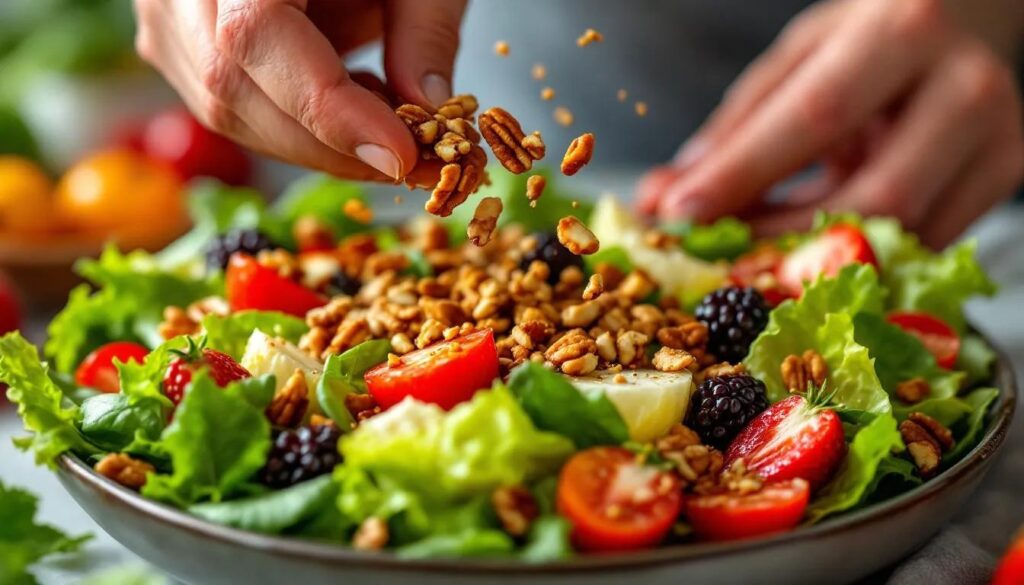
Add the spring greens to your large bowl first, then layer the asparagus ribbons, sliced radishes, snap peas, and peas over the top. Scatter the strawberries across the surface — do not toss them in at the bottom where they will break down under the weight of everything else. Add the torn mint and chopped dill, distributing the herbs evenly so every forkful catches some. Drizzle about two-thirds of the vinaigrette over the salad and toss gently with tongs or two large spoons, lifting from the bottom up rather than pressing down. Add more dressing as needed — the greens should be lightly coated, not pooled at the bottom. Finish with the crumbled goat cheese and toasted pistachios, both added after tossing so they stay whole and don't get crushed in the process.
Chef's tip
The strawberries lose their structure quickly once dressed, so this salad is best assembled no more than 15 minutes before serving. If you want to get ahead of things, prepare every component separately and store them refrigerated — greens in one container, prepped vegetables in another, dressing in a jar — then bring everything together just before serving. In early spring, if local strawberries aren't quite ready yet, thinly sliced ripe nectarine or even pickled green strawberries (a technique borrowed from Southern kitchens) make an equally compelling substitute.
Wine pairing
A salad like this — herbal, acidic, with strawberry brightness and creamy goat cheese — calls for a white wine that won't flatten its freshness or compete with the mint and dill.
A Sancerre or any crisp Loire Valley Sauvignon Blanc is the natural match: its citrus and green herb notes echo the lemon vinaigrette while its minerality cuts through the richness of the cheese. A dry Grüner Veltliner from Austria works equally well, bringing its characteristic white pepper finish into play. For a non-alcoholic option, sparkling water with a slice of lemon and a few fresh mint leaves mirrors the salad's aromatics without competing with them.
About this salad
Joanna Gaines built her culinary identity around food that connects people to place — to a kitchen, to a season, to a specific moment in a garden or around a family table. Her spring garden salad fits squarely within that philosophy. It is the kind of dish that has existed in domestic American cooking for generations, rooted in the tradition of pulling whatever is ready from the garden and arranging it with care. What Gaines adds is the strawberry — an ingredient that crosses the line between fruit and vegetable in a way that only a confident cook allows.
Raw spring salads of this type have parallels across many culinary traditions: the Persian Shirazi salad mixes cucumber and tomato with fresh herbs; British kitchen garden salads from the country house tradition often include edible flowers and fruit alongside leafy greens. What unites them is the understanding that freshness is its own form of sophistication, and the best spring salad is the one where you can still taste the cold of the morning on every leaf.
Nutrition facts (per serving, approximate values)
| Nutrient | Amount |
|---|---|
| Calories | ~210 kcal |
| Protein | ~8 g |
| Carbohydrates | ~16 g |
| of which sugars | ~7 g |
| Fat | ~14 g |
| Fiber | ~5 g |
Frequently asked questions
What exactly is the surprise ingredient?
The surprise ingredient is fresh strawberries. In a savory spring salad built around greens, asparagus, peas, and goat cheese, most people expect a strictly vegetable-forward composition. The strawberries arrive thinly sliced, undressed, and entirely unapologetic — and their tartness, particularly early in the season, is more acidic than sweet, making them function almost like a vegetable in context. It is a small decision with a significant effect on both flavor and visual appeal.
Can this salad be made ahead of time?
Most components can be prepped up to 24 hours in advance: shave the asparagus, slice the radishes, shell the peas, mix the dressing. Store everything separately and keep the greens dry in the refrigerator. Add the strawberries and assemble with dressing only just before serving — once dressed, the salad softens quickly and won't hold for more than about 20 minutes without losing its texture.
What can replace goat cheese for a dairy-free version?
A good dairy-free alternative is a firm cashew-based cheese, crumbled in the same way. Thinly sliced avocado also works well — it provides the same creamy, cooling contrast to the acidic dressing that goat cheese delivers, while keeping the salad vegan. If neither appeals, simply omit the cheese and increase the pistachios slightly for texture and richness.
Can frozen peas be used instead of fresh?
Yes. Thaw them fully at room temperature or under cold running water, then pat dry before adding to the bowl. Frozen peas are picked and processed at peak ripeness, so their flavor holds up well. Fresh-shelled peas have a slight starchiness and a more pronounced sweetness, but the difference is subtle once the dressing goes on. If fresh shell peas are not yet available at the market, frozen is a perfectly reasonable substitute.
How do you keep the asparagus ribbons from wilting before serving?
Once shaved, place the asparagus ribbons in a bowl of ice-cold water for about 5 minutes — they will curl tightly and become even crisper. Drain them thoroughly and pat dry with a clean kitchen towel before adding to the salad. This step is especially useful if you are prepping the salad components in advance, as it extends the window before the ribbons begin to soften.