

Spring mornings call for something more than the usual rushed scramble. As markets fill with the first produce of the season and mornings grow lighter, there's a quiet invitation to slow down at the stove — and pay closer attention to what ends up on the plate. Scrambled eggs are a fixture of the American breakfast table, but they are also one of the most misunderstood preparations in everyday cooking: overcooked, rubbery, and forgotten before the coffee even brews.
Alton Brown, the food scientist and television host known for his methodical approach to cooking technique, has long championed a small but significant addition to the scramble: cream cheese. Not as a topping, not as an afterthought — but folded directly into the eggs as they cook. The result is a texture that is markedly different from anything achieved with butter alone, and the technique is straightforward enough for any weekday morning. It’s time to pick up a spatula.
| Preparation | 5 min |
| Cook time | 5 min |
| Portions | 2 people |
| Difficulty | Easy |
| Cost | $ |
| Season | Year-round · Spring chives, fresh herbs |
Suitable for: Vegetarian · Gluten-free · High-protein
Ingredients
- 4 large eggs, preferably pasture-raised
- 2 oz cream cheese, full-fat, cut into small cubes and kept cold
- 1 tbsp unsalted butter
- Kosher salt, to taste
- Freshly cracked black pepper, to taste
- 1 tbsp fresh chives, finely sliced (optional, seasonal)
Equipment
- 10-inch nonstick or stainless steel skillet
- Silicone spatula
- Small mixing bowl
- Whisk or fork
Preparation
1. Beat the eggs properly
Crack all four eggs into a small bowl and season with a pinch of kosher salt. Using a whisk or fork, beat the eggs vigorously until the yolks and whites are fully combined — there should be no visible streaks of white remaining. Beating well at this stage incorporates air into the mixture and ensures the finished scramble has a uniform, pale yellow color rather than marbled patches of overcooked white. Avoid adding milk or cream here: the cream cheese will supply all the fat and richness the eggs need. Some cooks salt eggs before cooking with hesitation, fearing it will "toughen" the proteins, but a moderate amount of salt added before cooking actually seasons the eggs throughout rather than just on the surface.
2. Set up the pan over low heat
Place the skillet over low to medium-low heat and add the tablespoon of butter. Allow the butter to melt slowly — it should foam gently without browning or sputtering. The Maillard reaction, the browning process that develops nutty, complex flavors, is exactly what you want to avoid here: browned butter means the pan is too hot for a soft scramble. The target temperature for scrambled eggs sits well below the threshold that produces rubbery, tight curds. Patience is the most important thing at this stage.
3. Add the eggs and begin stirring
Pour the beaten eggs into the foaming butter. Immediately begin moving them with the silicone spatula in slow, deliberate strokes — not frantic stirring, but a steady figure-eight or folding motion across the bottom of the pan. The goal is to coagulate the proteins gradually, building large, soft, pillowy curds rather than small, firm, dry ones. As soon as the eggs begin to show the faintest resistance against the spatula, pull the pan off the heat entirely and continue stirring. Residual heat will carry the cooking forward. Return the pan to the burner briefly if needed, then pull it off again — this on-off technique, closely associated with Alton Brown's method, prevents the proteins from seizing up all at once.
4. Fold in the cream cheese
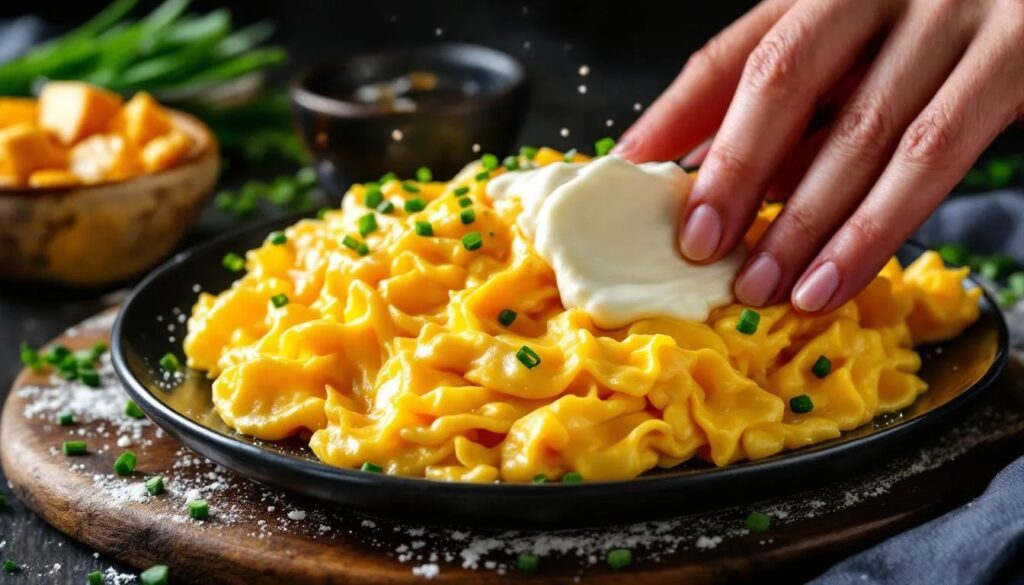
When the eggs are roughly 80% set — still visibly glossy, slightly underdone, and just beginning to hold their shape — scatter the cold cream cheese cubes directly over the surface. Continue folding gently with the spatula. The cream cheese will soften and melt unevenly at first, leaving small, distinct pockets of richness throughout the scramble. These pockets are the whole point: they add a tangy, dairy-forward creaminess that differs entirely from the uniform richness butter provides. The cold temperature of the cream cheese also acts as a brake on the cooking process, cooling the pan slightly and buying a few extra seconds before the eggs risk overcooking. Remove the pan from heat while the eggs still look just barely underdone — carryover cooking will finish the job.
5. Plate and finish
Transfer the scrambled eggs immediately to warm plates — leaving them in the hot pan will continue cooking them into a firmer texture. Season with a final crack of black pepper, and scatter the fresh chives over the top if using. In late March, when chives are among the first herbs to push through the soil, their grassy sharpness provides a clean counterpoint to the richness of the eggs and cream cheese. Serve at once: scrambled eggs are best served immediately.
Chef's tip
Keep the cream cheese cold right up until the moment you add it to the pan. The temperature differential is not incidental — it actively slows the cooking and prevents the eggs from crossing into rubbery territory. If you want to push the technique further, try swapping the plain cream cheese for an herb-and-garlic variety, or fold in a small amount of cold goat cheese for a sharper, earthier flavor. In spring, a few torn leaves of fresh tarragon added at the very end echo the anise notes that pair naturally with eggs.
Food & drink pairings
Scrambled eggs prepared this way carry a pronounced dairy richness and a mild tang from the cream cheese — the pairing strategy should either cut through that fat or complement it without adding further weight to the plate.
A light, dry sparkling wine — a Blanc de Blancs Champagne or a good domestic Brut sparkling wine from California — works well at brunch, its acidity slicing cleanly through the richness while its fine bubbles keep the pairing lively. A chilled Grüner Veltliner from Austria, with its characteristic white pepper notes, also pairs beautifully with egg dishes. For a non-alcoholic option, a cold-pressed green apple and ginger juice provides the same tart counterbalance without sweetness.
Background: why cream cheese changes everything
Alton Brown popularized this technique through his television work and subsequent writing, framing it within a broader argument about fat distribution and protein behavior in egg cookery. The science holds: cream cheese is an emulsified dairy product, meaning its fat is already suspended in a stable matrix of proteins and water. When introduced to a hot egg scramble, it melts into that matrix and coats the egg proteins, physically interrupting the bonds that would otherwise tighten the curds into a firm, dry mass. The result is a scramble that stays tender longer, even slightly past the ideal moment of service.
The technique itself has roots in European hotel kitchens, where enriching scrambled eggs with cold butter, crème fraîche, or fromage blanc has long been standard practice. Alton Brown's version simply substitutes cream cheese — a more accessible American pantry staple — and packages the method within a reproducible, scientific framework. Variations exist across cultures: in France, œufs brouillés are cooked in a bain-marie with crème fraîche for an almost custard-like result; in the United Kingdom, soft scrambled eggs on toast are enriched with cream and cooked over extremely gentle heat. The cream cheese method occupies a middle ground — faster than the French approach, richer than the British one, and forgiving enough for a Tuesday morning.
Nutritional values (per serving, approximate values)
| Nutrient | Amount |
|---|---|
| Calories | ~310 kcal |
| Protein | ~17 g |
| Carbohydrates | ~2 g |
| of which sugars | ~1 g |
| Fat | ~26 g |
| Fiber | ~0 g |
Frequently asked questions
What kind of cream cheese works best — whipped or block?
Block cream cheese is the better choice here. Whipped cream cheese has already had air and sometimes stabilizers incorporated into it, which changes how it melts and distributes through the eggs. Full-fat block cream cheese, cut into small cubes and kept cold, melts in a more controlled way and creates those distinct, creamy pockets that define this technique. Low-fat versions can be used but will produce a noticeably thinner, less rich result.
Can this technique be scaled up for a crowd?
Yes, but with caution. The on-off heat method that makes this scramble work becomes harder to control as the volume of eggs increases, because a larger mass retains heat more aggressively and is more prone to overcooking in the center while the edges cool. For more than four portions, consider working in two separate pans simultaneously rather than crowding a single skillet. The ratio of cream cheese to eggs stays consistent: approximately half an ounce of cream cheese per egg.
Why does Alton Brown recommend pulling the pan on and off the heat?
The technique is a form of temperature management. Scrambled eggs overcook when heat is applied continuously, because even a low-set burner maintains a steady upward pressure on the egg proteins. By pulling the pan off the heat periodically and relying on residual warmth stored in the pan itself, the cook maintains much finer control over the rate of coagulation. It is the same principle behind making a delicate custard or a hollandaise: intermittent heat prevents the sharp temperature spikes that tighten proteins too quickly.
What can be substituted for cream cheese?
Crème fraîche, goat cheese, mascarpone, and fromage blanc all work on the same principle and each produces a subtly different flavor profile. Crème fraîche gives a tangier, looser result; mascarpone is richer and milder; goat cheese adds an earthy sharpness that pairs well with fresh herbs. In spring, a young fresh goat cheese from the farmers' market folded into the eggs with a few torn mint leaves makes a seasonal variation worth trying alongside the classic cream cheese version.
Can the scrambled eggs be prepared ahead of time?
Scrambled eggs do not hold well and are not a dish that benefits from being made ahead. The proteins continue to set even after the pan leaves the heat, and within minutes the texture shifts from soft and glossy to firm and dry. Beat the eggs the night before if time is short, cover the bowl, and refrigerate — but cook them only immediately before serving. The entire active cooking time is under five minutes, so advance preparation is largely unnecessary.