

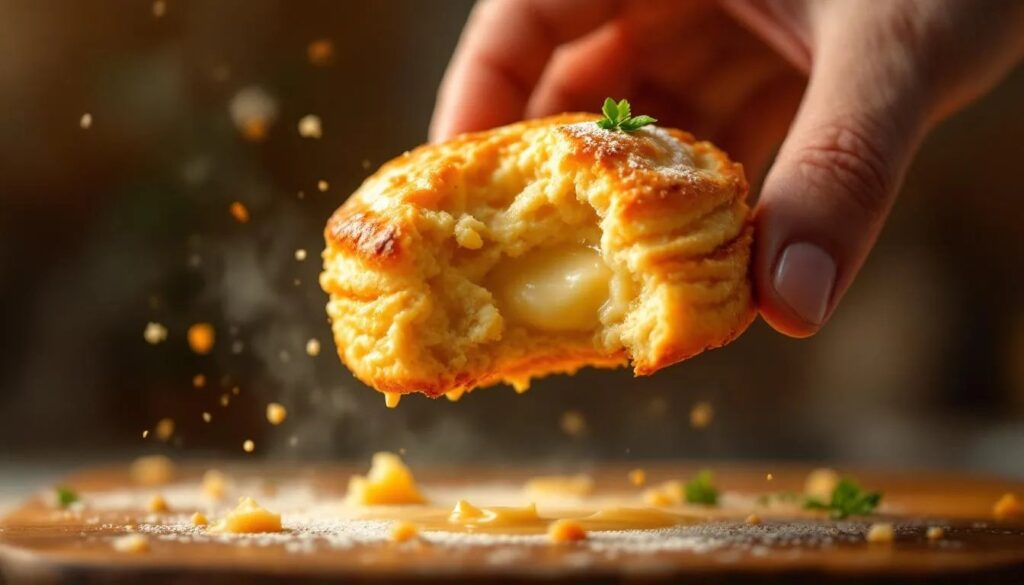
Three ingredients. That's all it takes to recreate the most talked-about biscuit in American comfort food history. As spring settles over the country and Easter gatherings start filling up the calendar, there's a particular kind of warmth that comes from pulling a tray of golden, cloud-soft biscuits out of the oven — the kind that smell like a Southern roadside breakfast and taste like someone's grandmother made them just for you. Cracker Barrel's biscuits have earned a near-mythical reputation over decades of highway stops and holiday brunches, and for good reason: they're tender, flaky, and impossibly buttery without being heavy.
This copycat version, which spread across food blogs and short-form video platforms with the speed of a brush fire, strips the whole process down to its bare essentials — self-rising flour, butter, and buttermilk. No baking powder measured separately. No sugar. No elaborate technique. What you get is a biscuit that holds up to scrambled eggs, country gravy, or a simple smear of honey butter at your Easter morning table. Time to put on your apron.
| Preparation | 10 min |
| Baking | 12–14 min |
| Servings | 10–12 biscuits |
| Difficulty | Easy |
| Cost | $ |
| Season | Year-round · Perfect for spring brunches and Easter tables |
Suitable for: Vegetarian
Ingredients
- 2 cups self-rising flour, plus extra for dusting
- 1/3 cup cold unsalted butter, cubed (European-style butter works particularly well)
- 2/3 to 3/4 cup full-fat cold buttermilk
Equipment
- Large mixing bowl
- Pastry cutter or two dinner forks
- Round biscuit cutter (2.5 inch / ~6 cm) or a straight-edged glass
- Baking sheet
- Parchment paper
- Pastry brush
Preparation
1. Start cold and stay cold
This is the step that separates a biscuit from a bread roll, and it hinges entirely on temperature. Place your cubed butter in the freezer for 10 minutes before you begin — if your kitchen runs warm, chill your mixing bowl too. Cold butter is what creates those distinct, paper-thin layers inside the biscuit: as the butter melts rapidly in the oven's heat, it releases steam that pushes the dough apart into flaky sheets. Room-temperature butter simply absorbs into the flour and collapses into something closer to a scone. Your buttermilk should go straight from the refrigerator into the measuring cup. Preheat your oven to 450°F (230°C) now, so it has time to reach full temperature.
2. Cut the butter into the flour
Measure your self-rising flour into the large mixing bowl and add the cold butter cubes all at once. Using a pastry cutter — or the backs of two forks worked in a crossing motion — press and break the butter into the flour without rubbing or warming it with your palms. You're looking for a texture that resembles coarse, irregular crumbs: some pieces the size of small peas, some finer, none larger than a lentil. This unevenness is deliberate. The variation in butter-chunk size is exactly what gives the finished biscuit its layered, irregular crumb structure rather than a uniform, cakey interior. Stop as soon as the largest chunks have been broken down. Thirty seconds of unnecessary work here is the difference between a tender biscuit and a tough one.
3. Bring the dough together with buttermilk
Pour 2/3 cup of cold buttermilk into the flour-butter mixture all at once. Using a fork or a flexible bench scraper, stir with a light hand — just enough to bring the dough together into a shaggy, slightly sticky mass. If dry streaks of flour remain after 10–12 stirs, add buttermilk one tablespoon at a time until the dough coheres. Overmixing activates the gluten in the flour and toughens the dough — you want it just barely unified, rough-looking and slightly tacky to the touch. It should not be smooth. It should not be elastic. It should look, frankly, like it needs more work — which is precisely when you should stop.
4. Fold, don't knead
Lightly flour your work surface and turn the dough out onto it. Gently pat it into a rough rectangle about 1 inch (2.5 cm) thick — no rolling pin needed. Fold the dough in half, then pat it back out to 1 inch. Repeat this fold-and-pat motion four to five times total. This technique, borrowed from lamination principles used in croissant and puff pastry production, builds the internal layers that make a biscuit pull apart in satisfying horizontal sheets. After your final fold, pat the dough to an even 3/4 to 1 inch thickness — resist the urge to go thinner. A thick biscuit rises high and stays soft in the center; a thin one bakes through too quickly and loses its pillowy interior.
5. Cut cleanly and place touching
Press your biscuit cutter straight down into the dough with one firm, decisive motion. Do not twist. Twisting seals the edges of the cut dough and prevents the biscuit from rising straight and tall — it's one of the most common reasons home biscuits bake into squat, dense pucks rather than tall, airy rounds. Gather the scraps, fold gently once or twice, and cut again until the dough is used up. Arrange the cut biscuits on your parchment-lined baking sheet so they touch each other slightly — this forces them to rise upward rather than spread outward, giving you that characteristic tall, soft-sided Cracker Barrel shape. Brush the tops lightly with the remaining buttermilk or a little melted butter.
6. Bake at high heat and serve immediately
Slide the tray into the center rack of your 450°F (230°C) oven and bake for 12 to 14 minutes, until the tops are a deep, burnished golden — not pale yellow, not ivory, but genuinely amber-colored. The high temperature is non-negotiable: it drives the steam from the cold butter rapidly, creating lift before the dough sets. A lower temperature produces a slower rise and a tougher crust. Pull the biscuits from the oven and brush immediately with melted butter for a glossy, rich finish. Biscuits are best if eaten within 10 minutes of coming out of the oven, when the crust is still slightly crisp and the inside is still warm enough to melt butter on contact.
Chef's Note
The single most impactful upgrade you can make to this recipe in spring and early summer is to swap standard supermarket butter for a cultured, European-style or local creamery butter with a higher fat content (~84% versus the standard 80%). The additional fat and the slight tang from the culturing process add a depth of flavor that makes these biscuits taste less like a copycat and more like the original's better cousin. If you can find buttermilk from a local dairy — particularly fresh in March and April when milk production peaks — the slight variation in its natural acidity will react more vigorously with the self-rising flour's leavening and give you an even higher rise. Freeze leftover unbaked cut biscuits on a tray, then transfer to a bag — bake from frozen at 450°F for 16–18 minutes for fresh biscuits any morning of the week.
Pairing Suggestions
A biscuit this simple and rich in dairy fat calls for accompaniments that either contrast its fattiness with acidity or double down on savory depth.
For a savory table, a country sausage gravy — seasoned aggressively with black pepper — is the canonical pairing, cutting through the butterfat with its salt and spice. A fried egg with a runny yolk works for the same reason: the yolk acts as a second sauce. For spring brunches, a light fruit jam made from early-season strawberries or rhubarb provides the acidic contrast. On the beverage side, a strong black coffee or a cold glass of whole milk both stand up to the richness without overwhelming the biscuit's delicate crumb. For a Southern-inflected sweet pairing, a mild wildflower honey with a squeeze of orange blossom water is quietly extraordinary.
The Story Behind the Biscuit
Cracker Barrel Old Country Store opened its first location in Lebanon, Tennessee in 1969, conceived as a combination restaurant and general store targeting highway travelers along the newly built Interstate system. The biscuits served there were never a secret recipe in the dramatic sense — they were simply well-made Southern buttermilk biscuits, executed consistently at scale, at a time when that consistency was rare on the road. The buttermilk biscuit itself is a distinctly American South tradition, its origins tracing to the post-Civil War era when baking powder and self-rising flour became widely available, making leavening accessible without yeast or long fermentation times.
What propelled this particular copycat recipe into viral territory — appearing across food communities, short-form video platforms and recipe aggregator sites in recent years — was precisely its reduction to three ingredients. Food content that strips a beloved restaurant dish to its essential components performs consistently well because it democratizes the experience: no specialty equipment, no obscure pantry staples, no culinary training required. The recipe's credibility also benefits from the fact that Cracker Barrel itself has never made a particular secret of its approach — confirming, in essence, that great Southern biscuits were never a mystery, only a discipline.
Nutritional Information (per biscuit, approximate values)
| Nutrient | Amount |
|---|---|
| Calories | ~175 kcal |
| Protein | ~4 g |
| Carbohydrates | ~22 g |
| of which sugars | ~1 g |
| Fat | ~8 g |
| of which saturated | ~5 g |
| Fiber | ~0.7 g |
| Sodium | ~380 mg |
Frequently asked questions
Can I make these biscuits without self-rising flour?
Yes. For every cup of all-purpose flour, whisk in 1½ teaspoons of baking powder and ¼ teaspoon of fine salt. This replicates the leavening balance already built into self-rising flour. Using all-purpose flour without adjusting gives you a flat, dense biscuit — the baking powder is not optional. Cake flour can be substituted for self-rising (with added leavening) for an even more tender, less structured crumb, though the biscuits will spread slightly more.
What if I don't have buttermilk?
Pour 1 tablespoon of white vinegar or fresh lemon juice into a measuring cup, then fill to the 3/4 cup line with whole milk. Stir briefly and let sit for 5 minutes — the milk will curdle slightly and thicken, mimicking the acidity and viscosity of commercial buttermilk. Low-fat milk works in a pinch but produces a slightly less rich biscuit. Full-fat plain yogurt thinned with a splash of milk is another reliable substitute.
How should leftover biscuits be stored?
Baked biscuits keep at room temperature in an airtight container for up to 2 days. To reheat, wrap individually in foil and warm in a 350°F (175°C) oven for 8–10 minutes — microwaving makes the crust rubbery and the interior gummy. For longer storage, freeze baked biscuits in a zip-lock bag for up to 3 months; reheat from frozen at 350°F for 12–15 minutes. Unbaked, cut biscuits freeze exceptionally well and bake from frozen at full recipe temperature with only 3–4 additional minutes of bake time.
Why did my biscuits come out flat?
The three most common causes are: butter that was not cold enough when it entered the dough (it absorbed into the flour rather than remaining in distinct pockets); biscuit cutters twisted during cutting (which seals the layers and prevents vertical rise); or oven temperature that was too low (below 425°F / 220°C). Check your oven with a separate thermometer — many home ovens run 25–50°F cooler than their dial setting, which is often the hidden culprit behind biscuits that bake wide and flat instead of tall and layered.
Can this recipe be scaled up for a large Easter brunch?
Easily. The recipe scales linearly — double or triple all three ingredients in proportion. The key constraint is not to crowd your baking sheets: biscuits need enough space to expand upward without steam-trapping adjacent biscuits into softness on their sides (unless you want that effect, which many Southern bakers deliberately produce by packing biscuits tightly in a cast-iron skillet for a pull-apart result). Bake in batches if necessary, keeping cut, unbaked biscuits in the refrigerator between rounds to maintain the cold-butter advantage.