



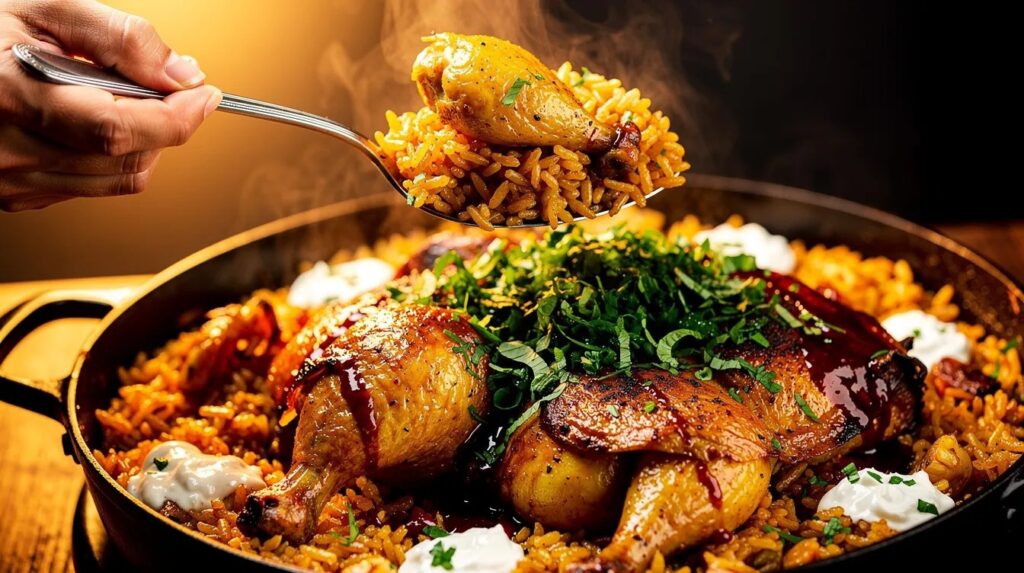
Saturday is not a day for complicated logistics. It's the kind of afternoon where the kitchen should smell good without demanding your full attention — where one pot does all the work and the result lands on the table looking like it took far more effort than it did. This one-pot chicken and rice delivers exactly that: skin that crisps up to a deep amber, rice that drinks in every drop of the braising liquid, and a single Dutch oven to wash at the end of the day. Early spring is the right moment for a dish like this. The weather hasn't fully committed to warmth yet, and a pot of something savory simmering on the stove still feels like exactly the right call.
What makes this version stand out is the layering of aromatics before the liquid ever hits the pan. Smoked paprika, whole garlic cloves, a handful of fresh thyme — they go in at different moments, each one building depth into a dish that could easily read as plain. The rice is added dry, toasted briefly in the rendered chicken fat, then cooked directly in seasoned stock. It absorbs, swells, and takes on a richness that no side dish cooked separately ever quite manages. The technique is simple enough for a relaxed Saturday, and the result is striking enough to bring to the table without apology.
| Prep time | 20 min |
| Cook time | 50 min |
| Servings | 4 people |
| Difficulty | Easy |
| Cost | $$ |
| Season | Early spring — fresh thyme, new garlic, leeks |
Suitable for: Gluten-free · High in protein · Dairy-free
Ingredients
- 4 bone-in, skin-on chicken thighs (about 2.5 lbs / 1.1 kg total)
- 1½ cups / 300 g long-grain white rice (such as basmati or jasmine)
- 2½ cups / 600 ml low-sodium chicken stock, warm
- 1 medium yellow onion, finely diced
- 1 small leek, white and light green parts only, sliced into rounds
- 6 garlic cloves, peeled and left whole
- 2 tablespoons olive oil
- 1½ teaspoons smoked paprika
- 1 teaspoon ground cumin
- ½ teaspoon ground turmeric
- 1 teaspoon kosher salt, plus more for seasoning the chicken
- ½ teaspoon black pepper
- 8 sprigs fresh thyme
- 1 bay leaf
- 1 tablespoon unsalted butter
- Flat-leaf parsley, roughly chopped, for serving
- 1 lemon, cut into wedges, for serving
Equipment
- Large Dutch oven or heavy-bottomed lidded pot (at least 5 qt / 4.7 L)
- Tongs
- Sharp chef's knife
- Cutting board
- Measuring cups and spoons
- Wooden spoon or silicone spatula
- Ladle or liquid measuring cup (for warming stock)
Preparation
1. Season and dry the chicken
Remove the chicken thighs from the refrigerator at least 20 minutes before cooking — cold chicken placed directly into a hot pan contracts sharply and browns unevenly. Pat each piece completely dry with paper towels. Moisture on the skin is the enemy of a good sear: any surface liquid will steam before it can caramelize, giving you a pale, soft result instead of the crisp, rendered skin you're after. Season generously on all sides with kosher salt and black pepper, pressing the seasoning gently into the surface. In a small bowl, mix together the smoked paprika, cumin, and turmeric. Dust this spice blend over the skin side of each thigh and press it in lightly — it will bloom in the fat as the chicken sears.
2. Sear the chicken skin-side down
Set the Dutch oven over medium-high heat and add the olive oil. When the oil begins to shimmer — moving freely across the surface without smoking — lay the chicken thighs in skin-side down, spacing them so they don't crowd each other. You should hear a confident sizzle the moment each piece makes contact with the pan. Do not move them. Let them cook undisturbed for 7 to 9 minutes, until the skin releases naturally from the surface and has turned a deep copper-brown. If you try to lift them and they resist, they're not ready. A properly seared thigh will lift cleanly. Flip and sear the flesh side for 3 minutes, then transfer to a plate and set aside.
3. Build the aromatic base
Reduce the heat to medium. The bottom of the pot should be coated in rendered chicken fat — a rich, amber-tinged fat that carries all the spice and flavor from the sear. This is your cooking medium for everything that follows, so don't discard it. Add the diced onion and sliced leek to the pot and cook, stirring occasionally, for 5 to 6 minutes until softened and beginning to turn translucent at the edges. Add the whole garlic cloves and cook for another 2 minutes, letting them pick up a little color. Season lightly with a pinch of salt. Add the thyme sprigs and bay leaf, pressing them into the aromatics so they begin to release their oils immediately.
4. Toast the rice in the fat
Add the dry rice directly to the pot and stir it through the onion mixture with a wooden spoon. Toasting the rice in fat before adding liquid is a technique borrowed from pilaf cooking — it coats each grain, prevents over-absorption, and develops a faint nutty quality that carries through to the final dish. Cook, stirring constantly, for 2 to 3 minutes, until the grains look slightly opaque and give off a faintly toasted scent. This step takes less than five minutes but makes a noticeable difference in the finished texture.
5. Add the stock and nestle in the chicken
Pour the warm chicken stock into the pot all at once, scraping up any browned bits stuck to the bottom — those caramelized deposits are fond, and they hold concentrated flavor that will dissolve into the liquid. Stir to distribute the rice evenly across the base of the pot. Bring to a gentle simmer over medium heat. Nestle the chicken thighs back into the pot skin-side up, positioning them so they sit above the rice without being submerged — the skin must remain above the liquid to stay crisp as the dish finishes cooking. Tuck the butter in alongside the chicken pieces.
6. Cover and cook low
Reduce the heat to low, place the lid firmly on the pot, and cook for 25 minutes without lifting the lid. Releasing steam during this phase disrupts the cooking of the rice and can leave it unevenly cooked — some grains gummy, others still firm. At the 25-minute mark, remove the lid and check: the rice should be fully cooked and have absorbed all the liquid, and the chicken skin should look matte and dry on top. If any liquid remains, replace the lid and cook for another 3 to 5 minutes. Remove the bay leaf and thyme sprigs.
7. Rest and finish
Turn off the heat and let the pot sit uncovered for 5 minutes. This resting period allows the rice to finish steaming in residual heat and firms up the grains, making them easier to serve without breaking apart into mush. Scatter the chopped flat-leaf parsley across the top — its grassy, slightly bitter freshness cuts through the richness of the rendered fat and spices. Bring the Dutch oven directly to the table with lemon wedges on the side. A squeeze of lemon over the chicken just before eating brightens the entire dish.
Chef's tip
In early spring, young leeks are just arriving at farmers markets — thinner, more tender, and far more fragrant than their winter counterparts. Use two small spring leeks instead of one large one, and you'll notice a cleaner, slightly sweeter allium note in the base. If you can find new-crop garlic — sometimes called "green garlic" — use three stalks in place of the whole cloves. Slice them like scallions and add them with the onion. They melt almost completely into the dish and give a garlic flavor that is rounder and less sharp than dried cloves. One more detail worth knowing: if you want a more golden, almost crispy bottom layer of rice — the kind Persian cooks call tahdig — increase the heat to medium-low for the last five minutes of cooking, lid on, without stirring. The rice touching the bottom of the pot will develop a light crust that peels away in satisfying sheets.
Wine pairings
The dish has a warm, spice-forward profile — smoked paprika, cumin, turmeric — softened by the richness of rendered chicken fat and the herbal lift of thyme. The pairing wants something that can echo that warmth without overwhelming it, with enough acidity to refresh the palate between bites.
A Grenache-based Côtes du Rhône — slightly rustic, with notes of red plum, black pepper, and dried herbs — sits naturally alongside this dish. From the Rhône Valley, producers in Rasteau or Sablet offer excellent bottles at accessible price points. If you prefer white wine, a lightly oaked Viognier from Condrieu or California's Central Coast brings stone fruit and floral aromas that play off the turmeric and thyme without competing. For a non-alcoholic option, a sparkling water with a squeeze of lemon and a sprig of thyme serves the same function — cleansing richness, cutting spice.
About this dish
One-pot chicken and rice is one of those dishes that appears in some form across nearly every cooking culture — Spanish arroz con pollo, Persian morgh ba berenj, West African jollof with chicken, Greek kotopoulo me rizi. The format is ancient and logical: a bird that gives fat as it cooks, and a starch that absorbs what the bird releases. Nothing is wasted, and every component finishes richer for having cooked together. The one-pot format became particularly significant in home cooking traditions where fuel, equipment, and time were finite — one vessel, one fire, one meal that fed a family.
This version leans Mediterranean in its spice profile, borrowing from Spanish and North African traditions without committing entirely to either. Smoked paprika is the Spanish element; the cumin and turmeric gesture toward Moroccan and Middle Eastern kitchens. The leek is a nod to French braise technique — softening in fat before any liquid is added, building sweetness rather than sharpness. What emerges is a dish with a clear, recognizable identity that doesn't belong strictly to any single tradition, which is perhaps why it works as well on a quiet Saturday in March as it does any other time of year.
Nutrition facts (per serving, approximate values)
| Nutrient | Amount |
|---|---|
| Calories | ~620 kcal |
| Protein | ~42 g |
| Carbohydrates | ~55 g |
| of which sugars | ~3 g |
| Fat | ~24 g |
| Fiber | ~2 g |
Frequently asked questions
Can this dish be made ahead of time?
Yes, with one caveat: the rice will continue to absorb moisture as it sits, so leftovers tend to be denser than the freshly cooked version. If you want to prepare components ahead, you can sear the chicken and cook the aromatic base up to a day in advance, refrigerating them separately. When you're ready to cook, reheat the base in the Dutch oven, toast the dry rice in it, and proceed from step 5. The final simmer takes the same time regardless. Fully assembled and cooked, the dish reheats well with a splash of water or stock added to loosen the rice before warming over low heat.
How do you store and reheat leftovers?
Transfer cooled leftovers to an airtight container and refrigerate for up to 3 days. To reheat, add two to three tablespoons of water or chicken stock to the bottom of a saucepan, add the chicken and rice, cover with a lid, and warm over low heat for 8 to 10 minutes. The added liquid rehydrates the rice and prevents it from scorching. The skin will not recrisp in this process — if that texture matters to you, transfer the chicken thighs to a baking sheet and run them under the broiler for 3 to 4 minutes while the rice warms separately on the stove.
What substitutions or variations work well?
Bone-in chicken drumsticks work in place of thighs and sear beautifully, though they may need an extra 5 minutes of covered cooking time. For a bone-free version, boneless thighs cook faster — reduce the covered cooking time to 18 to 20 minutes and check early. In place of white rice, long-grain brown rice can be used, but the stock quantity increases to 3 cups / 720 ml and the covered cooking time extends to 40 to 45 minutes. Come summer, diced zucchini or halved cherry tomatoes can be stirred into the rice before adding the stock, adding brightness and color. In autumn, a handful of sautéed mushrooms or a pinch of saffron bloomed in the warm stock transforms the dish into something earthier and more wine-worthy.
My rice came out mushy — what went wrong?
The most common cause is too much liquid. Different rice varieties absorb at different rates — basmati, for example, is relatively lean and drinks in liquid efficiently, while some domestic long-grain rices absorb more slowly. Start with the 2½ cups of stock specified and resist the urge to add more if the pot looks dry early on. A second common cause is too much heat during the covered cooking phase: a vigorous boil agitates the starch granules and breaks them down before the rice has cooked through, producing a gluey texture. The moment the stock is in and the chicken is nestled back, the heat should drop to a genuine low — barely a simmer.
Can the dish be made without a Dutch oven?
A Dutch oven is ideal because of its weight and heat retention, but any heavy-bottomed pot with a tight-fitting lid works — a large stainless steel saucepan, an enameled cast-iron braiser, or a deep sauté pan with a lid. The key requirement is that the lid seals well enough to trap steam. If your lid doesn't fit snugly, place a sheet of aluminum foil over the pot before placing the lid on top — this creates a tighter seal and prevents steam from escaping at the edges during the covered cooking phase.