



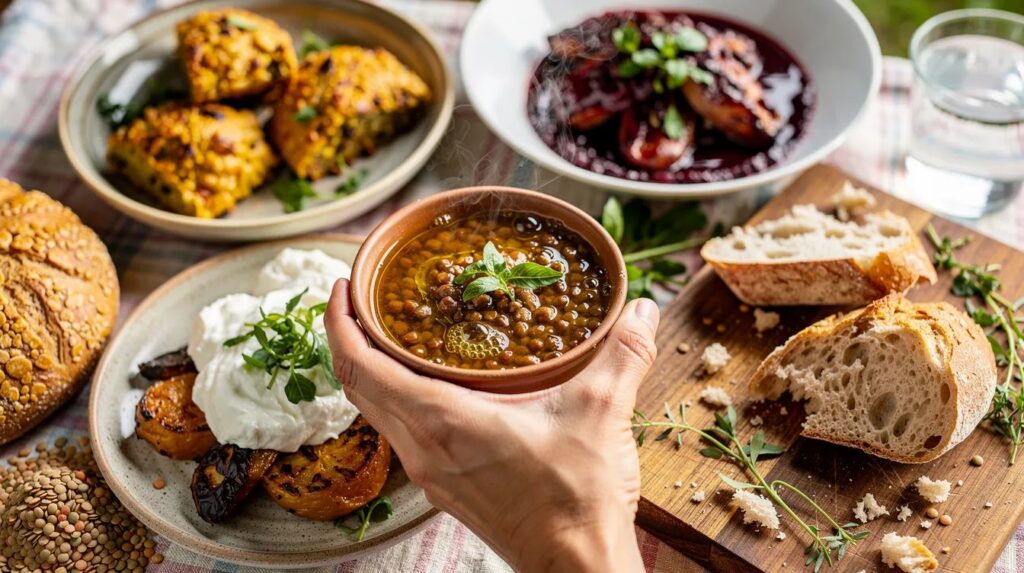
Some recipes refuse to die. While empires crumbled, languages vanished, and entire civilizations were swallowed by history, certain dishes survived — passed down through hands, copied into manuscripts, whispered across kitchens, and eventually written into cookbooks that still exist today. These are not reconstructions or approximations. They are real preparations with documented origins, some stretching back thousands of years, that people are still making and eating right now, in spring 2026, with the same core logic they had when first conceived.
What keeps a dish alive across centuries is rarely complexity. It is usually the opposite: a genius combination of accessible ingredients, a technique simple enough to teach without writing, and a flavor profile so satisfying it becomes part of cultural identity. The ten dishes below represent some of the oldest continuously prepared foods on record. Each carries its own story — and a remarkable stubbornness to endure.
Lentil stew — ancient middle east, circa 8,000 BCE
Lentils are among the oldest cultivated crops on Earth, domesticated in the Fertile Crescent during the Neolithic period. Evidence of their consumption dates back to archaeological sites in Syria and Turkey. The combination of lentils simmered with water, salt, and aromatics isn't a recipe that needed to be invented; it emerged naturally from the act of boiling the most available legume over fire. The Book of Genesis even references a "red pottage" of lentils as currency for a birthright. Variations exist across India, Egypt, Turkey, and Ethiopia, but the logic is identical everywhere: slow heat, water, lentils, time.
Flatbread — ancient egypt and the levant, circa 6,000 BCE
Before leavened bread, there was flatbread: a paste of ground grain and water, pressed thin and cooked directly on a hot stone or in the embers of a fire. Archaeological evidence from ancient Egypt, the Indus Valley, and the Levant confirms flatbreads as one of humanity's oldest prepared foods. What makes this dish extraordinary is its near-perfect survival. Lavash, injera, roti, tortilla, pita — all are direct descendants of that same prehistoric impulse. The technique has barely changed. Only the grain, the fire, and the name vary by latitude.
Garum — ancient rome, circa 4th century BCE
Garum was the fermented fish sauce that functioned as the salt, the umami, and the seasoning backbone of Roman cuisine. Made by layering salted fish — typically mackerel or anchovies — and allowing them to ferment for weeks or months in large clay jars, it produced a pungent amber liquid used in nearly every Roman dish, from street food to aristocratic banquets. Roman cookbooks like Apicius reference it constantly. Garum didn't disappear after the fall of Rome; it migrated into Southeast Asian fish sauces, Italian colatura di alici, and the fermented condiments of Northern Europe. The biochemistry is identical. The name changed.
Tamales — mesoamerica, circa 8,000–5,000 BCE
Long before the Spanish arrived in the Americas, Aztec, Maya, and Olmec civilizations were making tamales: masa dough wrapped around a filling, then steamed or cooked in corn husks or banana leaves. Archaeological evidence and Spanish colonial records confirm tamales were a portable, practical food for warriors, travelers, and ceremonies. Some sources place their origins as far back as 8,000 BCE. Today, tamale recipes vary enormously across Mexico, Guatemala, Colombia, and the American Southwest, but the structure remains unchanged: masa, filling, leaf, steam — a technology so effective it outlasted the civilizations that created it.
Congee — ancient china, circa 1,000 BCE
Congee — rice simmered in a large quantity of water until it breaks down into a thick, creamy porridge — appears in Chinese texts dating to the Zhou Dynasty around 1,000 BCE. As a dish, its appeal is brutally simple: it stretches a small amount of grain to feed more people, it is easy on the digestive system, and it accepts whatever toppings or accompaniments are available. From Guangdong to Tokyo to Bangkok, congee and its cousins (kayu in Japan, jook in Hong Kong, chao in Vietnam) are eaten daily. No dish better illustrates how a survival food becomes comfort food across millennia.
Roast meat — prehistoric, pre-writing
The act of roasting meat over an open flame predates recorded history — and predates Homo sapiens entirely, according to some anthropological evidence suggesting controlled fire use by earlier human species. What transforms this into a "dish" rather than mere survival behavior is the consistent application of technique: managing heat, rotating the meat, applying salt or herbs, resting before cutting. The ancient Greek Iliad describes roasted meats at feasts in considerable detail. Roman texts, medieval manuscripts, and 17th-century English cookbooks all record the same essential method. The backyard grill is, functionally, a very convenient campfire.
Kheer — ancient india, circa 400 BCE
Kheer — rice cooked slowly in milk with sugar and spices — appears in the ancient Indian text Mahabharata and in early Sanskrit writings as a sacred offering. The combination of milk, rice, and sweetener was considered not just nourishing but spiritually significant, used in Hindu religious ceremonies and offered at temples. Across centuries, it spread through Persia as sheer berenj, through the Arab world as ruz bi halib, through Europe as rice pudding. Each culture adjusted the sweetener, the spice, the texture, but the foundation held. A dish born in ritual became a household staple across three continents.
Moretum — ancient rome, 1st century BCE
Moretum is a pounded herb and cheese paste described in a Latin poem attributed to Virgil's circle. Made by crushing garlic, fresh herbs, salt, olive oil, and aged cheese together in a mortar until smooth, it was spread on bread and eaten as a simple meal or accompaniment. The technique — pounding aromatics in a mortar with fat and salt — is genetically identical to what produces pesto, skordalia, tapenade, and dozens of other Mediterranean preparations. Moretum never "ended." It simply changed its name and its proportions as it moved across centuries and borders, acquiring basil here, pine nuts there.
Falafel — ancient egypt, circa 1st century CE
The precise origin of falafel is contested — Egypt, the Levant, and Yemen all claim it — but most food historians place its earliest documented form among Coptic Christians in Egypt, who used ground fava beans to replace meat during Lent. The preparation: dried legumes soaked, ground raw, mixed with herbs and spices, then fried in oil. It requires no animal product, keeps well, and delivers a textural contrast — crisp shell, yielding interior — that no other cheap street food quite replicates. Today it is eaten from Cairo to Tel Aviv to Berlin to New York without meaningful modification to the core technique.
Haggis — medieval scotland, 15th century CE
The most recent dish on this list is also one of the most tenacious. Haggis — sheep's offal (heart, liver, lungs) minced with oatmeal, onions, suet, salt, and spices, then traditionally cooked inside the animal's stomach — is first clearly documented in Scottish texts from the early 15th century, though similar preparations appear in earlier English and Scandinavian sources. It was never a refined dish. It was resourceful cooking: using every part of the animal, binding it with oats, seasoning heavily to balance the iron intensity of organ meat. Burns Night on January 25th ensures haggis is still ceremonially served in Scotland and among Scottish diaspora communities worldwide, which makes it one of the few medieval dishes with a nationally protected cultural ritual attached to it.
What keeps an old dish alive
Across these ten preparations, certain patterns repeat. Simplicity of technique — nothing that requires equipment that might break, be lost, or become unavailable. Efficiency of ingredients — foods that grow easily, store well, or cost little. Cultural weight — dishes embedded in ceremony, religion, or identity are far harder to abandon than those that serve only appetite. And adaptability: the dishes that survived are the ones flexible enough to absorb new spices, new grains, new names, without losing their essential structure.
The oldest food on this list is at least ten thousand years old. The newest is six hundred. What they share is not age but resilience: a kind of culinary fitness that allowed them to outlast the specific contexts that created them and become useful, or meaningful, to people who knew nothing of their origins. That is a different kind of achievement than winning a Michelin star. It is considerably harder to pull off.
Frequently asked questions
What is the single oldest dish in human history?
Flatbread and lentil preparations compete for the title, with archaeological evidence pushing both back to at least 6,000–8,000 BCE. Roasted meat, as a practice, is even older, but the precise point at which it becomes a "recipe" rather than raw survival behavior is difficult to define. If a dish requires deliberate technique, consistent repetition, and recognizable intent, flatbread is among the strongest candidates for the oldest prepared food on record.
How do historians know what ancient people ate?
Through a combination of sources: archaeological residue analysis in ancient vessels and cooking pots, carbonized food remains at excavation sites, written records (administrative tablets, religious texts, cookbooks, poems), visual depictions on pottery and frescoes, and botanical evidence of cultivated crops. For dishes like garum and moretum, surviving Roman manuscripts provide explicit preparation instructions. For prehistoric preparations, the evidence is physical rather than textual.
Are these dishes still made exactly as they were in antiquity?
Rarely in exact form, but often with the same core logic. Ingredients shift with geography and trade: Roman garum used local fish, while its Southeast Asian descendants use different species. Spices unavailable in ancient Rome appear in medieval versions of the same preparations. What persists is the technique and the flavor principle — fermented fish liquid for umami, ground legumes fried in oil, grain cooked in liquid until soft — not a fixed recipe frozen in time.
Which of these dishes can be made at home today with minimal effort?
Flatbread, lentil stew, congee, moretum, and kheer are all straightforward preparations requiring basic pantry ingredients and no specialized equipment. Flatbread needs only flour, water, and a hot pan. Congee requires rice, water, and patience. Moretum can be approximated with a food processor, good olive oil, aged cheese, and fresh garlic. These are, in a sense, already part of most home kitchens; they simply rarely get identified by their ancient names.
Is there a connection between the oldest surviving dishes and plant-based eating?
There is a strong connection, though not absolute. Lentil stew, flatbread, falafel, congee, moretum, and kheer are all either fully plant-based or easily made so. This reflects practical history: animal protein was expensive, seasonal, and often reserved for special occasions or elite consumption. Grains and legumes formed the foundation of most diets across most of human history. The oldest dishes tend to be the most affordable, which is also why they survived. Luxury food disappears with the conditions that supported it.