



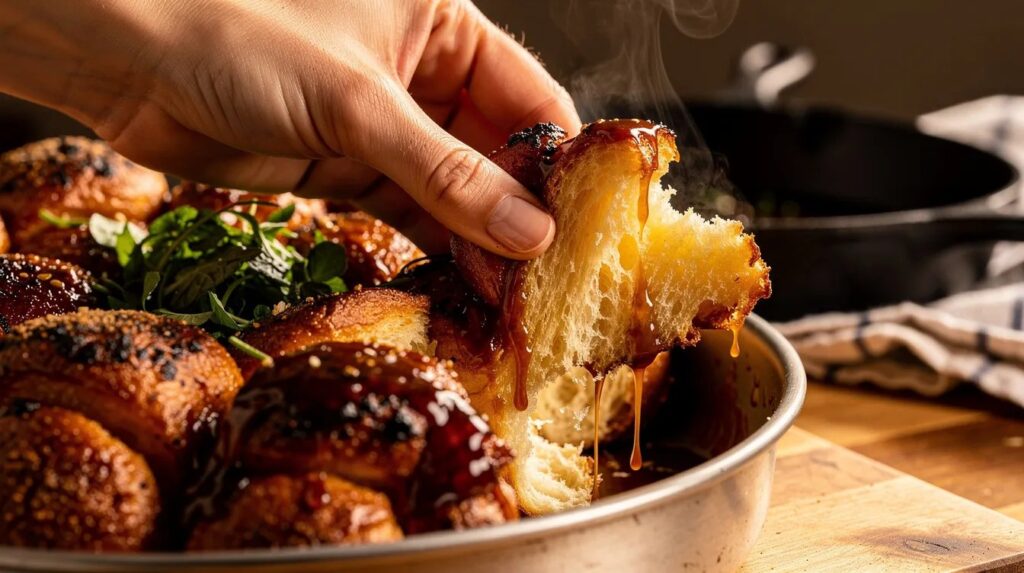
March arrives with that particular restlessness – the last cold mornings, the first real light through the kitchen window, and a craving for something warm that pulls everyone to the table without needing to be asked twice. Monkey bread sits squarely in that category: a pull-apart yeasted dough rolled in cinnamon sugar, drenched in butter and brown sugar caramel, baked until the whole thing becomes one molten, deeply fragrant mass. It is not subtle. It is not refined. It is exactly what the season calls for.
This particular version resulted from an unexpected test: a mother who typically avoids desserts – finding them too sweet, too heavy, or excessive – tasted a pull and paused. Then: "Perfect." That single word serves as a recipe endorsement that surpasses any star rating. What follows is the exact recipe, with all the details that earned it that praise, from the proof time on the dough to the ratio of brown sugar to butter in the caramel pour. So, tie on an apron.
| Prep time | 30 min |
| Rise time | 1 hr 30 min |
| Bake time | 35 min |
| Servings | 10–12 |
| Difficulty | Medium |
| Cost | $ |
| Season | Early spring — pantry staples, warming spices |
Suitable for: Vegetarian
Ingredients
For the dough
- 3 ½ cups (440 g) all-purpose flour, plus more for dusting
- 2 ¼ tsp (one standard packet) active dry yeast
- 1 tsp fine sea salt
- 3 tbsp granulated sugar
- ¾ cup (180 ml) whole milk, warmed to 110°F (43°C)
- ¼ cup (60 ml) warm water
- 3 tbsp unsalted butter, melted and slightly cooled
- 1 large egg, room temperature
For the cinnamon sugar coating
- ¾ cup (150 g) granulated sugar
- 2 tsp ground cinnamon
- ¼ tsp freshly grated nutmeg
- ½ cup (115 g) unsalted butter, melted
For the brown sugar caramel pour
- 1 cup (220 g) packed dark brown sugar
- ½ cup (115 g) unsalted butter
- 1 tsp pure vanilla extract
- ¼ tsp fine sea salt
Equipment
- Stand mixer with dough hook (or large mixing bowl for hand kneading)
- 12-cup Bundt pan, generously greased
- Small saucepan
- Instant-read thermometer
- Two medium mixing bowls
- Kitchen scale (recommended)
- Pastry brush
- Wire cooling rack
- Large serving plate or platter
Preparation
1. Activate the yeast and build the dough
In the bowl of your stand mixer — or a large mixing bowl if working by hand — combine the warm water and warm milk. The liquid should feel comfortably warm on the inside of your wrist, not hot: temperatures above 115°F (46°C) will kill the yeast before it even begins to work. Sprinkle the yeast over the surface along with a pinch of the granulated sugar, then let it sit undisturbed for 8 to 10 minutes. You should see a bloom: the mixture should become visibly foamy and smell faintly of bread and yeast. If nothing happens after 10 minutes, the yeast is inactive and you will need to start again with a fresh packet. Once the yeast is alive and frothy, add the egg and the melted butter, whisking briefly to incorporate. Add the flour, remaining sugar, and salt all at once. With the dough hook attached, mix on low speed for 2 minutes to bring the dough together, then increase to medium and knead for 7 to 8 minutes. The dough is ready when it pulls cleanly from the sides of the bowl, feels tacky but does not stick aggressively to a floured hand, and springs back when you press a finger gently into its surface. If working by hand, knead on a lightly floured surface for 10 minutes using the heel of your palm, pushing forward and folding back rhythmically.
2. First rise
Shape the dough into a smooth ball and place it in a lightly oiled bowl, turning once to coat all sides. Cover the bowl tightly with plastic wrap or a clean kitchen towel and set it in a warm, draft-free spot. An oven with only the light on, or a spot near a warm stovetop, works well. Let the dough proof — meaning rise until roughly doubled in volume — for 1 hour to 1 hour 15 minutes, depending on the warmth of your kitchen. In a cool March kitchen, it may take closer to 90 minutes. Avoid rushing this step: a full, slow fermentation is what gives the finished bread depth of flavor beyond simple sweetness.
3. Make the brown sugar caramel pour
While the dough rises, prepare the caramel. Combine the dark brown sugar and butter in a small saucepan over medium heat. Stir continuously as the butter melts and the mixture begins to bubble — this takes about 3 minutes. Once the butter and sugar are fully combined into a glossy, deep amber sauce, remove from heat and stir in the vanilla extract and salt. The mixture will steam and sputter briefly when the vanilla hits the hot pan; this is normal. Set it aside to cool for 10 minutes. It should remain pourable but not watery. Pour roughly two-thirds of this caramel directly into the bottom of your well-greased Bundt pan, tilting gently so it coats the base evenly. Reserve the remaining third.
4. Shape the dough balls and coat
In one bowl, combine the granulated sugar, cinnamon, and nutmeg, whisking until uniform. Pour the ½ cup of melted butter for coating into a separate bowl. Gently punch down the risen dough to release the gas, then transfer it to a lightly floured surface. Divide the dough into approximately 60 to 64 small pieces — about the size of a large grape or a generous tablespoon each. Precision here is less important than consistency: pieces of similar size will bake evenly. Roll each piece into a rough ball between your palms, dip it fully in the melted butter, letting the excess drip back, then roll it through the cinnamon sugar until completely coated. Place each coated ball into the Bundt pan, layering them loosely. They will fit and then some — this is intentional, as the dough will rise again and the pieces will press together during baking, which is exactly what creates the pull-apart structure. After the first layer, drizzle a thin stream of the reserved caramel over the balls before adding the next layer. Continue until all the dough balls are in the pan and the remaining caramel has been drizzled on top.
5. Second rise
Cover the filled Bundt pan loosely with plastic wrap — leave room for the dough to expand — and let it proof again for 30 to 40 minutes. The dough balls should puff noticeably and begin to look connected rather than individual. Meanwhile, preheat your oven to 350°F (175°C). Don't skip the second rise: this is what separates a bread with true lightness and airiness from one that bakes up dense and doughy at the center.
6. Bake
Place the Bundt pan on the center rack of the preheated oven. Bake for 32 to 35 minutes. The top of the bread will turn a deep, burnished mahogany — the color of good caramel — and the caramel sauce will begin to bubble visibly up the sides of the pan. If the top is browning too quickly after 20 minutes, tent loosely with aluminum foil. The interior temperature of the baked bread should register at least 190°F (88°C) on an instant-read thermometer when inserted into a thick section. Remove from the oven and let the pan rest on a wire rack for exactly 10 minutes. No more: if you wait longer, the caramel will cool and set, making it nearly impossible to invert cleanly.
7. Invert and serve
Place a large serving platter face-down over the top of the Bundt pan. In one confident, swift motion, flip the pan and plate together. Hold steady for 15 seconds, then lift the pan away. The bread should release with a sound that is part thud, part sizzle as the still-liquid caramel cascades down the sides and pools around the base of the loaf. If a piece or two sticks to the pan, simply lift it out with a spoon and press it back into place — the caramel acts as its own adhesive. Serve immediately, warm, while the caramel is still glossy and the dough pulls apart in long, soft, sticky ribbons.
My Chef's Tip
The single adjustment that elevates this recipe above most others is using dark brown sugar rather than light in the caramel. The additional molasses content deepens the flavor significantly, adding a faint bitterness that cuts through the sweetness and keeps the overall profile from feeling one-dimensional — which is exactly what convinces dessert skeptics. If you want to push further, swap a quarter of the granulated sugar in the coating for demerara: its larger crystals don't fully dissolve, leaving faint crunch between the soft folds of dough. In early spring, when good citrus is still at the market before strawberries take over, a teaspoon of orange zest added to the cinnamon sugar mixture adds a brightness that lifts the whole loaf.
Pairings
Monkey bread is best enjoyed as a morning or late-brunch treat, served ideally between the first and second cup of coffee. The caramel's richness and the yeast's subtle tang call for something that can stand alongside without being overshadowed by the sweetness.
A strong, lightly roasted coffee — a Central American single origin with notes of brown sugar and stone fruit — mirrors the caramel without amplifying it. For something different, a chai latte with minimal sweetener echoes the cinnamon and nutmeg in the coating while the spice cuts through the butter. If serving adults at a weekend brunch, a small pour of cold Calvados or apple brandy works beautifully: the apple and wood notes find a natural partner in the brown sugar caramel. For a non-alcoholic option, fresh-pressed apple juice, lightly chilled, brings the same conversation to the table.
About Monkey Bread
Monkey bread as Americans know it today is a mid-twentieth-century creation, popularized through women's magazines and community cookbooks in the 1950s and 1960s. The name itself is disputed — some food historians link it to the act of pulling pieces from a communal loaf the way monkeys groom one another, others trace it to Hungarian coffee cake traditions brought by immigrant communities to the Midwest. It's clear that the concept of pull-apart sweet breads coated in butter and sugar has roots across many cultures: Hungarian arany galuska, Eastern European korvapuusti variations, and similar preparations appear throughout Central European baking traditions.
The version that made it into American homes relied heavily on canned biscuit dough for speed, and many recipes still do. This from-scratch yeasted version takes longer, but the flavor and texture are not comparable: the dough develops genuine structure and character through fermentation, and the individual pieces remain tender at their centers while the caramel-coated exterior takes on a slightly chewy pull. The result is a bread that works as well at a holiday morning table as at a casual spring weekend breakfast — and one that has a documented record of converting at least one devoted dessert-avoider.
Nutritional Information (per serving, approximate values)
| Nutrient | Amount |
|---|---|
| Calories | ~420 kcal |
| Protein | ~6 g |
| Carbohydrates | ~62 g |
| of which sugars | ~34 g |
| Fat | ~18 g |
| of which saturated | ~11 g |
| Fiber | ~1 g |
| Sodium | ~210 mg |
Frequently Asked Questions
Can I make monkey bread the night before?
Yes — and this is one of the bread's most practical qualities. Complete the recipe through Step 4: layer all the coated dough balls in the Bundt pan with the caramel. Cover tightly with plastic wrap and refrigerate overnight, for up to 14 hours. The next morning, remove the pan from the refrigerator and let it sit at room temperature for 45 to 60 minutes before baking, to allow the dough to come back up to temperature and complete its second rise. Bake as directed. The cold fermentation can improve flavor, adding a complexity to the dough.
How do I store leftovers?
Monkey bread is undeniably best within the first two hours of baking, when the caramel is still fluid and the dough is warm and soft. Leftovers can be stored covered at room temperature for up to 2 days, or wrapped tightly and refrigerated for up to 4 days. To reheat, place individual pieces on a microwave-safe plate and warm for 20 to 30 seconds, or cover the whole loaf loosely with foil and reheat in a 325°F (160°C) oven for 12 to 15 minutes. The caramel will re-liquefy with gentle heat. Avoid refrigerating uncovered, as the dough dries out quickly.
Can I use store-bought biscuit dough instead?
Two cans of refrigerated biscuit dough (16 oz / 450 g total) will work as a shortcut, cutting prep and rise time entirely. Cut each biscuit into quarters, coat as directed, and proceed with the caramel pour and bake. The result will be noticeably denser and less flavorful than a yeasted dough version, but it is a serviceable option for a weekday morning when time is short. If using biscuit dough, reduce the bake time by 3 to 5 minutes and check doneness at the 28-minute mark.
What variations work well with this recipe?
The base formula is flexible. For a savory version, omit the sugar coating and caramel pour entirely: instead, roll the dough balls in melted butter and a mixture of grated Parmesan, garlic powder, dried rosemary, and flaky salt, and bake in the same way. For an early spring twist, add 2 tsp of orange or lemon zest to the cinnamon sugar mix and a tablespoon of fresh citrus juice to the caramel. A handful of chopped toasted pecans scattered between the layers adds crunch and a faintly bitter note that offsets the sweetness meaningfully.
My caramel hardened in the pan — what happened?
This is almost always a timing issue on the inversion step. The caramel needs to be still warm and fluid when you flip the bread — which is why the 10-minute window after removing from the oven matters. If you waited longer and the bread is now stuck, return the pan to a 300°F (150°C) oven for 5 minutes: the caramel should re-liquefy enough to release. Going forward, grease the Bundt pan thoroughly — including every ridge — before pouring in the caramel, as a well-greased surface significantly reduces sticking.